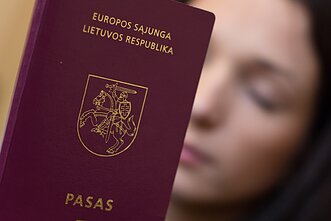

















Some lawmakers are proposing that Lithuanian dual citizens be allowed not to report their second nationality so as not to lose their Lithuanian passport. But is this not simply a license to break the law?
Elena Valiunienė has lived in Norway for six years. She says that when living abroad, having local citizenship solves a lot of very important issues linked to jobs, education, and access to services. So naturally, she is considering applying for Norwegian citizenship. But that would mean losing her Lithuanian passport.
“This is like being rooted out. Imagine – I take citizenship of another country and suddenly I am stripped of mine. The one I received at birth,” says Elena. “Article 12 of the constitution really needs to be reviewed, debated and amended in a way that serves today’s needs.”
Article 12 states that, save for a handful of exceptions, Lithuanian citizens cannot be citizens of another country at the same time. And since the article is in the part of the constitution that can only be changed by a majority of all eligible voters, amending it has been near-impossible.

A referendum on dual citizenship was held last May, but changing Article 12 fell short of 170,000 votes. And it was the second failed attempt. Meanwhile, around 1,000 people are stripped of Lithuanian citizenship each year once they report – or are found out – having become naturalised in another country.
So now a group of MPs are proposing a solution – suspending the obligation to notify the authorities about an acquired second citizenship for five years.
“Why five years? Because maybe there will be enough political will in the next parliament to have a referendum again along with the presidential elections and then somehow resolve the issue,” says Dalia Asanavičiūtė, chairwoman of the Commission of the Seimas and the Lithuanian World Community. “If not, it might still be worth extending it for five more years and having a referendum in 10 years. Maybe then we will have a sufficient number of votes.”

In other words, a temporary legal measure to prevent people from losing Lithuanian passports until the referendum is eventually successful.
MP Julius Sabatauskas, vice-speaker of the parliament, is critical, however, noting that a similar proposal was considered a few months ago and found to be in potential violation of the constitution.
“I see in this complete legal nihilism, a proposal to legalise what is today a violation under the law. It is the same as forging a passport and living with that forged passport until you are caught,” argues Sabatauskas.
The referendum could have been a success this year – 73 percent of those who came to the polls supported the amendment – but the turnout was just not sufficient. Including among expatriate voters, whom the issue affects most directly.
Representatives of the expatriate community speculate that some may have refrained from voting because they already have a second citizenship and were afraid that the authorities could get hold of that fact if they came to register.

“Very unfortunate – a large majority of those living in Norway did not vote, perhaps because of the fear factor,” suggests Valiunienė from Norway.
Asanavičiūtė argues that her proposal would alleviate those fears.
“We see the numbers [of voters abroad] are really small and the suspension would take some of the edge off people that fear they have to hide,” she says.
According to Asanavičiūtė, the Song Celebration – attended by tens of thousands of Lithuanians from all over the world – was a powerful proof that great many of them cherish Lithuanian traditions and come to such festivals sparing no expense.
Whether her proposal would not violate the constitution will be considered in the parliament in the autumn.
Further reading

Newsletter
Every Friday morning.