












After Russia invaded Ukraine, Riga became a hub for exiled Russian journalists. Among the first to arrive was TV Rain, a flagship of independent Russian media.
Unlike the previously exiled giants like Meduza, who found home in Latvia in 2014, they set about reporting not just Russian and international affairs, but also the processes in Latvia. For better or worse, they chose one of the most contentious, collective trauma-inducing topics of Soviet monuments.
Arguably, this was where they made their first mistake.
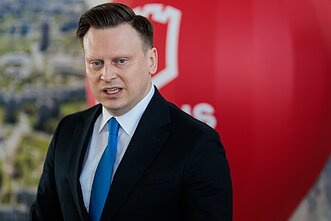
In a controversial interview with the then-Riga Mayor, TV Rain questioned the motives behind Latvia’s decision to topple the remaining Soviet monuments. To some in Latvia, it seemed like the channel was repeating the Kremlin's historical narratives.
A wave of contentious discussion swept across Latvia and in the neighbouring Baltic states of Estonia and Latvia. The talk in public, as well as at home and in media offices, ranged from admiring the tough interview to accusations of ignoring the local context and sensitivities.
Previously, the channel had already been criticised for using the phrase “our military” to refer to the Russian army, even if to them it meant taking responsibility for the crimes their country’s armed forces had committed.
What followed, however, was much more explosive.
During a broadcast on December 2, 2022, the host Alexey Korostelev found himself having to fill several minutes during a live broadcast.
Fumbling along, Korostalev called on people to donate to help the Russian conscripts invading Ukraine: “We hope that we’ve been able to help many servicemen with their gear, for example, and basic necessities at the front,” he said.
“Even as he heard the words coming out of his mouth, Korostelev wondered what had come over him,” his thoughts were paraphrased in an extensive New Yorker publication about the incident.
Korostelev was fired but the damage had already been done. The Latvian defence minister at the time, Artis Pabriks, even said the journalists’ residence permits should be annulled and the TV station expelled.
This followed other infringements for which they had received fines and warnings, including for failing to provide the mandated Latvian translation for a Russian-language programme and showing a map of Russia – by mistake, TV Rain said – that included the occupied Crimean peninsula.
Just several days later, on December 6, the station’s TV licence was revoked over an unspecified “threat to public security and public order”. The appeal process, which has seen the support and involvement of Latvian media and non-governmental organisations, has now been postponed until October this year. Meanwhile, TV Rain's staff and office have relocated to the Netherlands.
“I think it was a mistake made by the authorities,” Tikhon Dzyadko, the chief editor of TV Rain, told LRT.lt about the decision to revoke their licence. “This decision did not do any good [...] for Latvia, nor for the idea of civilised people fighting against Russian propaganda and this terrible war in Ukraine.”
Further reading

Settling down
Maria Kiseleva is a Russian journalist who fled to Riga in early 2022. Like most of the recent arrivals, she immediately set about reporting on the war in Ukraine, something that she had been unable to do back in Russia.
Endless shifts would be punctuated by outings in their relocated bubble. Over time, however, the life-work balance normalised, giving way to routine worries like acquiring residence documents and settling down.
But this is where life in exile proved the most challenging, as the invitation to resettle did not mean a simplified residence or asylum process.
“There is a Russian saying that an awful end is better than endless horror,” Kiseleva said. “People are exhausted by the constantly changing situation with [residency] documents, which is getting harder and harder.”
Some Russian exiles in Riga saw the writing on the wall – they are no longer welcomed with open arms, despite the invitations from Riga officials at the start of the invasion.
“The political rhetoric changed, not only because of TV Rain, that there was a threat to state security and spies could have come with these journalists and not really trustworthy people,” said Ērika Staškeviča, editor-in-chief of Latvia’s RUS TVNET, one of the biggest Russian-language media organisations in the country.
Similar debates echo in neighbouring Lithuania, including about Belarusians who have made Vilnius their home after the abortive revolution in Minsk in 2020.

“And it's no longer the case that we're straightforward that Latvia is waiting for all Russian journalists. Each case is assessed very individually, even if they represent a big media organisation,” said Staškeviča.
Much of the distrust centres around the I-told-you-so moment surrounding TV Rain. Critics of the exiled opposition would use the incident to prove that their negative perceptions were justified and that the Russian exiles were not, in fact, opposed to the war.
The “non-apology” by TV Rain’s owner, as aptly referred to by the New Yorker, was another case in point. “Can one feel sympathy for the conscripts?” Natalia Sindeeva, the CEO and main owner, said. “Everyone decides for themselves. I know I do.”
Speaking to LRT.lt from the offices in Amsterdam, Dzyadko said much of the distrust came down to the mismatched expectations from them in the Baltic states.
“Our black and whites are different from, for example, the Baltic journalists. They would like Russian journalists to become Ukrainian journalists and, to me, this is impossible,” he said.
This is why they cannot get behind some of the most hawkish positions toward Russia.

“When I read, for example, Ukrainian agency UNIAN and I see that ‘all Russians should be dead’, it’s not a position that has anything to do with me or TV Rain,” Dzyadko said.
“For Ukrainian journalists, they are at the edge of the existence of Ukraine – as a state and nation. It's understandable why they are not ready to distinguish ‘Russians’ and Russians and I’m the last person to blame them for that,” he added.
“At the same time, I’m really sorry for the losses of civilians in [Russia’s] Belgorod region, for example. But I understand why it is happening – it is because of Putin, because he started this war on February 24, 2022.,” Dzyadko said.
“But I think our position is black and white. That's why I'm sitting here in Amsterdam and not in my apartment in Moscow,” he added.
‘Emigrant bubble’
Few opportunities exist to form closer connections between the exiled Russian journalists and the local communities.
“This is a good illustration of what we are discussing,” said Aleksandr Šuņins, a Russian-speaking former TV presenter in Latvia. “They've been here for two years, I know almost everyone in this market and I have been working in this field for almost 30 years, but I don’t know any of them.”
According to Staškeviča, the RUS TVNET editor, the arrivals live in a separate “emigrant bubble”.
“They come in groups, they have their own community, and they live within that community. Only some journalists, who actively leave this community and start going to some Latvian events, burst this bubble and start building relationships and making friends with Latvians,” she added.
According to TV Rain editor Dzyadko, some of his colleagues had already started learning the Latvian language.

“I think there are a lot of stereotypes, and there are a lot of things that do not actually exist,” he said. “I had a lot of interactions with my colleagues and colleagues from other media in Riga and I’ve never seen any arrogance toward Latvia or the Latvian culture and language.”
Some exiles are more inclined to interact with Russian-speaking Latvian journalists. Part of that reason is to avoid being misunderstood, according to several journalists in Latvia interviewed as part of this publication.
“We are continuing to be in two different worlds, communication worlds,” said Ina Strazdiņa from the Latvian public broadcaster, LSM. “Maybe it's a natural process where there are two different cultural identities.”
“But questions were raised during the TV Rain situation,” said Strazdiņa. “There were mixed opinions, because since the war broke out, we are very attentive to this subject. We have said absolutely strictly in the Latvian TV that we are supporting Ukraine and that there is no grey zone and only black and white.”
Mental health issues
“You cannot rush integration, the changing of identity. They needed time to learn about our sensitivities, our triggers,” said Sabīne Sīle, head of Media Hub Riga. “The expectation for them was that they would be perfect, not make mistakes.”
Media Hub Riga has given space and a sense of community to a plethora of Russian, Belarusian and Ukrainian journalists who have found themselves seeking refuge in Latvia. The organisation is also helping TV Rain in its appeal process.
Apart from the giants like Novaya Gazeta and TV Rain that relocated from Moscow, the office also unites many journalists from regional Russian media. According to the New Yorker, Latvia issued over 260 visas to media workers fleeing Russia in the first few months of the war alone.

“It’s important to understand that exile media is diverse – there are regional, federal publications,” Sīle said
In all, around two dozen Russian media organisations are based in Latvia, according to the Reuters Institute. Western media outlets, including Deutsche Welle and the BBC, have also relocated their Russia offices to Riga.
“What they went through was a traumatising event. Their country see them as traitors and they came to European countries expecting freedom,” Sīle said. “Both winter seasons mental health has been an issue for media workers in exile because of the lack of legal status, there have also been suicide attempts.”
But since then, many have started integrating, passed Latvian exams and “have even started their own media outlets, which fill gaps in our media space for Russian-speakers and even Ukrainian refugees”, Sīle added.
“The ones who are struggling are younger journalists who are cut off from family and have no access to education. They struggle to see their future in Europe,” she said. “I found that their values are our values, [but] it’s a challenge to integrate.”

Newsletter
Every Friday morning.