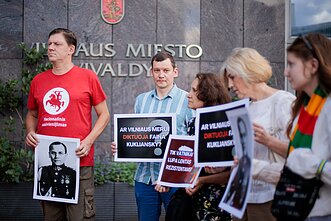












Members of the National Alliance, a far-right nationalist party, installed a commemorative plaque in Vilnius in tribute to Colonel Kazys Škirpa, a controversial officer and diplomat implicated in the Holocaust. The plaque was later removed because it did not have the city authorities’ permission.
The plaque was installed on a building that houses Vilnius Regional Court and the Court of Appeals but was taken down two days later, on Sunday, by the municipality.
Vytautas Sinica, one of the party’s leaders, said they decided to put the plaque up as the Vilnius authorities have failed to reply to an inquiry about Škirpa’s possible commemoration over the past three years.
“After more than three years of institutional bullying and delays, the National Alliance has installed a commemorative plaque in his honour on the building of the Lithuanian army’s former military commandant’s office, where the first volunteer, Colonel Kazys Škirpa, worked in 1918,” Sinica posted on Facebook.
The plaque was taken down on Sunday in the presence of a dozen protesters who gathered nearby chanting “shame”, “vatniks”, “occupiers”, “Bolsheviks”, and “Russists”.

Almantas Stankūnas, a member of the Vilnius Council and executive secretary of the National Alliance, said his party would take legal steps.
Meanwhile, the Vilnius authorities have already turned to police over the plaque’s installation without permission, Mayor Valdas Benkunskas has said.
Škirpa was a controversial diplomat and military officer of the interwar Lithuanian Republic who collaborated with Nazi Germany and spread anti-Semitic views.
According to the Genocide and Resistance Research Centre of Lithuania (LGGRTC), his activities during the Second World War were “controversial”. The centre states that Škirpa was “a patriot of Lithuania, who devoted much effort to the creation of an independent state and the organisation of resistance to the Soviet occupation regime”, while on the other hand, in the years 1940-1941, “there were also manifestations of anti-Semitism in his activities”.
Škirpa and the Lithuanian Activist Front he led were openly anti-Semitic, which “may have encouraged some Lithuanian citizens to join the Holocaust”, the centre says. The LAF proposed expelling Jews from Lithuania. However, its members were unaware of Nazi plans to carry out the Holocaust on the eve of the Second World War, the centre argued.
Other historians are also split on a clear assessment of Škirpa’s legacy.

Newsletter
Every Friday morning.