












Hearing more Russian in the streets of Lithuanian towns makes some locals uncomfortable. The recent migrants from Ukraine and Belarus are putting an effort to learn Lithuanian, although language courses are not always available.
In 2020, Lithuania was a staunch supporter of opposition protests in Belarus, welcoming opposition leader Sviatlana Tsikhanouskaya and her team to settle in Vilnius. Thousands more Belarusians came to Lithuania, some under special humanitarian visas, as the government’s repressions hardened.
Russia’s invasion of Ukraine also triggered the migration of dozens of thousands of Ukrainians and, to a lesser extent, Russians to the country.
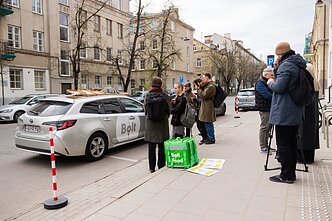
As a result, the Russian language has become noticeably more ubiquitous in the streets of Vilnius and other Lithuanian cities.
Political analyst Ieva Petronytė-Urbonavičienė comments that while locals understand the reasons for this ubiquity – not always distinguishing between Russian and Belarusian or Ukrainian – some still feel uncomfortable about it.
“We live in a threats-soaked environment and sensitivity about security is somewhat heightened. After the start of the war in Ukraine, there was a strong perception among Lithuanians that Russia was a threat,” she tells LRT.lt. “The Russian language in the context of security appears as a threatening attribute.”
However, she notes, most Lithuanians understand that the migrants stand on the same side when it comes to the Russian threat.
Naturally, Lithuanians want Ukrainians, Belarusians and Russians living here to learn Lithuanian. However, Petronytė-Urbonavičienė argues that there are not enough Lithuanian language courses, and the price is often high and the quality poor.

“It’s as if the conditions are not there for them to fully integrate or to start speaking more Lithuanian,” the political scientist said.
Making an effort
Vilija Valkauskaitė, who teaches Lithuanian to foreigners, says she has nearly equal numbers of students from Ukraine, Belarus, and Russia.
“I want to praise these people who really try hard and want to learn. They come willingly because they are not comfortable living in a country without knowing a word or basic phrases in Lithuanian,” says Valkauskaitė. “When they say that those people came here and don’t want to do anything, well that is not my experience at all.”
Work is the main reason for learning Lithuanian, says Valkauskaitė. However, some people study because they also want to get a permanent residence permit in Lithuania, which requires passing a Lithuanian language and constitution exam three years after arriving in Lithuania. This motivation is more common among Belarusians.
Paradoxically, Lithuanians themselves often willingly speak with foreigners in Russian in order to make them more comfortable, says Valkauskaitė.

“For example, I give my students a task – go to a café and order something in Lithuanian. And they say: We come, we start, but the person at the counter starts speaking Russian to us,” she relates.
This happens more often in Vilnius, however, while in other cities and smaller towns getting by with Russian is more difficult, she adds.
Job prospects
According to the Employment Service, the interest of Ukrainians in learning Lithuanian increased significantly last year compared to 2022.
“In 2023, 2,800 Ukrainians started studying Lithuanian, compared to only 100 in 2022. This change is due to key factors: the growing need to speak the local language in the workplace, and the decision of Ukrainian citizens to integrate in Lithuania for a longer period of time due to the protracted hostilities in Ukraine,” the Employment Service said in a written comment.
In the first quarter of this year, 1,358 foreigners studied Lithuanian, according to the service’s data. Three-fourths of them were Ukrainians and of the rest 87 were citizens of Belarus and 80 citizens of Russia.

“It is important for foreigners to know the Lithuanian language in jobs that involve servicing customers, such as taxi drivers, salespeople, etc. Not knowing Lithuanian is a major obstacle for foreigners who want to live and work here,” says the Employment Service.
Knowing at least some Lithuanian is less important in jobs linked to IT, construction or manufacturing, where employers seek specific skills.
New platform for language courses
The Ministry of Education, Science and Sport notes that foreigners can study Lithuanian for free in courses offered by the Employment Service, Caritas, Red Cross, and higher education institutions.
“There is no single registry that shows how many people attend these courses,” the ministry said.
According to the data of the National Education Agency, almost 1,000 foreigners took the state language exam in 2023. So far this year, 578 foreigners took the exam, while 355 people took the constitution exam.
The ministry notes that a new online platform kursuok.lt has been launched, where providers of adult education programmes can register and advertise language courses.
“On the platform, you can find the right training for you and receive 500 euros in government funding,” the ministry says.

Newsletter
Every Friday morning.