











Little is known publicly about the series of mysterious attacks on Lithuanian and Polish facilities, and Lithuanian law enforcement is reluctant to disclose further details. Former officials interviewed by LRT.lt say that the number of such cases could increase and that this is part of Russia’s war in Ukraine.
More may come
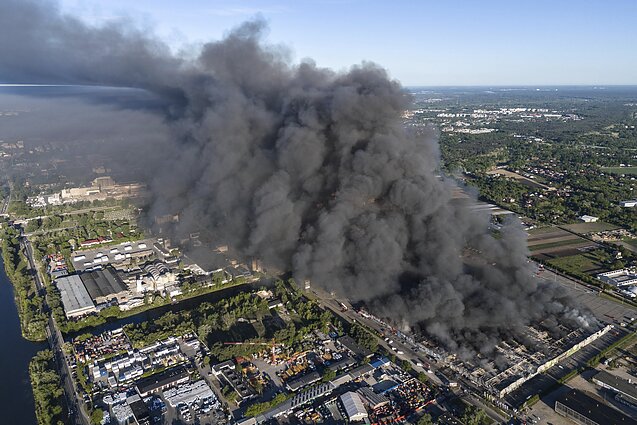
When the fire broke out at the IKEA store in Vilnius earlier this month, precious few details were known, and confirmation that it was not a simple arson attack only emerged in the Lithuanian media this week. Polish Prime Minister Donald Tusk told journalists on Monday evening that the series of arson attacks both in Poland and Lithuania were acts of sabotage, with Russia behind them.
Further reading
Poland is currently in the process of reviving a commission to investigate Russian influence.
According to Tusk, nine suspects were arrested and charged with direct involvement in acts of sabotage in Poland on behalf of the Russian services: beatings, arson, attempted arson. They were hired for these acts and their nationalities have been revealed: they are Ukrainian, Belarusian, and Polish citizens. The criminals operated in several countries.
Among the examples of sabotage acts Tusk mentioned an attempt to set fire to a paint factory in Wroclaw, western Poland, as well as a fire in the IKEA warehouse in Lithuania on May 9.

Regimantas Čiupaila, former Lithuanian interior minister, has told LRT.lt that the consequences of the fire in Vilnius were not serious and quickly liquidated.
“Apparently, it was not an operation of the scale like the one planned in Wroclaw. But it was also prevented there. I think the Lithuanian authorities will find out from their colleagues in Poland to what extent this is an isolated group, or whether it is already a systemic thing,” he said.
Gediminas Grina, former State Security Department head, said he would not shy away from openly describing the incident in Vilnius as sabotage or diversion linked to Russia’s war in Ukraine.
“Since there is clearly a war going on, the adversary is taking, if you will, easy action. I am not a law enforcement officer, but according to the intelligence categories, this is either sabotage or diversion. I’m surprised that anyone is amazed, it was only a matter of time before it happened,” he believes.

What can the authorities do?
Marcin Samsel, an expert on security and crisis management in Poland, told LRT.lt that the Polish authorities are partly to blame for letting the attacks happen.
“The previous government closed down many units of the Internal Security Agency and the number of officers was reduced. At the same time, older and more experienced intelligence officers who could have developed an appropriate strategy were dismissed. The then government did not fully grasp the scale of the threat. We are now living in Cold War 2.0 and, unfortunately, the conflict with Russia is going to last,” he says.
He warns that not all of Russia’s actions have been spotted.
“While it seemed that the Kremlin services were not sure about what to do further at the outbreak of the war in Ukraine, unfortunately, after two years of war we see that the Russians have done their homework and are now behaving in an organised manner. They have moved on to the next phase of hybrid warfare – destabilising actions in various parts of Europe,” Samsel believes.
Cyber-attacks remain a major threat and more explosions, traffic disruptions, aggressive demonstrations, terrorist attacks, and even incidents such as hazardous material spills and arson are to be expected, he said.

Grina says that when it comes to such acts of sabotage, the police have limited capacity to respond.
“This is not a war between criminals, this is a war between states,” he noted.
“You can’t rely on the police here because these are two different things: counter-intelligence and policing. You can follow people whose activities are suspicious, and surveillance does not violate their rights. It is more difficult for the police to do this because they have to have a basis for surveillance. It is not the police’s job to point fingers because [...] it is not the police’s job to fight states,” Grina points out.
No confirmed connection
Meanwhile, Lithuanian law enforcement was reluctant to comment on this information, urging against making links that cannot yet be substantiated.
Moreover, so far it is politicians who have taken the initiative to talk about Russia’s work in Europe, not institutions – Tusk, and a little earlier Gitanas Nausėda, who made public the information about the attack on the Russian opposition figure Leonid Volkov in Vilnius.
Artūras Urbelis, chief prosecutor of the Organised Crime and Corruption Investigation Department of the Prosecutor General’s Office, says that prosecutors cannot yet answer whether the criminal acts were actually initiated by a hostile state.
According to him, the investigations are still at an early stage, so without assessing the totality of the data and verifying the information, it is not possible to “either deny or confirm” these circumstances.
“Until that information is verified, we certainly cannot disclose it in order not to undermine pre-trial investigations in foreign countries,” Urbelis said.

Newsletter
Every Friday morning.