








Last week, a farewell ceremony for Lithuanian soldier Tadas Tumas, who died fighting in Ukraine, was held at St Nicholas Cathedral in Kyiv. Three fellow soldiers of the Foreign Legion shared their memories about Tumas.
Around a hundred people came to pay their respects to the deceased. Most of those present were Lithuanians. Lithuanian ambassador to Ukraine and Dalia Makarova, chair of the local Lithuanian community, said their farewells during the ceremony.
It was not easy to talk to the Lithuanian soldiers fighting in the Foreign Legion in Ukraine – most of them did not hide their sadness and said that they were not in the mood to talk. Some Lithuanian soldiers refused to talk because they did not want their relatives to find out that they were fighting on the frontline and not just delivering humanitarian aid.
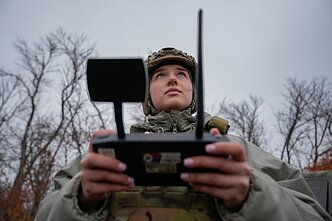
A young Lithuanian paramedic rescuing wounded soldiers on the battlefield refused to talk for this reason and asked not to be photographed. She cried during the farewell ceremony as she held the flag with the Lithuanian coat of arms.

A 37-year-old Polish female soldier who fought in the same brigade as Tumas and lived with him during the rotation also did not wish to give her name. The rotation is when soldiers return from the front, rest, and prepare to replace other frontline fighters.
“I go by the pseudonym Gypsy. I don’t give my real name because I don’t want my parents to know that I’m not doing humanitarian work but fighting on the front. When I call, they keep asking me to come back, but I cannot do that because there’s a lot of work here,” she said.
Gypsy used to work in a bank, started volunteering at the border at the beginning of the war to help Ukrainian war refugees, and decided to join the fight at the frontline a year and a half ago.
“Tadas was determined to learn as quickly as possible and to be as useful as possible. I could feel it when we were training and when he was taking me and other old-timers to the missions. He behaved like a true professional. It’s sad that he died, but his wife, children, and all people in Lithuania should be proud of him,” Gypsy said.
Ihor Bieda, 56, a Ukrainian soldier who also lived with Tumas, did not hide his tears during the farewell ceremony.
“We didn’t fight together a lot, as he was only here for three months, but I liked the guy very much because he was hard-working and kind, never refused to help when asked, never said he was tired or didn’t want to go on a difficult mission,” he said.

In 2022, Bieda fought in the same brigade as his son, but he later got a different assignment. The son has been fighting against the invaders since 2014, while the father went to the front in 2017.
“The Lithuanian soldiers are all good fighters, and thanks to Lithuania’s support, the legion is well equipped. For the Ukrainians, Vilnius’ support is very important because history has united us and knowing that brothers from the past do not betray, is a joy and a lift to the spirit,” Bieda said.
Raimundas Urvikis, 38, met Tumas on the very first days of his arrival at the legion. According to him, his compatriot’s death was the most painful loss for him in this war.
“I saw Tadas off on his last mission, hugged him as we always hugged each other before one of us left for a combat operation, and in the morning, I found out that he was gone,” Urvikis said.
On February 23, it was reported that Tumas and another soldier died when a Russian drone hit a moving car. The Lithuanian soldier and his partner were reportedly carrying mines to the front lines near Bakhmut.

Asked to describe Tumas, the Urvikis said he was hard-working and wanted to learn everything as quickly as possible. He was also calm but always willing to help.
“He was always asking me, ‘can I help you with this, can I help you with that’. I was also helping him. The news that Tadas had died affected me deeply, it was hard to recover, it was hard not to cry,” the Lithuanian soldier shared.
He said he had been fighting at the front for a little over a year and saw the death of more than one of his fellow soldiers. Asked if he was not afraid of dying himself, he said: “Of course I’m afraid. If you are not afraid, it’s not normal. There is always fear, but it has to be healthy and not interfere with the work.”
Urvikis’ commander granted him a short leave of absence after the death of Tumas. He took the personal belongings of the deceased to his wife and will later go visit his wife and two children in Rukla. Asked why he decided to go to war, the Lithuanian replied: “Because if we don’t help Ukraine now, the same enemy will come to us later.”
After the farewell ceremony in Kyiv, the remains of Tumas were cremated and brought to Lithuania on Thursday. From Friday, his relatives, friends, politicians, and the public bid him farewell in Vilnius.
"I came to pay my respects to a freedom fighter. We all know very well that Lithuania is unique in the sense that all our people, all as one, are ready to support Ukraine by all means. And especially brave people are ready to pay the highest price for it,” said Lithuanian President Gitanas Nausėda.
“First and foremost, he was a brave man, for whom the freedom of his homeland was the highest value, along with the freedom of Ukraine,” he added.
Tumas was buried at Vilnius’ Antakalnis Cemetery on Saturday.


Newsletter
Every Friday morning.