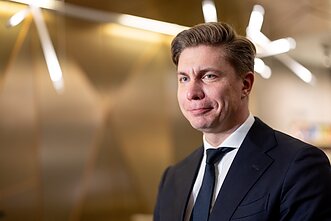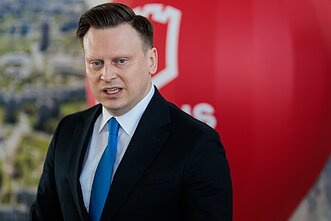













Lithuanian Foreign Minister Gabrielius Landsbergis says he welcomes discussions unleashed by French President Emmanuel Macron suggesting that NATO does not rule out sending troops to Ukraine. According to Landsbergis, “no option can be rejected out of hand”.
“I very much welcome and encourage the discussion that has started, because the situation we are in now only benefits Putin,” Landsbergis told reporters on Wednesday.
“We have set ourselves all possible red lines; we are not discussing at all the creation of any strategic dilemmas in Ukraine for the Russian army,” he said.
According to Landsbergis, it is difficult to say now which options for sending troops would be best, but “nothing can be taken off the table, no option can be rejected out of hand”.
French President Emmanuel Macron said at a gathering of European leaders in Paris earlier this week that the possibility of sending Western troops to Ukraine in the future has not been “ruled out”.
Commenting on the statement, Lithuanian Defence Minister Arvydas Anušauskas said on Tuesday that troops from NATO countries could be sent to Ukraine to train Ukrainians, not for combat operations.
Macron said after the meeting of over 20 European heads of state and government and other Western officials that “we will do everything needed so Russia cannot win the war”.

“There’s no consensus today to send in an official, endorsed manner troops on the ground. But in terms of dynamics, nothing can be ruled out,” he told a press conference at the Élysée Palace on Monday.
Meanwhile, German Chancellor Olaf Scholz rejected the idea of European countries and NATO sending troops to Ukraine.
Italy said that international support for Ukraine does not include the presence of ground troops and warned against giving the impression of being at war with Russia.
Sweden, which is set to join NATO, said on Tuesday that it did not currently envision sending ground troops into Ukraine.
The Kremlin warned that confrontation with NATO will be inevitable if the Alliance deploys its troops into the conflict, an important step the West has so far avoided.

Newsletter
Every Friday morning.