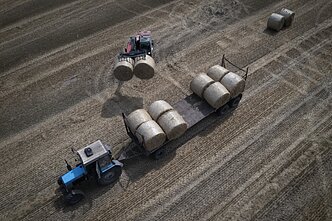













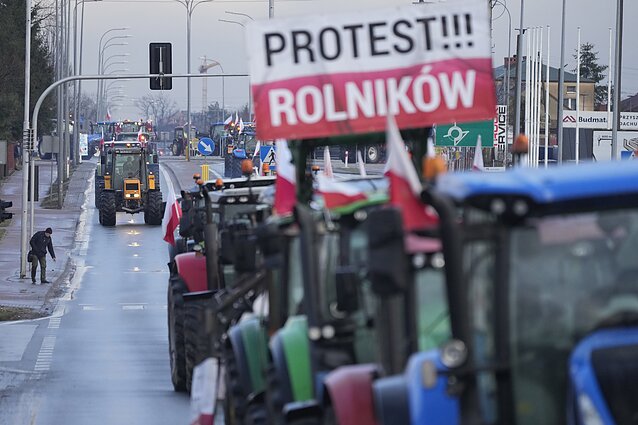
The Polish farmers are expanding their protests against the transit of Ukrainian grain. This week, they are preparing for two new blockades at the Polish-German border crossing in Świecko and the Budzisko-Kalvarija crossing on the border with Lithuania.
According to Karol Pieczyński, who is organising the blockade at the Lithuanian border, Polish farmers will stop and physically inspect all vehicles likely to be carrying Ukrainian grain or other agricultural products.
“The protest should start on March 1 at 10:00. It will not be a complete blockade of the border crossing. We, farmers, together with the Polish authorities, would like to check what is being transported in the trucks, with particular attention to those vehicles that have the potential to transport agricultural products,” he told LRT RADIO.
“Of course, this does not apply to private vehicles, fuel tankers, vehicles transporting metal or livestock [...]. If we see grain and other agricultural products on the road, we would like to know where they are coming from, why and how they are being transported to get a sense of the volume of traffic,” the Polish farmer added.
Zenonas Buivydas, secretary general of Linava, Lithuania’s national road carriers’ association, said the planned Polish farmers’ border blockage will cause significant damage to Lithuania.
“Blocking the border is a huge loss for us as a transit country,” Buivydas told BNS on Monday. “Now, we have the European Union market, it’s no longer a closed market. [...] We will suffer more than Poland.”
“It has to do not just with Lithuanian hauliers here, we are a transit country, a Scandinavian, Baltic corridor. We are no longer in a vacuum. [...] I understand that they want to achieve something but can they do it at the expense of others?” he added.
Pieczyński says he understands that such checks will inconvenience hauliers but asks for solidarity with the Polish farmers.
“We just want to draw attention to what is going on because we feel that our interests are being violated and we are not receiving support from anyone. [...] The idea of blocking the Lithuanian border came up in the context of thinking about how to put more pressure on the Polish government,” he explained.
As he points out, the main problem that the Polish farmers are facing is the suspicion that some of the Ukrainian grain that is supposed to transit through Poland is staying in the country.
“[The Ukrainian] agricultural production is transferred from trucks to trains in Poland. Their final destination is transit ports on the Baltic Sea, but farmers suspect that some of this production is staying in Poland,” said the organiser of the border blockade.

While some experts warn that the conflict over Ukrainian grain could be used as a propaganda tool by the Kremlin, Pieczyński says the Polish farmers avoid any contact with potential provocateurs.
“We are against any kind of provocation; we try and make sure that our protests are in the interests of Polish farmers. We make sure that no radicals, marginals, or other initiatives that are politically unfavourable to us emerge among us. We coordinate our protests with the authorities to ensure that all protests are legitimate and peaceful, and avoid any contact with potential provocateurs,” he said.
The Lithuanian Association of Grain Growers said on Monday that the country’s farmers will not join the Polish farmers’ week-long border blockade.
Polish farmers are blocking Ukrainian trucks from entering their country in protest against what they say is unfair competition from cheap imports from their eastern neighbour. The conflict over Ukrainian grain has undermined friendly relations between Warsaw and Kyiv.
A few weeks ago, Warsaw succeeded in quelling a similar two-month blockade by Polish farmers. However, they launched a new wave of protests last Tuesday, blocking around 100 roads to the Ukrainian border.

Newsletter
Every Friday morning.