














The BaltCap embezzlement scandal, in which the investment fund manager Šarūnas Stepukonis is suspected of having stolen – and possibly gambled away – dozens of millions of euros, has jeopardised the national stadium construction in Vilnius.
The national stadium – or rather, a multiplex of sporting facilities that the project grew into – was to be constructed by Vilniaus Daugiafunkcis Kompleksas, a company owned by BaltCap Infrastructure Fund, under a concession agreement with Vilnius Municipality.
Last autumn, the company stopped all works at the site, saying that construction costs had increased 40 percent and that it was going to renegotiate a price indexation with the city. Earlier this month, however, soon after the news broke about Stepukonis allegedly stealing some 30 million euros from the fund, BaltCap announced it was handing over the project to a new developer: Hanner.
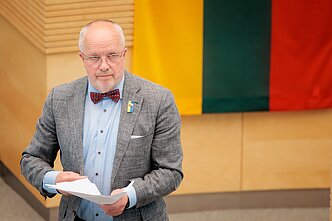
The Vilnius authorities met the handover enthusiastically, saying that with the arrival of Arvydas Avulis’ construction company – one of the biggest and best-known in the country – there is hope that the city will finally have a stadium in 2026.

Both sides want to move quickly – Avulis to build quickly and hand over the operation of the complex, and the Vilnius authorities to pay quickly and, they say, save money. But the question, which has already stirred up public passions, is whether Vilnius still needs a multifunctional complex in the midst of a difficult geopolitical situation and one that is significantly more expensive than initially planned.
An important detail of the national stadium’s history is European money. It is the reason why the edifice is not really a stand-alone stadium, but a “multifunctional complex”.
Around 2013–2014, when the city was still under the leadership of Mayor Artūras Zuokas – who now leads the opposition in the Vilnius Council – the idea was to build not just a stadium, as had already been decided, but a complex of facilities for sports, culture, events, and education. This was the only way to obtain European funding.
After liberal Remigijus Šimašius became the mayor of the capital city and the national government was led by the Farmers and Greens Union – the two belong to the opposite poles of Lithuania’s political system – things started to stall. The government claimed the project was risky, that the municipality was not coping with the project and faced losing the European funding.
Eventually, in May 2020, Mayor Šimašius called up a media conference in which he said: “This government has killed the multi-purpose complex and the national stadium. As you know, this is not the first time this has been attempted.”

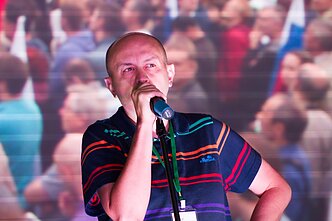
Saulius Skvernelis, then prime minister and now an opposition MP, says that the Vilnius Municipality has failed several times to control the processes, and the government was just trying to help. Today, Skvernelis calls what is happening with the national stadium a “financial abracadabra” that calls into question the need for such a project.
“A new developer shows up who has not been involved in any tenders or processes. And they just transfer everything to them, not as a subcontractor, but with renegotiated profit margins,” says Skvernelis.
He also questions the municipality’s financial calculations. Mayor Valdas Benkunskas has announced that the city agreed to cover most of the 40-percent increase of construction costs. However, it will pay out the money in two years, rather than 22 as previously agreed with BaltCap, thus saving on the interest. The actual cost increase to the city, Benkunskas said, would be only 2.4 million euros (158.4 million instead of 156 million).
“Between 2027 and 2028, we will be able to make these payments without borrowing money. This will save us at least 35 million euros in interest, which we can direct specifically towards the cost of construction work or indexation. These are financial solutions that allow us to accommodate the appreciation through saving on interest,” he explained.
However, the public is now questioning if Vilnius really needs a multifunctional complex instead of just a stadium – or even that.

Debates and solutions
With the coming of Hanner, the projected opening date of the complex is 2026, as promised by Hanner and Avulis.
According to Mayor Benkunskas, the reason to move ahead with the project is that the city needs more than just a football stadium, it needs more sporting infrastructure. For example, the project now envisages facilities for boxing, handball, and basketball.
“There’s just one option: make the changes and have the cranes back on this construction site in a few weeks or a month and finish the project in two years. The alternative is to go to litigation again, maybe lose the case, pay compensation,” says Mayor Benkunskas. “And at best, we could think about some new project in three or five years.”
Too much time and public money has been sunk into the project to abandon it now, he insists.
Meanwhile, Ainius Lašas, a political scientist at Kaunas University of Technology, argues there are more important priorities in Vilnius and the country as a whole that would be a better use of the money.
“One priority, I think, is defence, where there is a real shortage. The second priority is schools in Vilnius and kindergartens. And we should just think about whether it is really worth putting 180 million now into something that will create some added value in the future, instead of making much more added value now,” says Lašas.

Why are Avulis and Hanner undertaking such a project? In his public statements, he suggested that patriotism was part of the motivation.
“I have lived in Vilnius for more than 50 years and it’s disappointing that [football] competitions are held in Kaunas. I think that Vilnius, as the capital of Lithuania, should also have a stadium. And I think it will have one someday,” he commented.
President Gitanas Nausėda has also spoken about the project: “Sometimes one really starts to doubt whether Vilnius and a stadium are compatible words at all. [...] The stadium has to be built economically, efficiently. The experience of many countries shows that Vilnius should not be exceptional in any way.”
However, the story of the national stadium is already exceptional. Its construction began back in 1987 but stopped six years later. In 2008, a further 33 million euros was invested, to little perceivable effect. In 2022, whatever had been built on the site was demolished. At the moment, the site shows no signs of the multi-million investments and three decades of work.
Further reading

Newsletter
Every Friday morning.