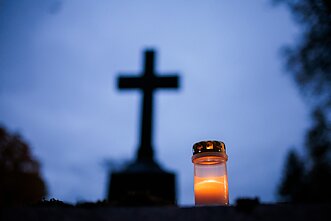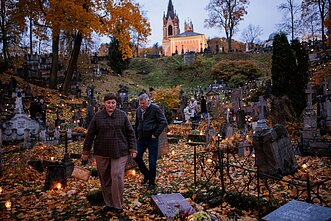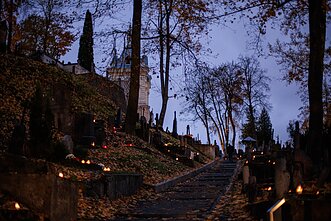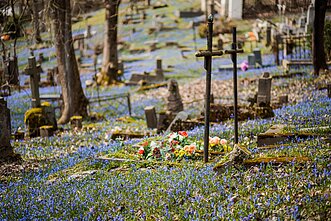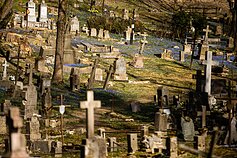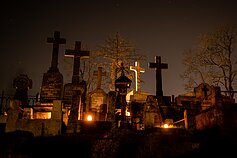











“Cemetery was a place I used to visit with my parents since I was a child,” says architect Eglė Bazaraitė, who has published a book entitled Cemeteries out of Town, in the Woods. While researching Catholic burial landscapes in 19th-century Vilnius, she noticed that Lithuanian cemeteries differ significantly from those in Western Europe.
Hygiene hazard
It has always been important for people to have their loved ones buried nearby, Bazaraitė tells LRT KLASIKA. This gives a certain sense of belonging to a particular territory.
“It is said that […] many peoples have claimed their right to a territory by saying that their ancestors are buried there. There is a strong charge, a strong connection that binds us to these places. Returning to the place, visiting the place, makes us part of it,” says Bazaraitė.
Traditionally, people used to bury their family members close to home. At the end of the 18th century, however, this changed dramatically. “There was a leakage of dangerous miasmas from one of the cemeteries in Paris and they realised that cemeteries were a hygiene hazard to humans. This led to moving cemeteries outside the city.”

At the same time, against the backdrop of the French Revolution, there was a desire to “remember every single person” with individual monuments, however small. Before then, people were usually buried in common graves.
“This is the time when monuments, memorials in parks and gardens are being erected for the little hero, the little heroine, the family man. This is the time when a new sense of family emerges: [...]family members want to be buried together. […]
Until then, most people were buried in common graves. Their memory lasted a very short time, or not at all in many cases,” says Bazaraitė.
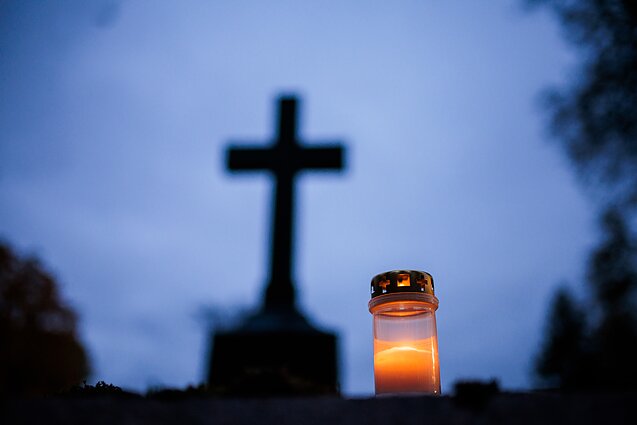
Rasų, the oldest cemetery in Vilnius
Bazaraitė’s book, Cemeteries out of Town, in the Woods, focuses on Catholic burial landscapes in 19th century Vilnius. As the author points out, at that time, Vilnius residents started moving cemeteries beyond the town limits. “Before then, there had been no cemeteries outside the town, except during the times of plague,” she tells LRT KLASIKA.
“Vilnius, like many other cities in Europe, were burying all the departed inside the town until the end of the 18th century. The 19th century and the removal of graves from the city is a very important urban turning point.
“Along with cemeteries, other types of facilities were also moved out: prisons, slaughterhouses. [...] In general, there was a tendency to clear the city of these dangerous typologies,” explains Bazaraitė.

The oldest cemetery in Vilnius that survives to this day is Rasų. Until the 19th century, cemeteries “were not formed as a separate territory”, graves were put next to churches and managed by them.
“Cemeteries are starting to be designed and planned. [...] A cemetery is being shaped as a garden, a park or a forest. [...] Until then, graveyards were just extensions of church buildings.”
Designating a cemetery as a separate site meant that it had to function without a church, says Bazaraitė. “In Western Europe, municipalities are starting to take care of cemeteries. In our country, however, churches are still in charge.”

Smaller monuments
There are a number of features that differ in Lithuanian and Western European cemeteries, the researcher says. Vilnius cemeteries are much more loosely planned and incorporate more nature.
“Our cemeteries are more natural. [...] The aim was not to design everything with precision – to plant particular trees in particular directions, form the perspective one way or another. Although, according to some Polish researchers, there were avenues, we do not see them in the iconography or in the plan,” she says.
Nineteenth-century cemeteries in France, Italy, or Spain have much clearer axes and symmetries, Bazaraitė notes. “Over here, all cemeteries are in free-plan.”
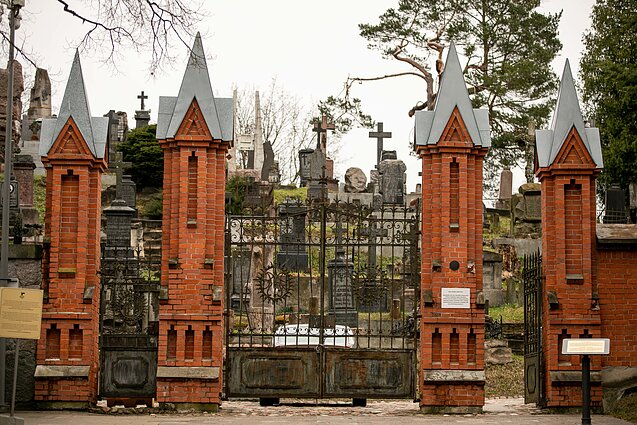
Another distinctive feature of Lithuanian cemeteries is that, unlike in some Western countries, they were not segregated by class or other features.
According to the architect, Lithuanian cemeteries are also characterised by different monuments than in Western Europe. Although there are classical forms, they are much smaller. In addition, family mausoleums, popular in other countries, have not caught on here.
“If we look at France, Italy, Portugal, Spain, we see these mausoleums as little houses that run along pathways and streets, creating a cemeterial urban landscape.” In Lithuanian cemeteries, mausoleums are few and far between, says the researcher.

Newsletter
Every Friday morning.