














When the youth currently entering the Lithuanian labour market retire, their pensions will amount to less than a third of their previous earnings – at least that’s the projection by the OECD, which puts Lithuania dead last among its members in terms of providing for the elderly.
According to the experts interviewed by LRT.lt, however, this forecast relies on a number of assumptions that will not necessarily pan out.
Worst among OECD members
In 2023, the average old-age pension in Lithuania was about 43 percent of the average national wage. This means that the elderly relying on pensions as their sole source of income enjoy significantly lower standards of living than the working population.
However, it may get even worse. A study by the Organization for Economic Co-operation and Development (OECD) projects that a young person born in Lithuania in 2000, who starts working in 2022 and continues until retirement age, will receive a pension equivalent to just 28.9 percent of their former average salary.
This is the worst result among the 38 OECD members. The highest estimates are projected for Portugal, Turkey, and the Netherlands, where the net pension replacement rate is expected to be over 90 percent.
The figure represents the ratio between the average pension and the average pre-retirement earnings in a given country. A rate of 100 percent means that, on average, people will not experience any drop in their income when they retire.
Assumption of shrinking workforce
Vilnius University Professor Romas Lazutka points out that the OECD’s projections take into account Lithuania’s current pension system. According to him, Sodra – the manager of the government-run pension fund – increases pensions in line with what it collects in contributions from the working population.
The size of the fund, therefore, depends on the size of the labour force and productivity (or, put another way, the workers’ salaries). The pension fund may decrease if the population – and so the number of people in employment – shrinks. Some of that may be offset by higher salaries, but not enough to maintain the current pension-to-salary ratio of 43 percent.

The OECD forecasts a slowdown in labour productivity growth for Lithuania, says Lazutka, supposedly leading to lower wages and lower contributions to the Sodra pension fund. However, he adds, the OECD has repeatedly made wrong assumptions about wage growth in Lithuania.
“[The OECD] assumes labour productivity growth to be quite slow. So far, however, their predictions have not been confirmed, they predicted that wages would grow by 3-4 percent, while they have been growing by double digits – 10, 11, 12 percent – at least since the [Prime Minister Saulius] Skvernelis government [2016],” he notes.
Worse than Latvia?
Economist Algirdas Bartkus, an associate professor at Vilnius University, is also not convinced by the OECD’s calculations.
For one, he is suspicious of the relatively big projected difference in net pension replacement rates between Lithuania and Latvia (28.9 and 52.8 percent respectively). The two don’t have very dissimilar pension systems and are close in terms of the current pension replacement rates (41.9 and 44.7 percent in 2022, respectively).
“Let’s not forget that in Latvia old-age pensions are subject to income tax if they exceed 6,000 euros per year. Here, pensions are not subject to any taxes,” Bartkus points out.
He admits that an ageing population will be a pressing problem for the Baltic countries, but Latvia will be hit harder than Lithuania.
Bartkus is also not convinced that countries like Portugal – which tops the OECD rankings with a projected pension replacement rate of nearly 99 percent – can indeed maintain essentially equal income levels between the working and the retired populations. “That is technically impossible,” says Bartkus, adding that he had doubts about the OECD study’s methodology.
Lazutka notes, meanwhile, that the projections take into account local laws. Some countries, he says, have indexation rules that allow pensions to rise faster than salaries, as sometimes happens. Some countries raise pensions in line with salary growth or inflation, whichever is higher.
“The reasoning is that pensions should keep pace with wage growth, but if there is high inflation and we don’t want pensions to shrink in real terms, then they are also indexed to inflation,” Lazutka comments.

Ministry underscores private saving
In a written comment to LRT.lt, the Ministry of Social Security and Labour says that the shrinking and ageing population in particular weighs down the OECD’s projections for Lithuania.
“As far as the situation in Lithuania is concerned, for many years now, Lithuania’s long-term demographic preconditions have been extremely unfavourable,” it says.
The ministry notes that, based on Eurostat’s projections of mortality, birth rates, and migration flows, Lithuania is estimated to have a population of 2 million by 2070, significantly down from the current 2.8 million.
“Of this number, there will be about 716,000 people over 65 and 756,000 in employment. In other words, there will be 0.95 pensioners for every working-age person,” the ministry calculates.
Moreover, the ministry says, the OECD only takes into account the state pension system in Lithuania, even though some people are also making contributions to private pension funds.
“In the case of Lithuania, the [private] pension saving is classified by the OECD as a voluntary scheme, despite its extensive coverage,” the Ministry of Social Security and Labour says.
According to its own calculations, if both the public and private pension schemes are added together, the replacement rate would be 47.9 percent for people who have been making the average wage all their working life or 37.9 percent for those making double the average wage.
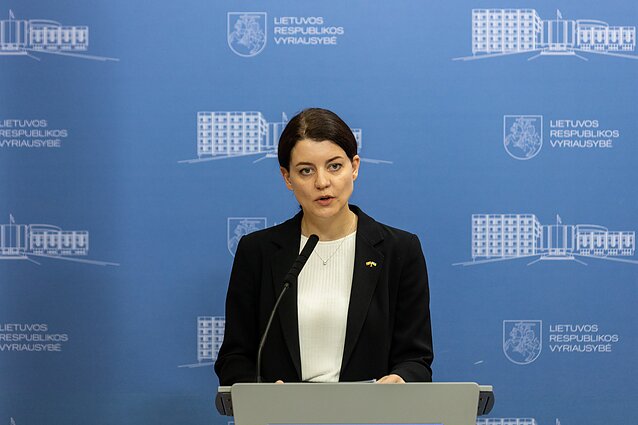
Social Security and Labour Minister Monika Navickienė later said she found the methodology of the study questionable.
“I agree with those economists who say that the methodology is highly questionable because we have those countries where Tier 2 pension saving is compulsory in the same pot, and if we were to look at our own Tier 2 pension saving system, then our projection would be close to the average, too,” Navickienė told reporters on Tuesday.
“Lithuania has no compulsory pension saving scheme, but it is put together with the countries that have compulsory saving. So this methodology is rather questionable,” the minister added.

Newsletter
Every Friday morning.