



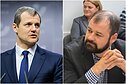









When Radosław Sikorski last served as Polish Foreign Minister, the relations between Vilnius and Warsaw were marked with animosity, demands, and apologies. He is now returning to the post in the newly formed government of Donald Tusk. What does this mean for Polish-Lithuanian relations?
In 2009, the then Lithuanian Foreign Minister Vygaudas Ušackas said the relations between Lithuania and Poland were strategic, as the two countries shared a “unifying history” and common interest. Meanwhile, Sikorski, who stood next to him during a press conference, described the relations as “pragmatic cooperation, with common interests on many issues”.
Plenty of disagreements
However, the pragmatic cooperation had many problems. In 2008, Sikorski compared the situation of Poles in Lithuania to that of the Polish minority in Belarus, where Lukashenko persecuted and imprisoned activists of the Polish Union. This caused an uproar in Lithuania, and it was suggested that Sikorski may have been offended by Lithuania’s failure to support his nomination as NATO Secretary General.
In 2009, Sikorski supported the decision of EU foreign ministers to start negotiations on a new EU-Russia partnership agreement, leaving Lithuania the sole opponent of this initiative.
But one of the most unpleasant episodes took place during the visit of Polish President Lech Kaczyński to Vilnius in 2010 when the Seimas rejected the government’s proposal to allow Polish surnames to be written in the original language.
Sikorski and other Polish leaders accused Lithuania of failing to address the issues of the country’s Polish minority and limiting education in Polish schools. They complained about infrastructure projects, the treatment of Orlen investors at the Mažeikiai oil refinery, the ban on displaying signs with Polish street names, as well as the alleged disruption of the return of land to people of Polish descent.

At one point, Sikorski even said that Poland was considering economic sanctions against Lithuania, and Polish leaders threatened to “not set foot in Lithuania until the Polish issues in Lithuania are resolved”.
The disputes were also noticed abroad. In 2012, The Economist wrote that the Polish-Lithuanian ties are “bafflingly bad and getting dangerously worse”. Both countries reportedly felt that the other side should apologise and make concessions, which was also worrying for the US, NATO, and the EU.
Sikorski hoped for a “revival” of Polish-Lithuanian relations after the 2013 Seimas elections. And he got it when then newly appointed Lithuanian Foreign Minister Linas Linkevičius went to Warsaw and declared a reboot of the two countries’ relations.
Speaking to LRT.lt now, Linkevičius recalled that during his time working with Sikorski “there were all kinds of things”, as the Polish minister raised the issue of national minorities “deeply, sharply, and with ultimatums”.
“No, we have never had a falling out, if that’s what you are asking. Were there tense conversations? Yes, there were,” he said.
In 2017, Sikorski’s secret conversations were leaked, in which he was angry about Orlen Lithuania's problems and the allegedly poor conditions for the company’s operations. He said he “wanted to educate Lithuanians so that they didn’t think that it wouldn’t cost them anything to shit on Poland”. Linkevičius then told Žinių Radijas radio that in his conversations with some Polish politicians, he felt insincerity and a desire to look for negative things instead of solving problems.

Sikorski’s temper
In 2011, the Lithuanian magazine Veidas published an article, citing sources in Polish diplomatic circles that called Sikorski not only “courageous, aggressive, charismatic”, and pursuing his goals by any means but also vindictive, with a personal hatred for Lithuania.
Sikorski is a graduate of Oxford University, and his spouse is the world-renowned historian Anne Applebaum. Earlier, Sikorski worked as a reporter for British publications covering the Soviet invasion of Afghanistan and later the conflict in Angola.
“Yes, he is a radical character, he is sharp, he is eloquent. He is a former journalist and has worked in hot spots,” Linkevičius said.
Sikorski was chosen as foreign minister by Tusk because of his experience as a diplomat, which is particularly needed at a time when Europe is in the midst of a war started by Russia, according to Marta Prochwicz-Jazowska, program manager at the Warsaw office of the German Marshall Fund.
“The challenging security environment that we are in requires somebody with substantial experience, especially with international partners,” she told LRT.lt “I think the main reason [for appointing Sikorski] is the experience, the proven track record in being able to form alliances that would help mitigate the security risks and perhaps find viable solutions to the war in Ukraine.”
She acknowledged that Sikorski may have been “a little less friendly” in the working environment during his previous term in office.
“Sikorski can be undiplomatic, but I think there were changes throughout these eight years,” Prochwicz-Jazowska said.

Relations with Lithuania
This spring, the Polish government, led by the conservative Law and Justice (PiS) party, presented a new foreign policy strategy, almost entirely based on security. As such, the old controversies have given way to pragmatic security cooperation, essential for the defence of NATO’s Eastern flank.
Under PiS, Poland had close relations with Vilnius, while the Russian threat and the invasion of Ukraine made it necessary to put grievances aside.
Prochwicz-Jazowska of the German Mashall Fund believes that the Tusk government’s relations with Lithuania will also be better this time than in 2007-2014. According to her, the two countries share attitudes towards Moscow’s aggression and support of Ukraine, while the deepening of NATO cooperation will bring Warsaw and Vilnius even closer because “we definitely need each other”.
Tusk and Sikorski who are now returning to the top of Polish politics will be different from eight years ago because Polish society itself is different and has different hopes, the expert said.
“Foreign policy is going to be far more coherent, starting from the fact that under the PiS government, it was very fragmented between different institutions. [...] Sikorski has been developing his ideas on foreign policy for the last eight years, so he’s coming in with a program and he knows what he wants to do,” Prochwicz-Jazowska noted.
According to her, Sikorski will boldly criticise Germany for stalling military aid to Ukraine. There will therefore be many complex debates on the supply of arms to Ukraine, the future of EU-Russia policy, and ending war in Ukraine.
“I hope that this is where he will be undiplomatic, saying ‘Guys, we can’t have this sort of situation where the Eastern flank is contributing so much and you’re not doing enough because of all this bureaucracy and so on,” she said.

Newsletter
Every Friday morning.