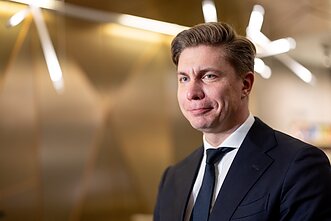











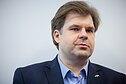


“My name is Juan Ignacio Fourment Kalvelis, but in Lithuania, everyone calls me Jonas. I like it when people call me Jonas Kalvelis,” says the man whose great-grandparents emigrated from Lithuania to Argentina almost a century ago.
We met on the first day of Jonas’ visit to Lithuania, which greeted the guest from distant Argentina with wind, low-hanging dark clouds, and persistent rain. However, Jonas says he came prepared, as this is already his ninth visit to Lithuania.
Although Jonas’ family has lived in Argentina for almost a century, he speaks excellent Lithuanian.
“I found out about my family’s history when I was looking for my relatives in Lithuania through a TV show. It was 18 years ago. I found my relatives on my great-grandmother's side, and I am still in contact with them,” the man shares.
“From them, I learned that my grandfather came to Argentina in 1926 when he was still a baby,” he adds.
Jonas says he does not know the exact reasons why his grandfather’s family decided to leave Lithuania. But almost 25,000 Lithuanians moved to Argentina, and even more to Brazil, during the interwar period. Speaking to the first-generation emigrants gave him a better idea of why so many people left Lithuania at the time, he says.
“Some of them said they felt that something very bad was going to happen in Europe, that the horrors [of the war] would be repeated. And the economic situation in Lithuania was quite difficult. That’s why they came to Berisso, the city where I grew up,” Jonas shares.

Bringing language home
Jonas calls the Argentinian city of Berisso a “multicultural mosaic” because many emigrants from different countries came here during the interwar period. There are still many national communities in the city today, including the Lithuanian community Nemunas.
This community is the reason why Lithuanian traditions are still alive in Jonas’ family, he says.
“In Argentina, there are communities that have been active for more than a hundred years and have brought Lithuanians together. I belong to Nemunas where my parents met while dancing folk dances,” the Argentinian Lithuanian man explains.
“My dad had nothing to do with Lithuania, but he worked with Lithuanians. And one day he was invited to dance because there was a shortage of male dancers at the time. He accepted and that’s where he met my mother,” he adds.
According to Jonas, his family today still celebrates Lithuanian holidays, listens to Lithuanian music, cooks Lithuanian dishes, and dances folk dances. But maintaining the language is more difficult, as his parents and many other expats in South America no longer speak Lithuanian.

Jonas, however, wanted to bring his grandparents’ language back to the family home. In 2003, he received a scholarship and spent a year studying the language at the Lithuanian High School in Germany.
“I decided to study because I realised that the language would be my bridge to Lithuania. Now, I try to build such bridges for others through my activities,” he says.
Lituano in Argentina
Jonas says that his family considers themselves Argentinians and are grateful to the country that once welcomed them. But this does not clash with feeling love for Lithuania.
“Here in Lithuania, although I speak Lithuanian, I am Argentinian. And in Argentina, they call me Lituano,” he smiles.
Asked how he feels about this duality, he says he is honoured to be and feel part of both countries.
“In Argentina, it’s an honour to be called Lithuanian by friends or colleagues. And, of course, I wasn’t born in Lithuania, but I’ve been here many times and I like everything here very much. I don’t feel like a foreigner, it’s like home to me. And if someone looks at me differently, I know the language and I can always explain who I am and why I am here,” Jonas says.
Lithuanian echoes
In addition to his activities in the Nemunas community in Argentina, Jonas has also been working on the radio show called Ecos de Lituania (Lithuanian Echoes) for several years now.
“I studied journalism and while I was still at the university, I realised that I needed to practice, to not be afraid to speak to a microphone. I also noticed that there was a lack of information [about Lithuania] both inside and outside the community. So, I combined these two things and started a Lithuanian radio hour,” he explains.
“I wanted the name of the show to be Lithuanian Echoes, and a show with this title had already existed before for 24 years. I got the permission of the previous creators of the show to use the name – they were happy that Ecos de Lituania would be revived again,” Jonas adds.

According to him, the show is constantly expanding and reaching more and more listeners not only in Argentina.
“At first, it was only available on FM, so all the listeners were from the city of Berisso, where the Lithuanian community is one of the most active. But later the show moved to the internet, we created our website, and now we have many more listeners, some even from Lithuania and also from the US, Brazil, and Uruguay,” the host of the show says.
South American representative
This time Jonas came to Lithuania to represent South American Lithuanians at the meetings of the Seimas and the World Lithuanian Community Commission in late November. According to him, his goal is to convey several messages that are important to South American Lithuanians.
The first, he says, is having a Lithuanian representation in South America.
“Having a Lithuanian embassy in at least one country is very important. At the moment, there is not a single representative office in the whole of the vast continent of South America. And there are a lot of Lithuanians here, descendants of Lithuanians,” he explains.

His second goal is to expand Lithuanian education in the South American diaspora. Jonas says he wants more people of Lithuanian origin to be able to come and see their grandparents’ and great-grandparents’ homeland.
“I’d like as many young people as possible to have the opportunity to go to Lithuania to study, to attend universities, and, most importantly, to learn the Lithuanian language,” Jonas says.
“It’s important for people in Lithuania to know that there are many people abroad who love Lithuania and work for Lithuania. Even those who have never been to Lithuania are actively involved in working for their country. They have created Lithuania in their hearts and at home, even though they are far away. That is why I’d like to give them the opportunity to come back,” he adds.

Newsletter
Every Friday morning.