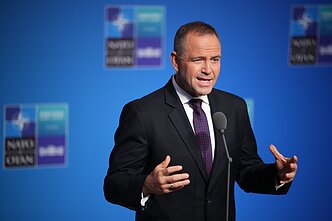

















The Baltic states can rely on NATO’s Article 5 of collective defence regardless of who is in power in the US and other countries of the alliance, Julianne Smith, US Permanent Representative to NATO, says in an interview with LRT.lt.
President Joe Biden has warned that Russia could attack NATO. We also hear similar warnings from German, Polish military officials. Do you believe that Russia will attack the Baltic states?
When the alliance presented its new strategic concept last year, it stated that Russia was the number one threat. Since then, we have taken many steps to ensure that this never happens, to deter Russia from encroaching on NATO territory.
We have recently deployed four new battalions in Eastern Europe that can be expanded to a brigade. We have changed our strategy and doctrine and developed new regional plans that will ensure that we can defend every inch of NATO territory. Many countries, including the US, have moved forces into your neighbourhood to ensure that Russia gets a very clear message – it must not and cannot attack NATO.
But are you noticing Russia rebuilding its combat capabilities and why is it doing so?
Russia has suffered heavy losses as a result of the war in Ukraine. It has lost hundreds of thousands of troops; it has lost an enormous amount of equipment. It will probably take them several years to rebuild their capabilities. We don’t know how long exactly. There are various estimates, ranging from a few years to more than a decade.
But NATO is not going to wait for this to happen again. We are taking action now to ensure that Russia can never attack NATO. We are also providing important support to Ukraine so that it can continue to push back the Russian forces that invaded their territory two years ago.
Can the Baltic countries rely on NATO Article 5? After all, the political environment is constantly changing, political administrations change, and it will all depend on who is at the negotiating table.
As in many European countries, the US will have elections next year. But let me say that, regardless of who will sit in the Oval Office in the future, I’m really encouraged by the fact that the American people and members of Congress are very supportive of NATO.

Republicans and Democrats may disagree on many things, but they agree on the importance of the alliance. We helped to create this alliance, we understand its importance and that it cannot be replaced. It serves America’s interests, and it serves your country’s interests as well. That is why I’m confident that, whether or not there is a change of administration next year, you will continue to be able to count on strong bipartisan support for the alliance.
But let us look at the battles in Congress over support for Ukraine. What would it mean for Kyiv to lose US military aid?
We don’t want to see the US support for Ukraine cut off. Maintaining it is President Biden’s priority. The president and all members of his cabinet are actively engaged in securing this additional support for Ukraine. Yes, we disagree on certain things with some members of Congress, particularly in the House of Representatives, but not so much in the Senate. I think we will do it because it is a priority for the president, and Ukraine has bipartisan support. I think the American people, by and large, understand what is at stake. We cannot stop supporting Ukraine. We have to make sure that it prevails.
Lithuania is sandwiched between Kaliningrad and Belarus. We also have transit between these countries through our territory. This creates many opportunities for Russian provocations and various hybrid attacks. How is NATO prepared to respond to them?
Your country does indeed have serious security concerns, and we take them very seriously. Because of your geographical location, you feel Russian aggression much more acutely than other members of the alliance. But I would like to say to your audience that NATO has a strong focus on security in the broadest sense, and we think of threats in terms of conventional war.
We do everything we can to deter and prevent such attacks. But here in the alliance, we also spend a lot of time talking about hybrid attacks. We pay a lot of attention to cybersecurity, critical infrastructure, and disinformation.
We know that Russia’s playbook is similar to the one they have been using for a long time, and the alliance is preparing to deal with all their tactics, in addition to conventional military tactics.

If Russia decides to test NATO in other, unconventional ways, won’t NATO say, “Let’s wait and see”?
Well, again, we know the rules of the Russian game and how to react to its actions. I will give you one example. Before Russia attacked Ukraine, we received news that Russia was going to undertake an operation where disinformation and provocations would be used to create the impression that Ukraine was to blame.
We have identified all of this in advance in an unprecedented way by sharing our intelligence with our allies. This put Russia in an awkward position because even before they launched the hybrid operation, we had essentially unmasked it. So, through intelligence, new strategies, and experience, this alliance is getting stronger and is ready to face any hybrid challenge.
It is no secret that the situation on the battlefield in Ukraine is complicated. Does this mean that Ukraine must prepare for possible negotiations with Russia?
Our message on possible negotiations is simple and clear. We want [Ukrainian] President Zelensky to set himself the terms on which he will come to the negotiating table. We don’t intend to impose anything on President Zelensky. This is his sovereign decision. Our role at the moment is to give him what he needs economically, to provide humanitarian aid, and also to provide security so that his government can function and ensure that it is able to drive Russia out of its territory. But the negotiations are a matter for Ukraine, and we will leave that in their hands.
But if Ukraine loses US military support, that may be the only option left.
I don’t want to enter into hypotheses. As I said, President Biden’s priority is to get additional aid to Ukraine. However, let us not forget that this is not just about US support. What Europe has done, what your country has done, is simply amazing. In terms of per capita aid, the Baltic countries have done more than most allies, including the US. So, we are very grateful for the help that your country has given.

Can we admit that the counter-offensive in Ukraine was not a success after all?
I think we all had very high expectations for the counter-offensive. I think the Ukrainians themselves had high expectations, as did many countries around the world. But only the Ukrainians themselves can do it, it is their war, and they choose how to fight it. We have seen that they knew how to make good use of the assistance, training, and capabilities that we gave them. They have combined these modern capabilities with inherited Soviet capabilities to achieve real results on the battlefield. We want to see this continue.
If the conflict is frozen, what will this mean for the security of Europe, and in particular for the eastern flank of NATO?
Again, I do not want to enter into hypotheses, but it is left to President Zelensky to decide how he would like to proceed in the peace talks. But whatever happens in Ukraine, we are addressing your security needs in real time. This is the alliance’s top priority, and we are not going to back down. NATO’s most important task is to make sure that we have what we need and that you feel safe.

Newsletter
Every Friday morning.