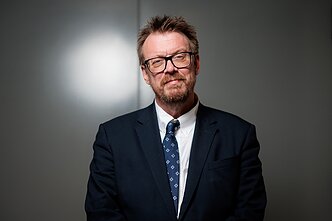













It is tempting for small countries to form regional groups in order to be more visible, says Laurent Le Bon, head of the Pompidou Centre in Paris, but that covers their uniqueness and irreducibility to shared traits. That is particularly true of Lithuania and the Baltics.
Le Bon came to Lithuania to chair the jury of the Young Painter Prize. He also visited various Lithuanian art institutions, talked to their managers and established cultural contacts.
After many years as a curator, art critic and director of the Picasso Museum in Paris, in 2021 Le Bon became the head of the Pompidou Centre, one of the most influential and largest art institutions in France.
In an interview with LRT.lt, he talks about the uniqueness of Lithuanian art, the phenomenon of Mikalojus Konstantinas Čiurlionis, his visit to Kaunas, and the upcoming Lithuanian culture season in France.
You’ve spent several days in Lithuania. Before coming here, what had been your outsider view of the Lithuanian art? How do we present ourselves to the world?
Well, I was lucky enough to have some idea about some of your artists. If we go a little bit in the past, for example, there’s Čiurlionis. Then Kaunas the European Capital of Culture was a really big success. And of course the energy of the younger generation with some very important artists like Deimantas Narkevičius and Žilvinas Kempinas.
But what I feel here is really strong energy. Sometimes from the outside, we see the three Baltic countries as something which is not quite a unity, but as having very much in common. It was really a big error for me, too. Because what I feel here is really a very specific identity of Lithuania, distinct from its neighbours.

What exactly do you mean by this specific identity?
When you don’t know a country, you have some prejudice. When we use the adjective “Baltic” to describe Lithuania, we have an idea of some kind of unity with the sea. But Lithuania is much more linked, for example, with what’s happening in Ukraine, the relationship with Poland is very different, and many other things.
In art criticism, there’s always the much broader question of how can you define that Lithuania is this and Lithuanian artists are like that. It’s much more complicated because behind a definition, you have individualities and you cannot put everyone in a category.
If I come back to Čiurlionis, as an art historian, you will begin by saying he is a symbolist. But when you are lucky to discover the museum that displays his work – because, as you know, the collection is only in Kaunas and you have to go to Kaunas, because for Čiurlionis it’s very important that you see his works, no books or social media will convey the strength of his work. So when you go to Kaunas and make this discovery, then you see: there’s no other artist like him, there’s only one Čiurlionis. And it doesn’t matter if he's a symbolist or part of any other movement.

And it’s the same for other Lithuanian artists. Sure, you can try and find some common qualities they share. But what I feel much better is the strength, the energy of Lithuanian art. And especially in the period of the war in Ukraine, I don’t think we have the same relationship with this moment.
I think that we ourselves present Lithuania as part of the Baltic unit. For example, there was an exhibition at Musée d'Orsay a couple of years ago called “Wild Souls. Symbolism in the Baltic States”, presenting early 20th-century artists from Lithuania, Latvia, and Estonia.
Who I am to say, but I think it’s a mistake. It makes things more complicated. We have been trying to define a European culture for years, for centuries now, and our strength is our diversity. And when you try to make this unification, it’s not based on any interesting grounds.
And I have another example. The Lonely Planet guide says “the Baltic countries”. And it’s interesting that when you are in Lithuania, you see that it’s not that easy to travel to the two other countries.

I think we choose to present ourselves as a unit in exhibitions or initiatives such as the Young Painter Prize, where you served as a juror, because it’s easier to attract attention that way. You’ll get more than just Lithuania, all the Baltic countries.
You are completely right. And also perhaps there is the spirit of a kind of romanticism: you are united with forests, rivers, nature. But I think your world is much more complex.
What did you make of the city of Kaunas that you visited?
Kaunas is a really fascinating city. What I like about my job is that you think about art history as a complex continuum from the prehistoric ages until today. And in Kaunas, I can feel the history and its layers. You have this feeling of the layers in its urban planning, which is fantastic. And with this very specific period of the interwar period when Kaunas became a capital city.
This is not unique, you have other examples in the world where a city becomes a capital very rapidly. But with this quality of architecture, there are not so many.

Do you think that views and awareness of Lithuanian art changed after Lithuanian artists won the Golden Lion at the Venice Biennale with their opera ‘Sun & Sea (Marina)’?
Of course. There are critics who say the Venice Biennale shouldn’t present art through the national angle. There is this competition among countries. But one thing which is interesting, I think, is that when it puts a spotlight on countries that we don’t know so well, it breaks prejudice and things like that. Remember when Angola won the Golden Lion and, of course, when Lithuania won.
There will be the Lithuanian culture season in France next year. What do the French people in Paris and all over France expect from these seasons?
I think it’s fortunate that the Lithuanian season is in autumn, coinciding with the opening of the new affair, Paris+ par Art Basel. A huge moment when everyone from the world comes to Paris.
I think it’s fantastic because, of course, not everything will be about Lithuania, but there will be an ecosystem where we can see the best of your country.

Newsletter
Every Friday morning.