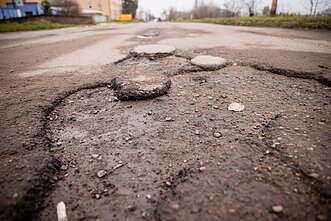















The poor state of Lithuanian roads is turning into a national crisis. Years of underinvestment and a failure to find sustainable funding sources have led to the present situation, say road managers.
“I have been saying for 23 years that our public spending is too small for our level of development. This is a general problem,” says Raimondas Kuodis, an economist and adviser to the prime minister.
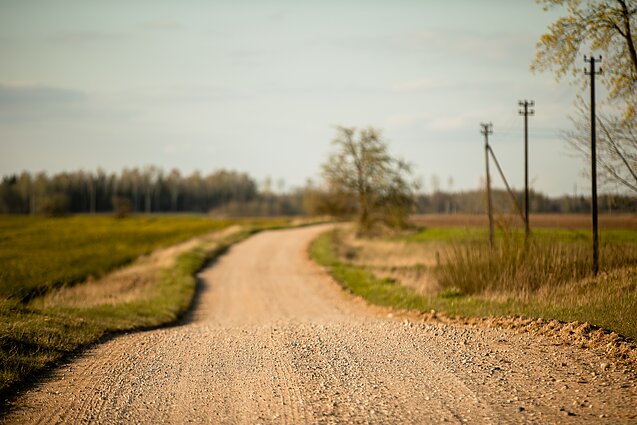
Lithuania has been underinvesting in its roads for years, say transport authorities. The neglect has been building up and is reaching a breaking point.
“The number of bridges that are in a state of disrepair is roughly 70. [...] Forty percent of the road network does not meet the standards. To fix them in one year at current prices, both roads and bridges, would require around 10 billion euros,” equivalent to more than half of the entire annual government spending, estimates Šarūnas Frolenko, executive director of the association Lithuanian Roads.
His opinion is echoed by a former head of the Road Directorate, Egidijus Skrodenis.
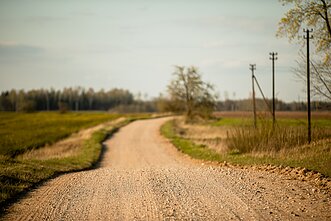
“On the one hand, we all have iPhones, Teslas, modern cars, and on the other, we probably still have the largest share of gravel roads. It’s like walking around in wooden clogs and a Prada bag,” says Egidijus Skrodenis, who headed the Directorate between 2015-2017.

The government has budgeted 543 million euros for the Road Maintenance and Development Programme next year.
“If we look at the increase in wages and inflation, the increase in product prices, fuel, this is really little, because it is the same amount as three years ago,” argues Audrius Vaitkus, researcher and director of the Road Research Institute at Vilnius TECH.
According to the Finance Ministry, however, that is not all. Additionally, 130 million euros will go toward road repair and maintenance from the so-called “solidarity tax” on banks’ windfall profits. Another 42 million euros will come from the EU. Therefore, the total spending on roads will be 715 million.

But those in charge of roads say the math is faulty.
Notably, the “solidarity tax” will go towards military mobility, so it cannot be used for repairing roads, says Frolenko. “Yes, some of it will probably go to Via Baltica, some of it will go to the access roads to the training grounds, some of it will go to the Miškinių Bridge, which is not being built now. But this will not improve [other roads].”
“If the funding remains as it is, next year we will have to make choices and decide what not to do,” adds Frolenko. “Whether to stop Via Baltica and not complete it next year. Or not to start the repair of the Utena-Molėtai road. Whether not to repair the bridges. Or not to do any routine repairs.”
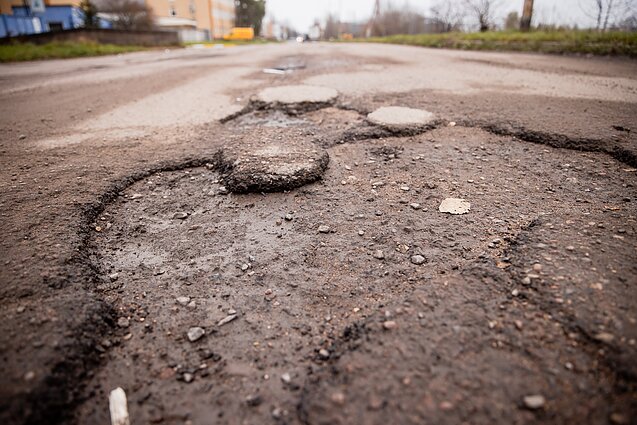
Fixing potholes
Kuodis, the prime minister’s adviser, questions whether the money that there is gets spent effectively.
“Do we patch roads instead of fixing them from the ground up, as is the case, for example, in Poland. If you see a road being repaired, you see a milled piece with 20 centimetres of concrete and only a small layer of asphalt on top,” he says.
Vaitkus notes that municipal authorities decide whether they want to fix a road profoundly or just to patch it up.
“If the entire structure of a road is crumbling [...] and we replace only the top layer, then we know that it will only last 4–5 years, we do it because of lack of money. And these decisions are not made by contractors,” says Vaitkus.
Tax on electric cars?
Part of the funding for roads and their maintenance comes from the excise duty on petrol. Road managers would like to get a bigger share of the revenue, 80 percent.
Experts say the problem is that fuel purchases are falling as the population shrinks. There are also an increasing number of electric cars, which wear out the roads as much as conventional vehicles, but do not contribute to their maintenance through the fuels taxes.
It is clear, says Frolenko, that a fundamental rethinking of the current funding model is in order – and that a tax on electric cars will have to be introduced.
“We all understand that at the moment [the government] wants to incentivise [electric car use]. But at some point, there will have to be a tipping point and we will have to find a tax for electric cars,” he says.
But taxes are unpopular and introducing new ones is a tough mission – as exemplified by the current government’s attempts to push through a property tax. Skrodenis, a former head of the Road Directorate, says there are alternatives, such as borrowing or investing private pension funds. But even these options, he says, have always remained just talk.

Newsletter
Every Friday morning.