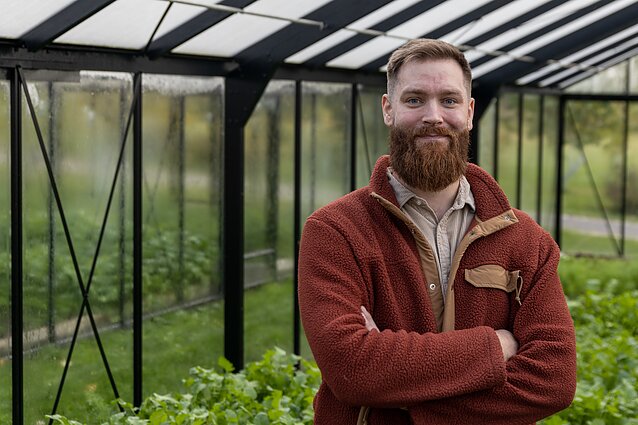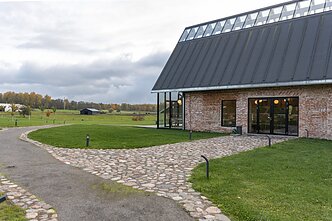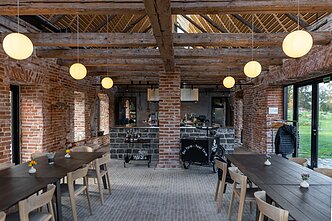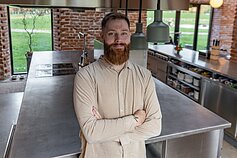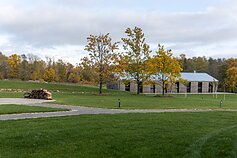











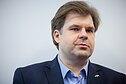


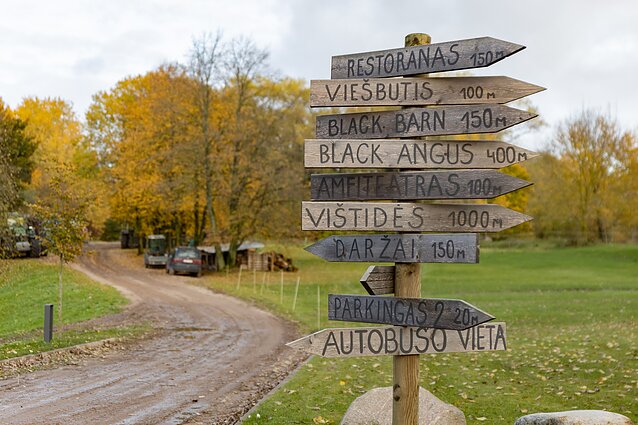
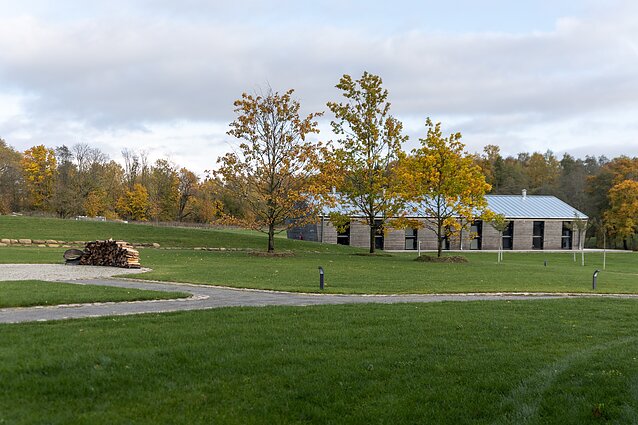
A few kilometres outside the town of Ukmergė, a 600-hectare organic farm is nested in the Lithuanian countryside. In its vast field stands a little reconstructed red-brick manor. It is home to Lithuania’s first certified ecological restaurant, run by Icelandic chef Arnór Ingi Bjarkason.
The organic farmland, called the Farmers Circle, features more than 400 Black Angus cattle, 800 free-range hens, and a variety of vegetables, berries, and herbs, all grown and cultivated according to sustainable circular farming principles.
The organic produce is not only made for sale but is also turned into gourmet dishes by the Icelandic chef at the Red Brick restaurant, the centrepiece of the Farmers Circle.
‘Perfect after perfect’
As most of these stories go, Arnór ended up in Lithuania following a woman. He met Lithuanian Lina in Iceland where she was volunteering at the Lithuanian community’s Sunday school almost five years ago.
“We met thanks to the power of smart apps and just started dating,” Arnór smiles.
Half a year later, Lina found out she was accepted to study Master of Psychology at Lund University in Sweden. Without much hesitation, Arnór followed her there.
After Lina’s graduation, the couple moved back to Iceland and tried to settle there, but it was not easy for the Lithuanian woman to get a job in her field in a foreign country.
“So, I said, let’s go to Lithuania, because being a chef, it’s easier for me to get a job anywhere,” Arnór says.

The couple moved to Lithuania in July last year, and from there, everything went “perfect after perfect”, according to the Icelandic man. Although he “simply jumped on a plane” and came to Lithuania without a plan, a month later, he landed a job as an executive chef at Pacai, one of the best restaurants in Vilnius.
Dream come true
Despite the prestigious name, not everything was perfect at Pacai, so Arnór started looking for job opportunities elsewhere. Via Instagram, he met a Danish businessman called Niels, who happened to own the Farmers Circle and other businesses in Lithuania.
“I asked him if he had plans for the restaurant premises because I wanted to maybe rent it off him,” Arnór says, “When we met again, he asked me if I was looking to open a restaurant and offered me to run Red Brick.”
He recalls being in awe when he first set foot on the Farmers Circle. According to the Icelandic man, it is almost every chef’s dream to run a restaurant on a farm where you can go pick fresh ingredients.
“Not many chefs start by opening a restaurant like this, so it was a dream come true,” Arnór says.

He wasn’t dismayed by the fact that the farm was around an hour’s drive away from Vilnius, as he “always loved nature”. Lina, however, was a bit more sceptical – having grown up in Vilnius, she could not imagine herself living anywhere else in Lithuania.
“But now, she feels very good about it, so I guess, she was lying,” Arnór smiles. Lina now works as the front-of-house manager at the Red Brick, and the couple lives in Ukmergė four days a week when the restaurant is open.
High hopes
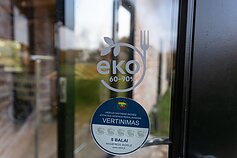
The Red Brick opened its doors in August this year but has already become the first restaurant in Lithuania awarded an official ecological certificate at the silver level, which means that 60 to 90 percent of the produce it serves is organic.
Most of the ingredients Arnór uses to create his dishes are grown right here on the Farmers Circle. The rest is sorted locally and only a small portion, such as fish and some seasoning, is imported.
“I almost always like to use local ingredients with some sort of Japanese twist,” the Icelandic chef says when asked to describe his cooking philosophy.
“It’s a bit tricky here because I’m trying not to use anything imported. For now, I’m using a little bit of soy, tamari, and miso, but we’re also planning to make our own,” he adds.
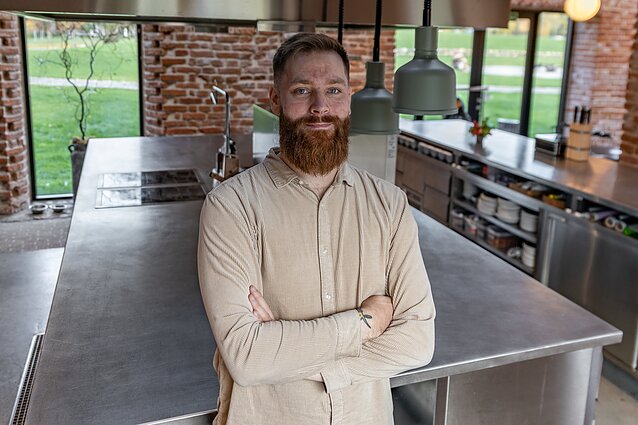
Red Brick’s menu is also highly season-dependent.
“In summer, the menu is 90 percent vegetables. In autumn, it’s going to be more root vegetables and meat. Then come winter, it’s mostly going to be fish and vegetables that I’m already preserving, pickling, and drying,” Arnór explains.
So far, there are no restaurants with Michelin stars – a hallmark of culinary excellence – in Lithuania. It has been reported, however, that the country has concluded an agreement for Michelin inspectors to visit its restaurants in the near future.
Arnór does not hide the fact that he hopes to be awarded a Michelin star one day.
“I believe my food is worthy of a Michelin star. But there’s maybe one thing I’d like more than a Michelin star, which is a Michelin green star,” the chef explains. The latter is awarded to the best restaurants that are following sustainable practices.
“I 100% believe that this restaurant would deserve [the Michelin green star]. So, I’m very expecting, very hoping,” Arnór says. “Most chefs dream about a Michelin star because it sets a stamp of excellence. But I’ll not be sad if I don’t get it.”

Learning by doing
Arnór says he has been working as a chef “for half of his life”. At the age of 15, he started off as a pizza baker, but being a chef was never his top career choice.
“I rode BMX a lot as a kid and I was making videos, taking photos. So, journalism was my number one choice. But I was very bad at showing up at school, and the only thing you need to get into [journalism] school is attendance,” he says.
As such, Arnór opted for cooking school. As part of his studies, he did several internships at high-class restaurants before finally deciding to drop out and continue working full-time as a chef.
“I did the first year of school, then I went to work. I had an internship in Denmark at the restaurant called Noma, which was named the World’s Best restaurant a few years in a row. Then I got a job offer in Finland, so I just didn’t go back to school,” the chef explains.
“Cooking is not like medicine, for which you need education. You mostly learn by doing,” he adds.
Asked if being a chef has made him a picky eater, Arnór says that this is the most common misconception about his profession.
“You could take me to McDonald’s or cook a frozen pizza for me, and I’ll be happy. Most chefs I know are just happy they don’t have to cook at home,” he says.
Now, one of his favourite dishes is Lithuanian koldūnai (dumplings), he admits.
“I can eat koldūnai every day. If I’m cooking all day, when I come home, I don’t feel like cooking and all I want is a bag of koldūnai with a bit of grietinė [sour cream]. My wife is not happy about that,” Arnór smiles.

Newsletter
Every Friday morning.