











An identity clash between European-facing Belarusians and Lithuanians has echoed across social media, as well as from the lips of politicians eyeing next year’s elections. At the core is Litvinism, a strand of Belarusian nationalism questioning the Vilnius-centric legacy of the Grand Duchy of Lithuania, the mediaeval state stretching from the Baltics to the Black Sea and incorporating parts of present-day Belarus, Russia, and Ukraine.
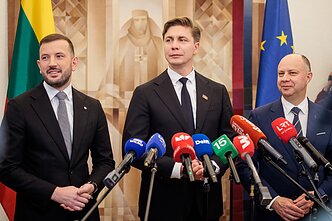
Raimundas Lopata, a liberal MP and member of the parliamenty Committee on National Security and Defence, recently said that the country could start prosecuting Belarusians who propagate ideologies that "imply a claim to Lithuania's territorial integrity".
His words followed a heated debate on social media, which was quickly picked up by politicians: Who owns the history of the Grand Duchy – Lithuania or Belarus?
Alexander Fridman, an expert on Belarusian history, says that identifying Belarusians as a threat is a danger in itself.
"This hurts the mood of the Lithuanian population and strengthens antipathy towards Belarusians,” he said.
The discussions about Litvinism in Lithuania are mainly held in the political context, Fridman said. Both Belarusians, who are supporters of this trend, and Lithuanians, who see it as a threat, are often guided by emotions rather than facts.
According to Fridman, the concept of Litvinism should be considered more broadly.
"Litvinism first and foremost emphasises the importance of the Belarusians, or rather the ancestors of modern Belarusians, in the history of the Grand Duchy,” he said. “The Grand Duchy is presented as the most important stage in the history of Belarusians.”
The theory states that the ancestors of modern Lithuanians played a part in the history of the Grand Duchy, but did not play the main role. It also claims Vilnius as an important Belarusian centre of culture.
However, the Litvinists have no political or territorial claims to Lithuanian capital. "Rather, these claims are cultural," said Fridman.
Alfredas Bumblauskas, a Lithuanian historian and professor at Vilnius University, says there are different tiers of Litvinism, some of which do pose a threat to Lithuanian statehood.

"If this is the kind of Litvinism that questions whether Lithuania is the inheritor of the Grand Duchy, then we are out of step with such an ideology – an ideology that claims that the Samogitians [people from the Western region of Lithuanian] occupied Vilnius. This is extreme nationalism," he said.
"But there are also constructive Litvinists who recognise that the historical borders of Lithuania are wider than the [20th century borders]. In that case, it is a Litvinism with which we will have to live with," said Bumblauskas.
"We will want the Belarusians to recognise that there is a Lithuanian trace in it, so we in turn will have to recognise that there is a Belarusian trace in the Grand Duchy," he added.
According to one expert of Litvinism, there are several strands of Litvinism. Vadimas Vileita, a translator born in Belarus but living in Lithuania for more than 20 years, researched Litvinism at the Vilnius University’s Institute of International Relations and Political Science.
He investigated how discussions about the threats of Litvinism erupted in Lithuania and what made Lithuanian society and politicians fear this ideology.
In his work, Vileita distinguished between radical and radical Litvinism.
According to Vileita, moderate Litvinism has been taught in Belarusian schools and universities for years. In it, the Grand Duchy is considered a Lithuanian-Belarusian state, emphasising the peaceful coexistence
"This theory focuses on joint wars with the [Teutonic] Crusaders and Moscow. In other words, it is a moderate pro-Western theory about the origin of the Belarusian people, which is quite favourable to Lithuanians and partly to Poles, and according to which Belarusians and Lithuanians are linked by a common, glorious past," said Vileita.
"Historians may debate to what extent the Lithuanian ethnos or the Belarusian ethnos contributed to the life of the Grand Duchy, but this theory is supported by a significant number of Belarusians. According to indirect data, it is consistently supported by about 30 percent of the Belarusian population," said Vileita.
Radical Litvinism is the idea that Belarusians were the main ethnos of the Grand Duchy and should be called Litvins. Therefore, as present-day Belarusians, they claim the heritage of the Grand Duchy, including the capital Vilnius, as theirs.
"This is a separate manifestation of the radical sentiment that can exist in any society. It can exist, for example, in Lithuanian society, where radicals can make territorial claims against Poland or Belarus. Such sentiments can spread in Polish society, for example among some football fans, where radical right-wingers can make claims to Vilnius," said Vileita.

"There are such manifestations in Belarusian society too, but they are certainly not popular," he added.
Some of the Belarusian volunteers fighting for Ukraine are no strangers to nationalist ideas. For example, many of them have links with Zenon Pazniak, former head of the conservative Belarusian People's Front (BPLF) party.
This politician was a fierce opponent of Alexander Lukashenko in the 1990s and an advocate of the revival of Belarusian nationalism.
Recently, he said that the Bolshevik decision to hand over Vilnius to Lithuania in 1939 had been a great tragedy for Belarus. He also recalled that in the 1990s, members of Lithuania’s rebirth movement, Sąjūdis, together with members of the BLF had raised the question of who laid claim to the city.
According to Pazniak, the BLF did not make any territorial claims at that time, but only asked for the newly independent Lithuanian government to "preserve the Belarusian character of the city". At that time, a Belarusian school named after Pranciškus Skorina was established in Vilnius, Belarusian cultural events were in the city, while Lithuanian radio and television, the present-day LRT, started broadcasting programmes in Belarusian.
Disputes stretching decades
Despite the current uproar, debates over Litvinism are not new. According to Fridman, historical disputes between Belarusians and Lithuanians peaked in the late 1980s and early 1990s. At that time, both states tried to downplay each other's contribution to their common history.
"In Lithuania in the 1990s, there was a particularly strong tendency, also among scholars, to try to present the history of the Grand Duchy as only Lithuanian history, without the Belarusian component. As far as serious scholars or intellectuals on both sides are concerned, it was clear to them from the very beginning that the history of the Grand Duchy was a common history of Lithuania and, consequently, a common history of Belarus," said Fridman.
Some people also criticise the Belarusian use of the Lithuanian coat-of-arms Vytis.

"The Belarusians, as well as the Ukrainians, are the heirs of the Grand Duchy. If there are Lithuanians who are angry that Belarusians also use the Vytis as their coat of arms, I would advise them to calm down," said Bumblauskas.
According to Fridman, radical Litvinism is unpopular among Belarusians.
"We are talking about an extreme marginal current, both among the Belarusians on the territory of Lithuania and among the Belarusians on the territory of Belarus,” he said.
Post-Lukashenko Belarus and shared history
For three decades, Lukashenko has pursued a dual historical policy. On one hand, he claims the country’s history begins with the Bolsheviks in the early 20th century. On the other hand, he says the country's history stretches hundreds of years as part of the Grand Duchy, together with Lithuania and Poland.
Depending on the political context, Minsk constantly changes the line on which Belarusian statehood is based.
"The timing of these waves coincided with periods when Belarus was seeking to improve relations with the West,” said Vileita. “Paradoxically, this happened precisely when the Belarusian regime decided that it should not focus solely on Moscow and tried to manoeuvre to improve relations with Europe, reinforcing historical narratives that emphasised Belarus' commonality with its Western neighbours.”
"It was at that time that Belarus started to build monuments to Lithuanian princes and to rebuild the castles of the Grand Duchy in Belarus. It was during this period that the Lithuanian society displayed a negative reaction,” said Vileita.
One such phase in Belarus took place between 2013 and 2020 when Lukashenko decided to release political prisoners after the 2010 crackdown in exchange for the lifting of sanctions.
For example, a monument to Prince Algirdas was unveiled in the centre of Vitebsk in 2014, and a monument to Gediminas in Lida in 2019. Several hundred people gathered in the city centre with the country’s historical white-red-white flags. The use of such national symbols was not punished.
A year later, however, both the flag and Vytis were banned amid increasing repressons following the 2020 presidential elections.

According to Vileita, Lithuania’s tendency to deny the Belarusian component of the Grand Duchy shows the Baltic country being more accustomed to the regime and not a democratic Belarus.
Therefore, the narratives that have been actively promoted by the Minsk regime for the last 30 years – that Belarusian history begins with Bolshevism and that Belarus has always been part of Russia – are very convenient for Lithuania.
"I think Lithuanian society needs to understand that for Belarus to become a European, reliable, stable, friendly neighbour of Lithuania, it needs to have its own European history,” he said. “This European history is related to the Grand Duchy and the Polish-Lithuanian Commonwealth.”
Why fear Litvinism today
Previously, the heated debates over Litvinism had been sparked by the actions of the Lukashenko regime. For the first time, the current debate came from within Lithuania.
Experts point to the increasing Belarusian diaspora in Lithuania, with around 60,000 Belarusians now living in the country. Many of them arrived following the post-2020 regime crackdown.
"The securitisation of Litvinism was provoked not by Minsk, but by Belarusian civil society, which is currently active in Western countries, especially in Vilnius,” said Vileita. “We can see that this is provoking a similar response, a great deal of confusion and defensive reactions from Lithuanians.”
However, there is no evidence to show that any strand of Litvinism has been spreading among Belarusians in Lithuania.
According to Vileita, many Belarusians have never analysed their identity in depth, having lived their entire lives in authoritarian Belarus, where a manipulative view of Belarusian history prevails.
According to Fridman, the Belarusian expert on History, Lithuania lying exclusivity to the history of the Grand Duchy could contribute to the Belarusian diaspora’s radicalisation.

This has happened before.
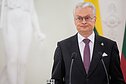
For example, Lithuanian President Gitanas Nausėda visited Czechia a year ago. There, he posted on social media a picture of a monument to the Lithuanian public figure Pranciškus Skorina (Francysk Skaryna), with a caption stating that Skorina was an important person for the Czech Republic and Lithuania, without mentioning Belarus.
This led to anger among Belarusians. Another such episode occurred when Lithuania commemorated the 160th anniversary of the 1863–1864 anti-Tsarist uprising, in which Lithuanians, Poles, as well as Belarusians, were involved. However, the president did not mention Belarusians.
"These discussions about Litvinism are mainly taking place on social networks. In many cases, they are related to the statements and activities of President Nausėda, because he excludes Belarusians,” said Fridman.
A similar episode played out during the NATO summit in Vilnius in July.
“He said that the Belarusian state no longer exists, that Belarus has turned into a province controlled by the Russian Federation,” said Fridman. "This attitude towards Belarusians is very unpleasant [and] encourages such tendencies and attempts to prove that this is not the case, including by using the arguments of Litvinism."
In response to public statements, Lithuania’s intelligence agency, the State Security Department (VSD) also said that the ideology of Litvinism does not pose a threat. However, the resulting controversy may turn Belarusians against Lithuania, the agency said.
Belarusian opposition leader Sviatlana Tsikhanouskaya, based in Vilnius since 2020, also reacted to the tensions, saying that they were the result of state propaganda from the Minsk regime and Moscow.
"They are using all kinds of dirty methods to worsen the relations between Belarusians and Lithuanians. The Belarusians don't talk at all about Litvinism – these are isolated, marginal cases, but they have been picked up by the local media," Tsichanouskaya told LRT.

Newsletter
Every Friday morning.