














As the host of the NATO summit, Lithuania's capital is at the centre of world politics these days. It's a great time to have a closer look at Vilnius, because there are a couple of things that Berlin could learn, writes Felix Wessel, a German journalist.
Let’s be honest: Many Germans wouldn’t find Vilnius on a map. And I was one of them for quite a while. Lithuanians are used to that. It even inspired them to launch a tourism campaign: Vilnius as the G-spot of Europe. “Nobody knows where it is but when you find it - it's amazing”. After spending two months in the region before the NATO summit I can say: Amazing, I would agree with that.
I also covered topics like high inflation or food poverty – so I am not saying Lithuania is a fairytale wonderland. But I think it can be a role model, for example when it comes to solidarity with Ukraine.
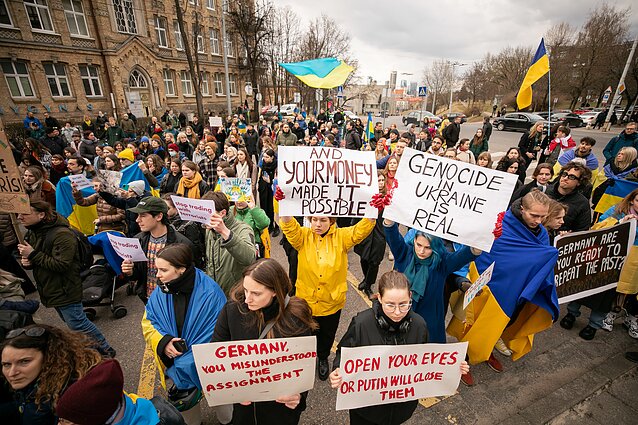
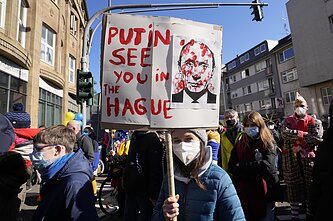
Sometimes it’s still weird to be back in Cologne, Germany’s fourth biggest city, where hardly any Ukrainian flag is seen on the streets. Of course, you’ll also find many political messages on the walls in my district. But it’s mostly "Woman. Life. Freedom.", the slogan of the protest movement in Iran. Sure, that's important, too. But the war in Ukraine suddenly seemed so far away again.
More than one year after Russia started its full-scale invasion, solidarity is omnipresent in the streets of Vilnius. For example, the public buses repeatedly display the message "Vilnius loves Ukraine". Of course, there were also some similar signs of solidarity in Germany, mostly on a smaller scale and especially at the beginning of the war. But there is so much more we could do.

Lithuania hosts more Ukrainian refugees relative to its population than Germany and, according to the Kiel Institute for the World Economy, has provided even more military aid in proportion to its economic strength than the US. And people do not leave that to politicians alone.
For example, NGOs had launched a campaign together with media outlets such as LRT to better protect Ukrainians with radar devices from Russian air attacks. 14 million euros were raised. Extrapolated to the population of Germany, that would amount to around 420 million. We didn’t have anything similar and it would be hard to imagine such a campaign here in Germany.
Of course, all of this also has to do with Lithuania’s location: The distance from Vilnius to the Belarusian border is as small as from Cologne to the western German city of Düsseldorf. And Lithuania also borders the Russian exclave Kaliningrad. So the fear of a possible attack is ever-present.
After 9/11 one of our former ministers of defence said that Germany’s security is defended in the Hindu Kush region. But many Germans still don’t understand that now our security is also being defended in the Baltics. The Bundeswehr is already present with hundreds of soldiers. And Germany, after a long period of hesitation, is now ready to deploy around 4,000 troops to Lithuania on a permanent basis to protect the country against Russian aggression.
Further reading
Long before the full-scale invasion, Lithuanians warned us repeatedly about Russia. And Lithuanians were working on reducing their dependence from Moscow for quite a while. Back in 2014, an LNG terminal was launched in the port city of Klaipėda. We were laying pipes for North Stream 2 many years after that.
But the good news is that we can also learn something from Lithuania for the future: Not to repeat our mistakes with Russia another time. What would happen if the Chinese military actually attacked Taiwan? How well would our economy cope with the consequences? Just have a look at our car producers who make up to 40 percent of their sales on the Chinese market and you see that there is a problem.

German Politicians keep talking about "de-risking" from China. But the German Economic Institute in Cologne recently concluded for raw materials and some other products there was no diversification visible, on the contrary. And Lithuania's Foreign Minister Gabrielius Landsbergis told me how our approach to China appeared to him as if we were building the next North Stream 2.
Lithuania was not as dependent on China as Germany. And it has reduced that dependence even further after China’s massive pressure related to the opening of the Taiwanese Representative Office in Vilnius. I know that there are business people, politicians and commentators in Lithuania that are still unhappy with their governments‘ approach. But Lithuania, with a population of just 2.8 million, did not back down. And it seemed to have worked. Even if this policy cannot be a role model for Germany right now because we are too dependent on China, we could still take our cues from that.
So when the NATO summit is over, Germans should not forget where Vilnius is located. And I think we should also dare to act like Lithuania more often.
Felix Wessel is a Cologne-based freelance journalist working for public media stations WDR and Deutschlandfunk. He was at LRT in Vilnius in April and May as a fellow of the German-Northern European Bursary organised by IJP, an NGO that runs several exchange programmes for journalists.

Newsletter
Every Friday morning.