





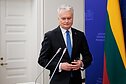
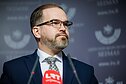

Despite intense discussions among NATO countries, the forthcoming Vilnius summit will manage to agree on commitments to Ukraine that will not disappoint the country fighting Russian invasion, Lithuanian President Gitanas Nausėda says.
Ukrainian President Volodymyr Zelensky hopes that NATO members will agree in Vilnius to invite the country to join the alliance after the war. The Ukrainian presidential office says Zelensky will refuse to travel to the Lithuanian capital next week, unless he receives signals on this matter.
“I have a feeling that we will, nevertheless, agree on those wordings that will not disappoint the Ukrainians and will say more than what we are used to saying,” President Nausėda says in an interview with BNS.
Some NATO countries will come to Vilnius with commitments to provide security guarantees to Ukraine, the Lithuanian leader says, and there’s already agreement on the establishment of a NATO-Ukraine Council to strengthen Kyiv’s integration into the alliance.
Mr President, there’s still a lack of unanimity in the run-up to the summit as to what NATO should promise Ukraine. Are you sleeping soundly?
No, not lately, but I don't know, maybe not only because it's an important event.
Yes, indeed [...] some issues are still pending, but I think it's a matter of the next few days. And, well, I have a feeling that we will, nevertheless, find those wordings that will not disappoint the Ukrainians and will say more than what we are used to saying.
Yes, NATO’s door is open, but it opens very quickly for some countries, while others cannot find that door, and I think the Ukrainians are quite rightly raising the issue of not being a member of NATO today yet. They are saying: we understand that and we respect your decision, but you must also respect us and say what about tomorrow? So that is the main discussion now, and I wouldn't say it's an argument, but we probably have a slight divergence of positions as to what we can say and what we cannot say yet.
But for me, the success will be if we say more than we said at the Bucharest Summit. We will add what we have already foreseen and what will certainly be in the NATO documents, namely the Ukraine-NATO Council and bilateral assistance.

I think that individual countries will come to Vilnius with their own packages of additional support. Symbolically, they want to do it in Vilnius. President Zelensky, I hope, when he comes to Vilnius, will certainly get perhaps not quite what he's hoping for in his maximum plans, but he will certainly get quite a lot.
Ukraine will not be invited to join the alliance in Vilnius, that's clear already. Nor probably it will get the promise to be invited to join NATO after the war. Don't you have a feeling that you're negotiating for a minimum goal?
I wouldn’t put it so categorically that they won't get invited [to join] after the war in one form or another. That's what we're discussing now. It will not be a minimum agenda because a minimum agenda would probably be a mere repetition of what Bucharest is saying, plus the NATO-Ukraine Council, and plus that support commitment.
[...] I think we'll go beyond the minimum agenda, but I just don’t want to get ahead of ourselves. In any case, we certainly have not one, not two and not even four countries that, well, would like to have a more ambitious text, and right now we are having an ongoing dialogue between those countries and the more cautious countries, and I hope we'll have a mutually acceptable result in the end.
Despite all the problems we have discussed, and probably not the commitments to Ukraine that Lithuania would have hoped for, NATO and Ukraine will certainly strengthen political ties in Vilnius. The establishment of the NATO-Ukraine Council will be agreed and its first meeting will formally take place in Vilnius.
The inaugural meeting, yes.
What difference will this make to Ukraine's situation on the road towards NATO?
We will have a very clear platform and at the same time a rather authoritative and influential platform to have a close business relationship between Ukraine and NATO. I think that contacts between Ukraine and NATO will intensify in all areas. [...] In fact, this is already happening, the Ukrainians are learning to use Western equipment, technology, they are doing it very quickly and, to tell the truth, they are probably surprising allies by mastering things for which ten times more time is allowed. They are doing it very efficiently, and it's understandable. This is a nation fighting hard for its freedom [...]. So I think the ties between Ukraine and NATO will become even closer, and we, in fact, will already start to prepare for Ukraine's membership this way, in the good sense of the word, by simulating the processes as if Ukraine were already a NATO member. [...]

Next week, the leaders of the powerful NATO countries will bring to Vilnius their commitments to provide Ukraine with additional arms and provide further economic assistance, and they will call them security guarantees. Are they satisfactory?
You better ask Ukrainian President Volodymyr Zelensky whether he's satisfied. I think that all his actions and all his activities so far have a very strong military component. In fact, the president probably doesn't have the time and the opportunity to talk about the weather or geopolitics in the broadest sense of the word, therefore, his speech, his conversations, and our conversations with him, are businesslike. We have no time for emotions amid the ongoing war when people are dying every day, every hour, every minute. That's why the implementation of those declarations the Western countries have made a number of over the last period is extremely important to him because Ukraine's ability to defend itself and, at the moment, to launch a counteroffensive depends on that.
So, I say, yes, it will be important for him. And seeing the attitude of my counterparts to go that extra mile and help in whatever way they can, seeing these things, I think he should get some good signals here.
NATO countries are now in the process of agreeing on new regional defence plans, and you yourself have said on several occasions that the goal is to agree on them before the summit. We are talking on a Tuesday, which means we have exactly seven days until the summit, will that be done?
You know, sometimes it's a last-minute thing. Do you remember when in 2019, in London, it was not clear until the last minute whether Turkey would not block the Eagle Defence plans [the previous regional defence plans]. We still had that uncertainty on the eve, and then we were already taking pictures with [Turkish] President Erdogan the next morning, all the countries in the region, and were welcoming the last-minute decision.
Some people like to keep the intrigue until the last minute. Perhaps the decision itself looks all the more joyous afterwards when it comes almost as soon as the curtain has fallen, but I think we should avoid last-minute decisions to have calmer and more coherent work.
Can you confirm that Turkey is still blocking the new defence plans?
I don't want to confirm that; you just see the fact. It hasn't been done yet. There's not much time left, and the aim was to have (the plans) approved before the Vilnius summit.
Time is pressing. The implementability of these plans is another matter. We're already talking only about the end of this year as a possible [date of] preparation for their actual implementation. In the meantime, what's happening around us right now and what we aren't really happy about – Prigozhin and other things – requires having it all in place as soon as possible, not just on paper, but in reality, because it's a question of our own security and survival. This is why we're in favour of a faster process.

Are we going to hear, during the summit, concrete commitments from the allies to Lithuania on the rotation of the deployment of ground-based air defence systems in the country?
I hope that the principle will be established, because there's consensus on it, which I'm pleased to note. Will we have an outline of how this will be done? We're at too early a stage [to say] and, judging from my conversations with my colleagues, everybody understands that this has to be done because there's no other way. Everybody understands that the air policing regime is, of course, sufficient in peacetime, but we also have to prepare for somewhat different scenarios, provocations or whatever, and air policing isn't enough for that; we need air defence.
Air defence on a permanent basis isn't possible at the moment because of the total lack of supply, so the rotational air defence model proposed by us, the countries of the region, – where everyone contributes what they can and then we form a certain structure of the air defence system – is the most appropriate. But I don't think that we'll have any specifics on this until the Vilnius summit. However, until we have a principled decision that this is necessary, we'll not be able to get to specifics either. This first step may take some time.
Shouldn't Lithuania acquire a long-range air defence system itself?
That will take even longer. You know what the delivery times are. Of course, we can plan a few years ahead, but we'd need functioning systems, or at least fragments of them, very soon.
Poland has recently announced that it's sending a contingent of Special Operations Forces to Lithuania to protect the summit, and President Andrzej Duda is coming to Lithuania to observe a SOF exercise. The Polish side has said that the deployment of the contingent reflects agreements between you and the Polish president on closer defence cooperation. Recalling your recent statement that the Poles have offered Lithuania something interesting...
We'd like this to be more than a one-off nice gesture that ends once and for all after the July summit. I think this is the beginning of something more serious. The Polish side is very well aware of the vulnerability of the Suwalki corridor. Poland is very serious about the recent developments in Belarus and the Belarusian threat, (and) the emergence of the Wagner group there, which is still hypothetical, but which may happen.
Here, I very much like their position that they are treating us as one region and that they are not only taking responsibility for themselves, but are also thinking about their neighbour, who is close and has really very good relations with Poland. I appreciate them very much, and I think that the fact that we can talk about more concrete forms of military cooperation, not just declarations, is, among other things, a result of my personal relationship with President Duda.
Last week, you called Wagner mercenaries "serial killers" and warned that they might try to enter Lithuania by posing as irregular migrants. How should Lithuania react to this? What should it do additionally?
We already took note of this at the State Defence Council's meeting last Sunday, and it was mentioned there, among other things, that we have to agree as swiftly as possible on new border cover plans and on the strengthening of the intelligence capacity on the eastern border, which has been done, and at this point I think that would be sufficient as far as this is concerned.
On the other hand, [...] we have that decision, that law that we adopted very recently, which, despite my veto, failed to subject people with Belarusian citizenship to the same legal regime at the border and for certain operations in Lithuania as that for people with Russian citizenship. Certain exceptions were envisaged for Belarus.
Naturally, I have nothing against the Belarusians as a nation, but Belarusian citizenship can be obtained simply by acquiring a Belarusian passport, and we have also seen cases where well-known people have, for example, not only a Russian passport, but also a Belarusian passport. Thus, people of unclear origin with Belarusian passports and with unclear intentions can apply for entry into Lithuania. I’m not saying it has to happen right here, tomorrow or something like that, but could anyone (...) deny that such a possibility exists? Given that this is a great lever in the hands of an unfriendly regime, why would the Wagner group not use such a lever?

Newsletter
Every Friday morning.