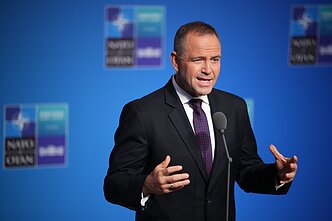


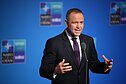
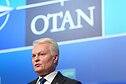






NATO Secretary General Jens Stoltenberg, who is visiting Lithuania, says the alliance will support Ukraine for as long as necessary. “We are sending a message to Putin that he will not win the war,” he told LRT TV.
Mr Secretary General, what is the main obstacle to inviting Ukraine to join NATO at the Vilnius summit?
I think all the allies realise that Ukraine is in the middle of a war, and this is not a good time to invite it to join. But all allies understand that the door remains open, and we have demonstrated that with Finland and Sweden.
All the allies realise that Ukraine will become a member, and it is up to the allies to decide when Ukraine is invited to join NATO. But most importantly, the allies understand that the most important thing now is to support Ukraine. If we don’t do that, Ukraine will no longer exist as an independent country. And if it doesn’t exist as an independent country, the question of its membership becomes meaningless.
You have repeatedly said that NATO will support Ukraine for as long as necessary. Does this mean that NATO is prepared for a long war?
It means that we have to be prepared for war because wars are unpredictable, wars can last a very long time. President Putin has started a war, and he can end it, but at the same time, we know from history that wars last much longer than expected.

President Putin may think that he will defeat us, but he is wrong. He must realise that he will not achieve his goal by using the armed forces. It would be a tragedy for the Ukrainians if President Putin wins there. Then, there would be no democratic, independent Ukraine, and this is important for all the allies – Lithuania, Norway, and other countries.
You don’t have to explain what Russia is to Lithuanians. My grandparents were exiled to Siberia, many Lithuanians suffered from it, and now Ukrainians are suffering from it. They are being killed every day and night, and they are being killed as we speak. Do you believe when you say that Putin can stop the war? Does he want to stop the war?
No, we don’t have any indication that Putin wants peace and wants to stop the war. I want to say that it was his decision, the Kremlin’s decision, to start the war. And I think that we will have to wait a long time, but Putin started this war, and he can end it.
However, our main response is to help Ukraine with military aid. The Ukrainians need to liberate their lands, they need to take them back, they need to be strengthened before coming to the negotiating table. And we are sending a message to Putin that he will not win the war. Nobody can say when the war will end, but we have to realise that as long as we support Ukraine, and we will continue to do so for a long time, Putin will not be able to defeat us.

Do you see any signs that NATO countries are willing to supply Ukraine with long-range weapons, ie weapons that could attack targets in Russia, such as ammunition depots, and thus provide security for its people?
As NATO allies, we are providing a number of advanced weapons, including the HIMARS rocket launchers, the Storm Shadow cruise missiles that were delivered by the UK. These are long-range weapons, and they have an impact on the battlefield. They are very accurate and very effective. The NATO allies have also decided to train pilots to fly F-16 fighter jets and fourth-generation aircraft. And this is another important help for Ukraine when the NATO allies decide to supply aircraft as well.
Leaders in some Western countries say: “Let’s not provoke Putin, let’s not escalate the conflict.” But what could be worse than what Putin is doing now?
There are always risks when we are in the middle of a war in Europe with a brutal aggressor like the Kremlin regime. Of course, there is no risk-free option, but the biggest risk is that if Putin wins, it will be an incentive to aggression once again.
So, I think that we have to help Ukraine, and the NATO allies are providing support. Initially, we supplied a lot of anti-tank systems, artillery, air defence capabilities, battle tanks, and now we are supplying missiles and we have started training F-16 pilots. This allows us to see that the Ukrainian forces have pushed out the Russian forces in the north of Kyiv, and it was yet another demonstration of the determination and courage of Ukrainian forces. It is precisely this kind of counter-defence that was based on the capabilities we supplied.

But courage is not enough when you have to fight, say, artillery from the left bank when Kherson or its settlements are shelled. Is it possible to supply more?
The courage and determination of the Ukrainian government and forces have been very important factors on this battlefield. And we are all committed to helping them. They have managed to repel the Russian forces, but they also need equipment. They need armoured vehicles, and the allies, including Lithuania, are providing them. We need to do more, and what we started last autumn, which was the supply of weapons, is not enough. We must not only use our stocks but also produce weapons so that we can continue to help Ukraine.
Russia is blackmailing the whole world with nuclear weapons. Can NATO feel safe seeing what Russia is doing at the Zaporizhia nuclear power plant?
First of all, we must distinguish between nuclear weapons and nuclear power plants. We are following what is happening very closely and, so far, we have not seen any signs that there are plans to use nuclear weapons. However, we must remain vigilant.
It is, of course, very dangerous to put the largest nuclear power plant in Europe at risk, and Russia should not do so, which is why the International Atomic Energy Agency is involved in these matters. There are experts and specialists involved to help minimise the risks.
What advice can be given to prevent a tragedy if a plant is mined?
But we know that wars are dangerous, especially wars around nuclear power plants.

That is what we are talking about.
And that is why the only sustainable and good solution is to end this war. And when we have a president like Putin, who shows no sign of wanting to end the war, we must help the Ukrainians to end the war.
If NATO had the will and the ability to end this war, would that be theoretically possible?
NATO has two tasks. The first is to provide support to Ukraine as we have been doing and for as long as necessary.
Which means for as long as the war lasts?
Yes, because Ukraine needs to be an independent country for Putin to realise that he has to end the war. And the other task is to prevent this war from escalating, to prevent a war between NATO and Russia. That is why we are not deploying NATO troops, we are not directly involved in the war, but we are providing support to Ukraine and ensuring its right to defend itself.
It doesn’t seem like a great achievement when you say that Ukraine has the right to defend itself. Of course, it does. How could it be otherwise?
I mean that this is enshrined in international law, and that is why we are saying that, by helping Ukraine and ensuring its right to defend itself, we are not getting directly involved in the conflict ourselves.
Can you share your thoughts on Prigozhin’s march to Moscow, which ended very oddly?
I think that the events of the weekend in Russia show the fragility and weakness of the Russian regime – a dependence on the marshals, who can then turn against you. However, we have to remember that these are internal Russian issues. We must not underestimate Russia, and we must continue to support Ukraine.

Newsletter
Every Friday morning.