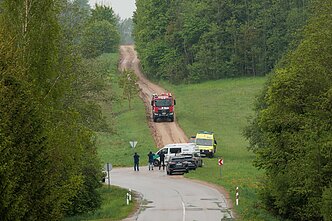










In a case that remains murky, a former Belarusian fighter in Ukraine has been found dead in an apartment in Vilnius. The one suspected of murder is his comrade; both had allegedly turned to psychologists upon return from combat.
The tragic story focuses on two Belarusian men, both aged in their early 20s, who came back from the war in Ukraine in August. They had fought since March as part of the Kalinowski Battalion, a Belarusian outfit that later attracted hundreds of volunteers and grew to the size of a regiment.
Although the exact figures are not public, scores of Belarusians have been injured and at least several dozen have been killed. There are also Lithuanian volunteers serving among the Belarusians.
The brutality of the Russian invasion and the intensity of combat has scarred thousands if not millions in Ukraine, both physically and mentally. Now, the same lingering fallout from the war has reached Lithuania.
Last December, the two men – Alyaksei and Vladimir (names changed) – were spending an evening together, months after returning to Vilnius from Ukraine. Both had sought psychological support, but were adapting to life at home, according to Alexander, the father of Alyaksei. He would not disclose his surname for fear of repression against the rest of the family that remain in Belarus.

Because the pre-trial investigation is ongoing, the witness statements of what happened that night could not be made public. What’s certain is that Vladimir received a stab wound and was declared dead. Alyaksei was then detained on suspicion of murder. He has remained behind bars ever since.
Defenders of Alyaksei claim he did not kill his friend, but, on the contrary, was trying to stop him from suicide.
On June 16, around a dozen protesters gathered at the prosecutor’s office demanding a polygraph test for Alyaksei, as all other means to prove his guilt, or innocence, have allegedly failed. His detention has now been extended to July 18.
“All sorts of medical and psychological examinations were carried out,” said Alexander, the detained man’s father. “None of the expert examinations proved his guilt.”
LRT attempted to contact the mother of the deceased via Alexander, but without success.

Now, the man has announced a hunger strike, asking to be tested using a polygraph, a method that can indicate whether a person is lying.
The process may also be used in criminal investigations, however, it cannot be the sole method to prove, or dismiss, accusations. And although it cannot be presented as evidence, a polygraph test can still be used in a trial to argue a person’s guilt or innocence.
Regardless of what happened that night, the case exemplifies the need to address trauma when soldiers return home. And even if the link between combat and the man's death are not established, such cases may give time for Lithuanian institutions, and society, to prepare.
In September last year, Ukraine’s Health Ministry said it expected 15 million people will require psychological support after the war, including soldiers. Since then, the number has undoubtedly risen.
According to recent studies, nearly a quarter of the Ukrainian population may be suffering from PTSD. The rates are likely higher in the military. Suicides have already been reported in Ukraine, including among serving personnel. One officer, profiled by the Washington Post, said he lost 16 people in his brigade over several weeks, two to suicide.

Although there are no official figures, dozens of Lithuanians have joined the fight in Ukraine, some were injured, many returned home, some others have stayed. Similarly, dozens of Belarusians who fled Belarus left their families in Vilnius and went on to fight in Ukraine.
"So far, there are no horrible examples like in other countries, where people are shot [by a veteran] in a shopping centre, but it doesn't mean there won't be any cases like that in the future,” Rosita Kanapeckaitė, a psychologist at the Lithuanian military academy, previously told the Karys newspaper.
Speaking later to LRT.lt, she said the main problem is that civilian psychologists are not adequately prepared to treat those coming back from war.
"[They] do not have enough knowledge about the war itself and what it is like to be there. A soldier then faces the fact that he was at the front and had to kill and now he has to explain it to the psychologist,” she said. "Now all [psychologists] need to know how to work with post-traumatic syndrome."

Traumas affect not only combatants, but also the scores that have gone to Ukraine to volunteer and bring aid.
"There are many more volunteers who are contributing to the war in Ukraine, and the traumatic experience is affecting them as well, and they also live among us," said Kanapeckaitė.
Even Lithuanians without any direct contact with fighting in Ukraine are affected, she added.
"With the war in Ukraine, [...] the sense of uncertainty has become an everyday thing," she said. "Both the Covid pandemic and the war in Ukraine have triggered a sense of vigilance [that leads to the fight-or-flight response], and it hasn't gone back to that pre-pandemic period."
Together with their Ukrainian counterparts, Lithuanian military psychologists are now analysing whether the existing PTSD-treatment training is sufficient.
"We are testing whether the theoretical models that are out there, that commander, peer, family support and in general those resilience building programmes are effective and what helps," said Kanapeckaitė.
"The most important thing is that the person who is experiencing difficulties has the opportunity to both ask for help and receive help from those around them," she added. "The conclusion of the study is that there are too few military psychologists in Ukraine. The other takeaway is that not only military psychologists need to be trained [to work with PTSD]."

A committee set up by Lithuania's Union of Psychologists aims at improving the effectiveness of treating trauma. According to Kanapeckaitė, specialists able to treat PTSD were not in demand before the war in Ukraine.
"The main function is to look for ways [...] if they don't have the knowledge of how to work with post-traumatic syndrome, how to get it. Because until now, there has not been a need for more specialists than there were," she said.
In a written comment, Lithuania’s Health Ministry provided a detailed list of available support options (the full list is available here). Crucially, since January, those diagnosed with PTSD can receive a ten-day in-hospital rehabilitation or 50 hours of consultations.
Lithuanian hospitals now also offer psychosocial rehabilitation lasting up to nine months, which includes 100 hours of consultations, according to the ministry.
"People who have been involved in hostilities can also seek support from emotional support hotlines. Volunteers and mental health professionals provide help there,” the ministry added.
In emergencies, family members or those affected can call 1815. Operators of the hotline can also dispatch mobile teams that provide help on the spot.
"In 2022, more than 65 people have been assisted as a result of the devastating events related to the war in Ukraine," said the ministry.

Newsletter
Every Friday morning.