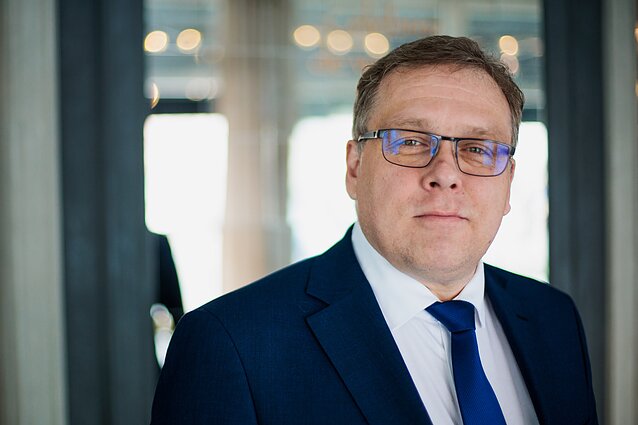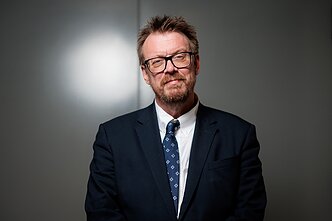











Estonia may become the first Baltic country to legalise same-sex marriages. According to Lauri Hussar, the newly elected president of the parliament, the changes are the result of a more united country. In an exclusive interview with LRT, Hussar discusses the same-sex legalisation law, the future of digital Estonia, and Russia;s threats to the Baltic states.
With the new government in power, what is the next chapter for Estonia?
The next chapter for Estonia is to fulfil all that we have signed in our coalition treaty. It is a really ambitious coalition treaty, probably one of the most ambitious in the last 20 years.
We have to bring the state budget into the order, we have to increase some taxes. Very soon, in two or three weeks, we are going to adopt the same-sex union and same-sex marriage laws. Another big step ahead is that from the minister of economy, we made the minister of economic affairs and IT. One of the main tasks for the minister will be the building of a so-called Estonian personal state, we will start to design personal services for every citizen. [...]
If there is a social need and you don’t have enough income, there should be a way to understand that you need help, and it should be very automatic.

Of course, we want to make the green turn in energy, to build up the big windmill parks into the sea and land. We want to get rid of the polluting oil shale energy. It will take some time, but our goal is to get rid of the oil shale factories before 2050. So hopefully, we will succeed very soon. If we're talking about the perspectives, probably the oil shale as a source of electricity could be history already in 12-13 years. But the closure of the oil shale chemistry is a bit in a longer perspective, but we'll see when the time is right.
One very big step ahead is to make big reforms in education. We want to bring more money into higher education and also to the lower level, to increase the salaries of the teachers, invest in the small schools and there must be very clear criteria in which circumstances are we going to close these schools, because the idea is to hold them open until the sixth grade.
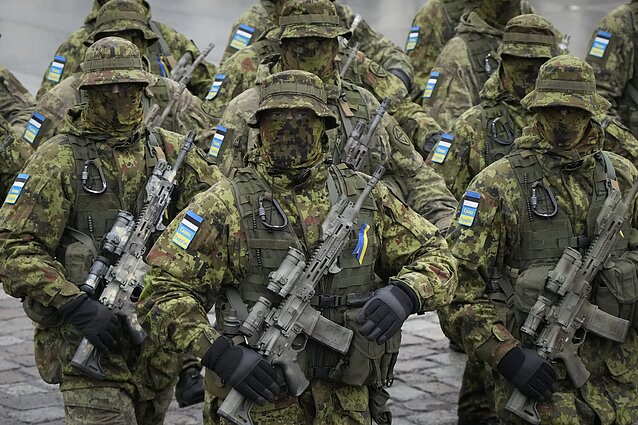
And of course, [we plan] to increase our defence budget up to 3 percent of GDP. There is a lot to do ahead, we have to build up our middle-range air defence system, we have to do it from our own budget, but we're working on this.
Further reading
You mentioned personal help to every citizen. Could you give an example of what kind of help that would be?
If there is a social need and you don’t have enough income, there should be a way to understand that you need help, and it should be very automatic. Also, combining the social and healthcare systems – it is very important to see when somebody is already in a socially problematic situation and when they have healthcare problems. If we would help them on the social level, probably there wouldn’t be such huge problems with their health. So [the systems] must be combined. It is a long process, but we have to start, because it's what modern technology allows us, and we have to work on this.
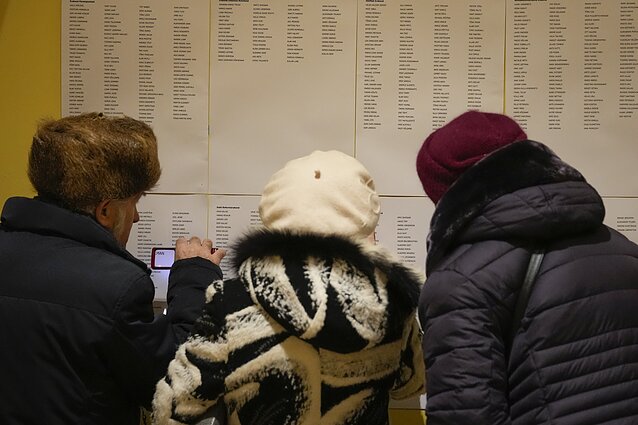
There are many personal services like e-voting or everything going through our digital identities. We have to develop [digital personal state], we have to develop it quickly and to be at the forefront. Just to give an example, already for several years, we have digital receipts for pharmacies.
I heard two weeks ago from my Latvian colleague that Latvia is going to implement this system and I know that Lithuania is using the same [system], so these are the things that push us further. That means that if I will have a necessity to buy my medicine here in Lithuania, I can do it with my receipt, which is written in Estonia.
You have a lot of trust in technology.
Yes, but as a small country, we should be at the forefront. In 1996, the former president, who at the time was the ambassador to the United States, Toomas Hendrik Ilves wrote his article about the Tiger leap of Estonia in IT. And his very first idea is that we should go with IT into schools to teach the pupils more about IT and technology, and it has been quite a success, because in five years we actually implemented our digital identity […] and this ID card changed a lot in the society. This has been the real Tiger leap for us, but now we have to make another leap forward. The digital personal state is a thing that we have to implement.
As a small country, we should be at the forefront.
Further reading
You also mentioned same-sex marriage. Lithuania is discussing a civil partnership law, but you are already considering same-sex marriage. Could Estonia be the first of the Baltic states to allow same-sex marriage?
We'll see in probably four weeks. I hope so, because we have the Liberal government, we have the liberal Reform Party, we have the social democrats, and I am myself from the party Estonia 200. We are the only party which has same-sex marriage in our programme. So, therefore, I think we're going to do it.
Also, according to the last polls, more than 50 percent of Estonians are supporting same-sex marriage. So it is not an issue like it has been six, or seven years ago, the mood has changed. And I think the mood has changed also, because of what happened in Ukraine, because the war brought us to the real problems and what is really important for us. It united us in helping Ukraine and also brought us to the roots of liberal democracy and therefore, I think it brought us to think about what is important for us as a society.
According to the last polls, more than 50 percent of Estonians are supporting same-sex marriage.
This topic is not divisive in Estonia?
It is still of course, there are a lot of [people] also against it, the church and the conservatives have said that they are against it, they had demonstrations with 1,000 to 2,000 people. So, there is still a stand against it, but you can't compare it with what was six, seven years ago.
I want to point out one very interesting thing, that in every society where same-sex marriage has been legalised, it hasn’t been any issues anymore, because the issue has been closed and the society moved forward.
And almost everybody felt that now it is a little bit more equal society than before. And I think this is what we have to do, because if we were making the civil partnership decision, then there is still another decision ahead, the same-sex marriage decision, and you will have to make it anyway. So why make two steps? And anyway, it is too political. […] We hope to adopt the law before July, to make it once, I think it is reasonable enough.
But such sensitive topics can divide society, we see that in Lithuania as well. And this might be used by our neighbour, Russia. Do you see any issue here?
Yes, but the problem is that Russia is always trying to use the weaknesses of all societies and turn us against each other, we saw it also during the coronavirus times, we saw it in very many issues. So I think our goal is actually to stand against it, to be strong enough to fight against this psychological war. In this info war, we have to be aware of their weapons and we have to be tactically and strategically strong, we have to understand what these influences and info operations are and how they are made and guided by Russia and we have to fight against it.
We are living in an information society where the main power, which turns everything around, is information. It means that we have to be very aware of how information has been used against us and fight it.
Actually, if we're talking about a democratic society, responsible citizens should know how to gather balanced and trustful information. And therefore, we have to make a turn in schools for our kids. What is important is that they should not follow only social media, but they should get the information from the traditional media about what is going on in society, to make balanced and wise decisions.
If we're talking about a democratic society, responsible citizens should know how to gather balanced and trustful information.

Further reading
As a former journalist, who understands the value of information, do you think Estonia is winning against Russia’s propaganda? Especially considering that there is a more vulnerable part of Estonia’s population – Russians and Russian-speakers.
The war in Ukraine changed a lot in Estonia. Before the war, the Kremlin influence in Estonia was much, much bigger than it is now. I saw significant changes because we closed all the Russian channels. Of course, probably they watch it on the internet and through other ways that they have, but still, I think significantly less than before.
The younger generation started to watch more Estonian channels. The Estonian public broadcaster has a Russian-speaking channel, we have the radio, different internet news channels, and the following of these channels has increased after we closed the Russian TV channels.
So, I would say that the interest for the balanced information on what is going on locally in Estonia has increased and I hope it will continue. Of course, we have to work a lot to bring up especially the young generation with their faces towards Europe, towards Estonia and there has already been success, but this is not enough. In some years we have to finish our school reform, where we are turning the Russian-speaking schools into the unified Estonian schools where the kids are learning in Estonian language. This is a big task and I think we will succeed, but it needs huge resources.
What threats do you see that Russia poses to Estonia and the Baltic states?
We have the same questions between us [the Baltic states]. Of course, there are the military, psychological threats, also the hybrid threat, like the migration crisis on our borders. […] I know that you prepared a lot, we are doing the same and our partners in Latvia are preparing to avoid such kind of crisis from the Russian side.
But of course, the main goal for us is to help Ukraine. The Baltic states are the biggest supporters of Ukraine by GDP per capita and I think we should be proud about this. Our only goal is that Ukraine would win the war, which would bring Russia to a situation where Russia has to withdraw all its troops from Ukrainian territory so that Ukraine could build a new, democratic and modern country, which will be a member of the EU and NATO. If this happens, it will change the whole continent. And then we have to wait if any changes are ready in Russia. But let's see, the first step is, of course, that Ukraine would win the war.
The Baltic states are the biggest supporters of Ukraine per capita, and I think we should be proud of this.
But it seems unlikely that Ukraine will be offered membership into NATO during the summit in Vilnius. Would such a decision be disappointing or rational?
I think there will be a message for Ukraine and we're working very hard to have this message. Your parliament made already a decision on this in April, we did it in May and the Latvian parliament did it. Recently, we heard that 20 chairpersons of the foreign affairs committees from the parliaments of the NATO countries have made the same statement, the chairman of the US Senate Committee on Foreign Affairs also made it. So, therefore, I think it has been quite a strong message. And therefore, I hope that we have still enough time until the summit in Vilnius in July so that there would be a very clear message.
But we have also another problem to solve – our very close neighbour Sweden is not a member of NATO. And we must find a solution with Turkey and the new government of Turkey so that Sweden could join NATO as quickly as possible, because it's in our own interest to bring more security into the Baltic Sea region.

What do you think will happen now in Ukraine?
There will be the Ukrainian counterattack and I think today the conditions are very good for this one. And then we are going to see what the balance of the two sides actually is. But I still think that Ukraine has one very, very big advantage – they know what they are fighting for. And I think the spirit of the Ukrainians is by far stronger than the Russians’.
I think the spirit of the Ukrainians is by far stronger than the Russians’.
Estonia in different democracy rankings scores high, so congratulations on that. But I want to ask, what threats do you see to your democracy?
I think the biggest problem for democracy in today's information society is that people are getting tired of politics, they don't care anymore. If there are too many scandals or they are getting too disappointed, then they don't care anymore and the choice becomes more in favour of the populists.
If there are too many populists and there are few wise decisions, that could be a problem for the whole democratic world. So, we have to work so that people would not become tired of politics, of making wise decisions about who is representing them.

Newsletter
Every Friday morning.