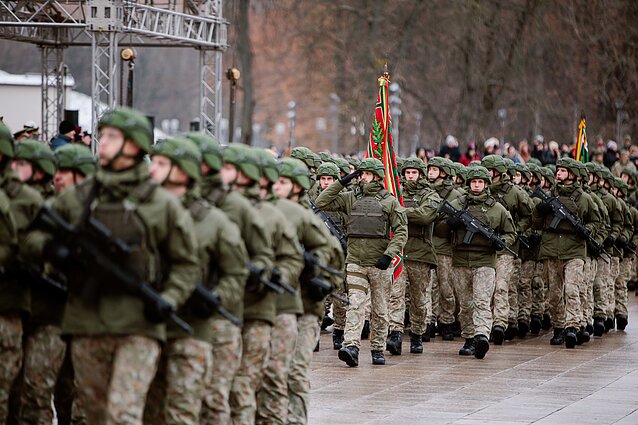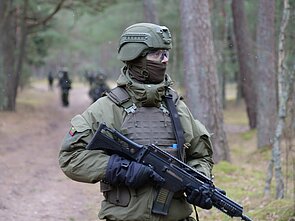













On Monday, Lithuania’s leadership approved plans to set up a division – the country has never fielded a military unit such size. Although the move looks good on paper, defence experts say the country’s military now resembles a one-battle army and much needs to be done for the plans to become a reality.
"The first responder unit that should be in Lithuania should be at least a divisional unit," which would have around 17,500 troops, said Lithuania’s Chief of Defence Lieutenant General Valdemaras Rupšys.
Further reading
The move to establish a division was welcomed by the former commander of NATO's Combined Forces Command in Brunssum, Retired General Jorg Vollmer, who was also in charge of the defence of the Baltic states,
"[But] what should really be avoided is a paper division," said Vollmer.
"You have to bear in mind that it will require a lot of money because a division is not a divisional headquarters, a division is a unit that commands several brigades, usually three, all of which are capable of going to war," he added.

Officially, Lithuania now has two brigades, with around 11,000 soldiers in full-time service.
"There is a lot of undone homework. Realistically, we can say that the first brigade Iron Wolf is being finalised, but Žemaitija [brigade] is inexcusably light and incomplete, and the reserve brigade Aukštaitija is just a name and a flag," said Locked N' Loaded, a group of Lithuanian military bloggers.
An answer could be conscripts, but weapons fielded by the military require extensive training, and the armed forces need more of them in the first place.
"We need mobile air defence, we need additional artillery, we need additional rocket artillery,” said Artur Plokšto, a lecturer at the Military Academy.
Reconnaissance units would also require drones capable of collecting data beyond 100 kilometres, which is now the working range of the country's new artillery systems. For air defence, the mid-range NASAMS system fielded by Lithuania is no longer enough to create the defence area of a division.
According to Rupšys, the current chief of defence, all of this is needed even without creating a division. "We need to have those eyes and ears, and we have budgeted money for that," Rupšys said.
Defence experts say that a light division would be the best option for Lithuania, but the country also needs tanks.
"Without tanks, you cannot have any illusions of counter-attacking [and] any defence without counter-attacking has no meaning," said Retired Colonel Gintaras Ažubalis.

Lithuania plans to acquire 50 tanks, the military chief said. But even so, this leaves Lithuania “very naked”, added Ažubalis.
"Around 100 tanks are needed for the division to have an influence on the battlefield," Plokšto added.
The cost to establish a division is also staggering when compared to Lithuania’s current defence budget.
"In Poland, a new division is now being formed from scratch, and they have calculated that it will cost 17 billion euros," said Plokšto. "Poland bought the K2 tanks, and one unit costs around 19 million euros."
Lithuania may need up to 6 billion euros, which is three times as much as this year's annual defence spending. Currently, it accounts for over 2.5 percent of GDP.

According to former Lithuanian military chief Arvydas Pocius, defence spending of "3 percent over the next 10 years" would be enough to establish a division.
And until that is achieved, all hopes are pinned on the allies. The creation of a division is also aligned with NATO defence plans.
"The allies and the United States promise to compensate in part, ie by having an [allied] division [assigned to Lithuania] before we create our own," said Defence Minister Arvydas Anušauskas.
According to Vollmer, the former NATO commander, the brigade promised by the Germans could also be part of the division.
"The decision was taken to assign a permanent brigade to the defence of Lithuania, but that does not mean that it has to be permanently deployed in Lithuania," Vollmer said.
The German army is also facing its biggest challenges since the fall of the Berlin Wall, from a shortage of soldiers to a shortage of weapons.
Further reading

"I see a very, very low probability that everything will be ready on time and deployed as promised,” said Joachim Weber, an analyst at Germany’s Kiel University. “It will be to some extent, but I don't see a fully operational division, I don't see a fully operational brigade in Lithuania."
People with close ties to the Lithuanian military say there is still much to be done, adding that Lithuania’s military is now a one-battle army.
"The Lithuanian military has been simulating deterrence during the post-independence period rather than building lasting combat capabilities. Changing this requires a mental shift, starting from the rank and file to the president," said Locked N' Loaded.
Rupšys, head of the military, says that attitudes are changing. "We are now [seeing] clearly that this threat [from Russia] will remain for decades to come," he stressed.

Newsletter
Every Friday morning.