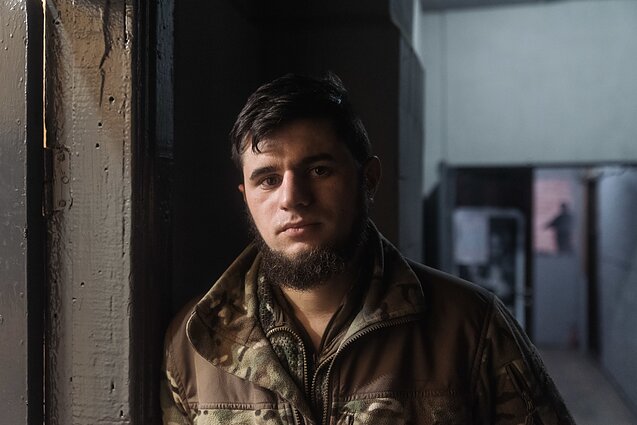










Ukraine is mourning the death of Dmytro Kotsyubaylo, a decorated soldier and the country’s youngest commander better known as Da Vinci. He was killed near Bachmut in Donbas on March 7. On the eve of Russia’s full-scale invasion, LRT sat down to speak to him in a base near the frontline. The interview was never published before.
“When the war started, I was 18, and now, I’m 26. And all these years, I’ve been at the front almost without rotations,” Kotsyubaylo said at the time. “We have been living in a state of war for eight years, and that is why most European countries do not understand us because they do not face this.”
“And we are facing the fact that tomorrow Russia could attack us,” he added.
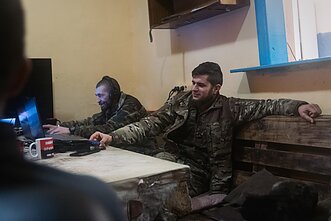
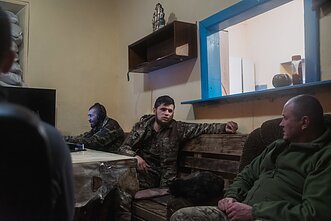
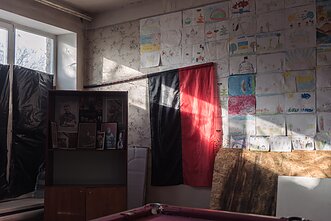
On the morning of February 24, Da Vinci and his men would leave the base that had become a pro-Ukraine bastion in Avdiivka, Eastern Ukraine, complete with a mural of Stepan Bandera, Ukraine’s nationalist icon and Russia’s boogeyman, as well as a pet wolf. The unit was known as Da Vinci’s Wolves.
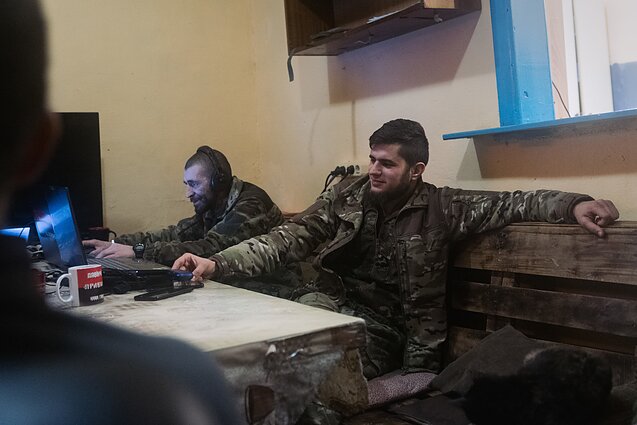
Kotsyubaylo was the country’s youngest commander, leading men into battle from the age of 21. He chose the Da Vinci nickname because of his dream to study art, which he abandoned when the Maidan revolution began. In 2014, he joined the Pravy Sector (Right Sector) volunteers that resisted the Russian-led separatism wave sweeping across Eastern Ukraine.
They later became the Ukrainian Volunteer Corps (DUK), which never became part of the Ukrainian Armed Forces and functioned as a paramilitary force under the auspices of the Defence Ministry. They also lacked heavy weapons or funding, using help from volunteers and captured loot from the Russians to reinforce their outfit.
In the first months of Russia’s full-scale invasion, they continued working as they did throughout the war in Donbas – getting in contact with a local Ukrainian brigade, offering their help, and entering the fight in a particular stretch of the frontline.
Only later in spring, they were incorporated into the ranks of the official military, ending the group’s path as an independent outfit that had existed alongside its political wing.
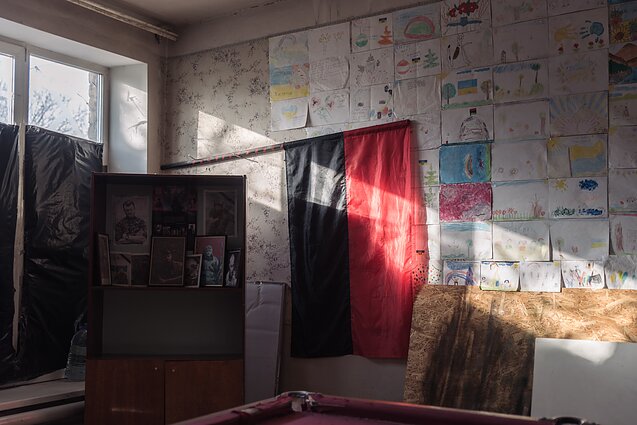
Like the Azov Regiment, the Right Sector had been at the centre of discussions about far-right nationalism in Ukraine. The group was a routine target for Russian propaganda, which labelled them “ultra-nationalist”. The tag stuck, even in Western media.
With this context in mind, we sat down to speak in their Avdiivka base, just days before the Russian invasion. The topics that dominated our conversation focused not on the impending tragedy but on nationalism, Ukraine’s future, and Da Vinci’s own place – and role – in it.
The interview has never been published before, hoping that we would have a chance to speak again, to build on the topic of Ukrainian nationalism. But the chance never came.
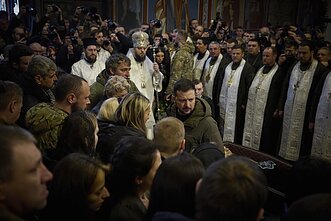
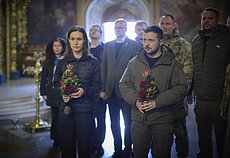
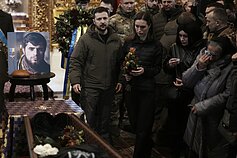
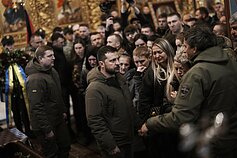
Thousands attended his funeral in Kyiv on March 10. Among those to pay their respects were Ukrainian President Volodymyr Zelensky, army chief Valery Zaluzhny, and visiting Finnish Prime Minister Sanna Marin.

How has your life been in the last seven or eight years?
It all started with Maidan, which was when the Right Sector was forming. And the Right Sector were guys who were ready to act, which appealed to me. [...] The Volunteer Ukrainian Corps was created because we were divided into several categories, such as the political party Right Sector, the Youth Wing, [and] the Volunteer Ukrainian Corps.
All these years, we had to take part in almost all the hotspots of the frontline and help, cooperate with the military. I was seriously wounded in Piskty. [...] But after the injury, I returned to the east. I didn’t even stay in the hospital for a month. I became a platoon commander, and we took part in almost all the hotspots of the frontline.
You received the Hero of Ukraine award in 2021. What did it mean to you?
It meant as much to me as it did to others because it meant the volunteers were finally recognised [on the state level] because many people did everything to prevent us from being here.
There were a lot of difficult positions in very, very difficult battles. We had losses, a lot of them were killed during various operations.
We actively cooperated along almost the entire frontline, helping the military, holding positions. These are hundreds, maybe even thousands of completed missions that we have carried out in the east of our country.

What should Lithuanians understand about the Right Sector?
First of all, we are volunteers, we are defending Ukraine, we are patriots of our country, we are not some ultra-nationalists. There are many different nationalities in my unit, including Muslims, different faiths. But we all have the only goal of defending our country.
We have an example in history, including the Ukrainian Insurgent Army (UPA), which fought against the Nazi troops and the communist regime that occupied our country at that time. So, we try to remember the feat of our ancestors.
We are ordinary citizens. Some are architects, some are teachers, some are agronomists, and some are lorry drivers, people are different. They are not random people who were simply lumped together. They are all ideological people who came to defend their country from different professions.
You said that when [journalists] call you “ultraright nationalists”, they don’t understand Ukrainian nationalism. What is Ukrainian nationalism?
Do you have nationalists, patriots in your country? Same with us, we have our own traditions, customs, heroes who fought for the homeland in different years. Why, for example, when in Israel someone says “Glory to Israel”, he is a patriot, but when you shout “Glory to Ukraine”, you are a Nazi?
We love our country. We want the country to join NATO because it is collective security. We want Ukraine to be in the European Union, for Ukraine to develop. We have an enemy that has been killing us for decades, hundreds of years, destroying our identity [and] nationality.
Maybe people are afraid of the word “nationalist”?
The Russian propaganda is so big that people don’t hear anything else. For example, I was travelling on a train. A fellow fighter comes up to me and says that there are journalists with him who would like to interview me.
Later, he sends me the interview, and I see that the headline says “ultraright nationalists”. I ask where did you get it from, we didn’t speak about it during the conversation.
He [the journalist] says, “I read it on the internet”. Well, if we take our information from Russia, from Russian sources, then we are all fascists and murderers.
Russian propaganda is so big that it spreads not only in Ukraine and Russia but in the whole world, including Europe.

Why do you think Russian propaganda makes such a monster out of you?
Well, we are the kind of people who will always defend ourselves, no matter what agreements you make.
It’s as if a neighbour came and hit your wife, took her away, took half of your house, and then said: “let’s negotiate”. I don’t know what you would do in that place.
There is a quote: You have to live your life in such a way that after your death, they will still be afraid of you. It’s Stepan Bandera. He was a leader of the Ukrainian nationalists who spread the word about Ukrainian identity and he was a threat to the communist dictatorship and the authorities. And until now, they are afraid of him.
Russia is dreaming about the restoration of the Soviet Union. [But] we will fight until our last drop of blood. We will kill them with such hatred.
We didn’t come to them, they gathered troops around our country, not us. You have been around here – have you seen a swastika or something? There are no such things here.
[...] You have to explain to the mothers [in Russia], why they had to send their sons to die. Because the Banderites are mythical, the fascists are mythical. Explain to the mothers why their sons had to die in Ukraine.
We can die at any time while performing our tasks. [...] We are volunteers, a volunteer unit that is purely based on an idea, on patriotism.
We’ve been carrying on for eight years. Yes, it’s really hard to motivate yourself and people for eight years, which feels like an eternity. [But] Russia has moved its troops to our border and the threat is still there, the devil is sitting in Russia under the nickname Putin, and we have to be always ready.
I heard you set up a museum.
We established a museum at the second base, where we train our fighters. Locals come from different parts of Donetsk and Luhansk regions to talk to us, to visit us, to hear the story of our unit, about the fighters who have died.

Are the locals interested in hearing stories from you and not what they see on TV?
Many people want to know and we are always open to dialogue. When they speak to us, they understand that we are actually ordinary people, not some radicals.
Is it a crime to defend your homeland? Is it some kind of radicalism? No, it’s just the defence of your country, it is the duty of every citizen. You have to show your civic position.
I’m ready to die for my country, and all my soldiers are ready to die for Ukraine. At such a difficult time for Ukraine, you cannot stay at home.
It’s very scary when a country has been at war for eight years. It cannot develop economically. [...] And who is going to invest in our country when you know that tomorrow this resource will be taken away?
You can’t build anything because a Russian soldier will come and kill you and take your property. It’s very difficult to explain this to people. Maybe even we, Ukrainians, don’t understand it very well. And I’m not even speaking about our foreign partners, although they have started to provide Ukraine with weapons.
Lithuania has openly and clearly shown its position on Ukraine. It understands what Russia is, what an idiot Lukashenko is. Because when you look at what Germany is doing now, it’s shocking. They’re thousands of kilometres away, but Russia is here, killing us.
What do you think will happen now?
Putin is always trying to bargain. He has options – perhaps it will be a full-scale [invasion]. We do not rule it out, but it is unlikely.
I think there will be some kind of escalation. He will try to bargain with blood. When people are desperate, [...] he gets dividends. Ukraine has been living in a state of war with the Russian Federation for eight years, but now, it is more pronounced. So we need to be prepared.
If Europe does not support us, it will be next. Russia needs Ukraine for its empire, but it will not stop with Ukraine.
Simply – it will not stop in Ukraine.


Newsletter
Every Friday morning.