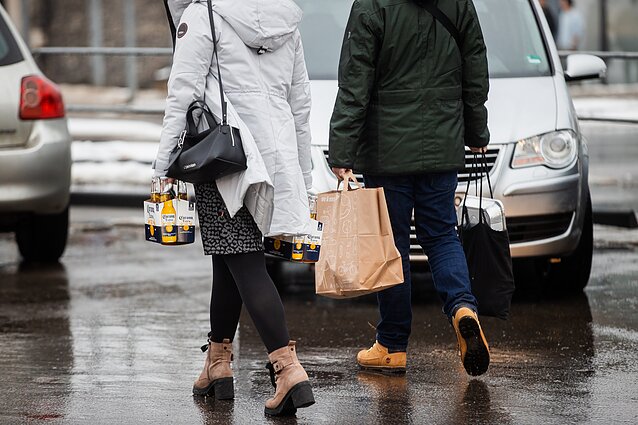


With food price rises as one of the main driving forces behind Lithuania’s soaring inflation, the central bank has conducted a study, concluding that retailers did not use the situation to shore up their profit margins.
According to the Bank of Lithuania, food prices in Lithuania were mostly driven by higher energy prices. And the relatively high demand and the purchasing power of the population made it easier for retailers to fully pass on the increased costs to the final consumer.
The analysis shows that final prices have increased at a similar pace to input costs. However, according to the Bank of Lithuania, no exceptionally high profitability was observed either in food processing or retail sectors.
In December, the appreciation of bread and cereal products, milk and dairy products hit 50 percent compared to the same period a year ago.
The Bank of Lithuania has undertaken an investigation into the rise in food prices. It says the results show that the main factor was electricity and gas prices, driving up the cost of raw materials. Businesses have passed on the increased costs in their entirety onto the consumers.
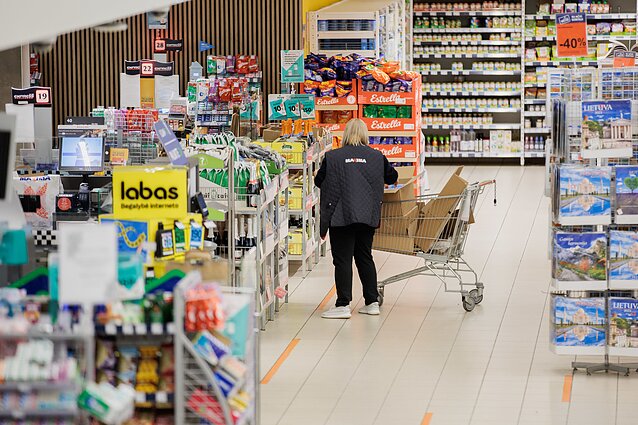
“In my opinion, we need to look at how to manage the energy sector, because even now electricity prices in Scandinavia are two-three times lower than in Lithuania, and we need to look at that if we want lower prices,” Dainius Dundulis, the owner of the Norfa supermarket chain, tells LRT TV.
In the agricultural sector, however, prices have risen faster than costs.
“In the agricultural sector, the trends in prices and costs should have meant a fairly good period, [...] so we explain that in the agricultural sector, prices may be dictated by the market rather than by the costs of producers,” says Aurelijus Dabušinskas, head of the Bank of Lithuania’s Economics Department.
According to the Bank of Lithuania, no one has made huge profits from the rise in food prices, only agriculture may have benefited more than other sectors since farmers sell their production at global prices.
Processors say that they had to pay much more than before. According to the manager of Varėnos Pienelis, everything has become more expensive.
“Sugar, for example, has more than doubled in price from 46 cents to 1.25 euro. Everything that goes into the recipe of the product, but also packaging and transport, has gone up,” says Jolanda Kuzminienė, the company’s manager.

Arūnas Svitojus, president of the Chamber of Agriculture, admits that there was an upswing, but now the situation is different, with extremely low purchase prices.
“We see that farmers are making the biggest losses, but the other two chains – processing and retail – have the income and profitability,” he says.
For their part, processors insist it is impossible for them to profit from agriculture.
“In this situation, with the market economy and competition, there can be no super-profits,” stresses Dalius Trumpa, the manager of Rokiškio Sūris.
The Bank of Lithuania reports that energy prices have had a bigger impact on food prices in Lithuania than elsewhere in the euro area, currently reaching 98 percent of the EU average.

Newsletter
Every Friday morning.