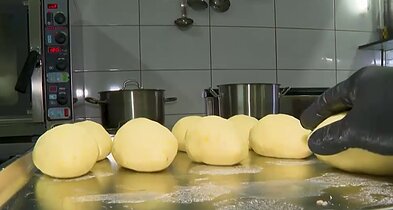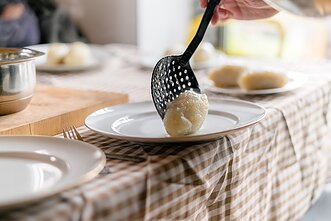













We celebrate the ninth World Cepelinai Day this Sunday. Proposed by Lithuanian-American Jonas Vaičiūnas, the holiday has been celebrated since February 2014, with people around the world making and devouring the hearty Lithuanian dish.
Although cepelinai is arguably the most-recognisable staple of the Lithuanian cuisine, ethnologists say they are a fairly recent invention and won an established place in Lithuanian culinary imagination only after the Second World War.
This dish has been popular in cafés for decades, but fewer people are attempting to make cepelinai at home.
Silvija Katinaitė-Kavaliūnienė, the manager of the café Pas Katiną in Piniava, just four kilometres from the northern town of Panevėžys, says that, for Lithuanians, Cepelinai Day is every day. The dish has been on her menu for three decades and is by far the most popular choice.
“On World Cepelinai Day, seniors or families often come and order the traditional dish – cepelinai, of course,” says Katinaitė-Kavaliūnienė.

The most important thing when making the dish is the potatoes, she says. “Potatoes are the main ingredient so they must be of very high quality, first class,” she says. “Only starchy potato varieties and late varieties are suitable for making cepelinai.”
She estimates that in the café’s three decades of existence, the cooks have already made about one million cepelinai.
However, although Lithuanians are very fond of cepelinai, they cook them less and less at home, she says, especially the younger generation. That is why she has started training them on how to prepare the dish correctly.
“For some, grandparents pass on traditions from generation to generation, along with recipes and various tips on how to make cepelinai, but not everyone has had the opportunity to do so, and we have felt a great deal of interest in learning how to make them, so we have decided to create a training course that will help the younger generation to get to know the history of the dish, as well as the whole process of making it,” says Katinaitė-Kavaliūnienė.
According to Vitalija Vasiliauskaitė, a specialist in ethnic culture, although this dish is often referred to as a Lithuanian national dish, it originated in Germany. The very name “cepelinai” – or “Zeppelin” – indicates that it is not a Lithuanian invention, she says.

“We should call them didžkukuliai (big dumplings), because they are really big. They remind of a dirigible. And so they are named after the inventor of the dirigible, Zeppelin,” smiles the ethnologist.
She says the dish probably came to Lithuania from Lower Saxony and Prussia.
In Lithuania, the first recipes for cepelinai appeared between the wars, in the 1930s, and only became popular after the war. The first Lithuanian cookbook doesn’t even include cepelinai, says Vasiliauskaitė.
“The first recipes for cepelinai appeared in the 1930s and 1940s. That’s when they started publishing cookbooks. However, the popularity of cepelinai rose after the war. It is a cheap, filling meal, and in Soviet times, the canteens of large factories had to feed many workers, so this dish simply came into fashion. Of course, you could say that we have had that recipe for zeppelins for perhaps a hundred years,” she says.
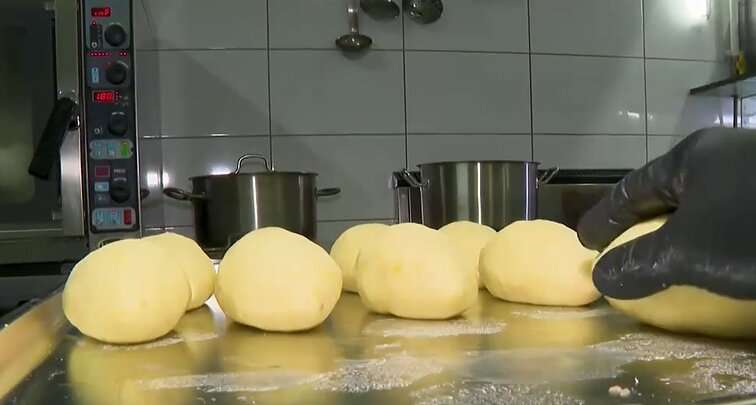
There is little variation in how cepelinai are prepared in different Lithuanian regions, says Vasiliauskaitė, mostly because of its fairly recent adoption.
“Of course, potato dishes are more common in the regions that used to be close to Prussia, such as Sūduva, Žemaitija, and Lithuania Minor. In Aukštaitija [in the east of Lithuania], potato pancakes were more common than cepelinai,” says the ethnologist.
Modestas, a Panevėžys resident interviewed by LRT, says that cepelinai is one of his favourite dishes. Not only because of the taste, but also because of the memories that take him back to his childhood.
“I’m mostly reminded of my mother’s cepelinai, that smell of home. Every time the whole process [...] brings back a certain memory, especially when I eat them – that maybe one day I will come home and eat my mother’s cepelinai again,” Modestas says.
Panevėžys resident Angelija always tries to treat her friends or relatives from other countries with cepelinai. “We often hear that foreigners don’t like cepelinai because they are very fatty, very calorific, very filling, but I don’t agree at all, because my relatives who come to Lithuania, to Panevėžys, are happy to eat cepelinai,” says Angelija.
Not everyone is making cepelinai at home these days. “My mother always used to cook from time to time, but I rarely cook for my own family, actually. Why? For some reason, it seems like a lot of work,” says Jūratė from Panevėžys. “I’ve cooked it a few times, but it's been long ago.”
Want to have a go at making cepelinai? Here is a recipe you can try.

Newsletter
Every Friday morning.