












The Lithuanian tech firm Teltonika has concluded a major agreement with Taiwan’s Industrial Research Institute to share its coveted semiconductor chip technology. The head of Teltonika says this is a game-changing deal that will give Lithuania a spot in high-value global supply chains.
Lithuania’s government has been demonstrably building closer ties with Taiwan, suffering Beijing’s ire and trade sanctions in return. The island has hinted it was willing to invest into the Baltic country and help it develop semiconductor production.
Earlier this month, the Lithuanian company Teltonika IoT Group and Taiwan’s Industrial Technology Research Institute finally signed a deal, worth 14 million euros, to share semiconductor chip technology.
Read more: Lithuania and Taiwan sign deal on semiconductor technology sharing
Under the agreement, Teltonika will acquire the right to use the licences for semiconductor chip manufacturing technologies and devices developed by the Taiwanese institute.
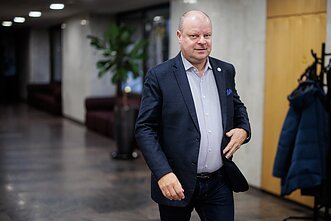
Teltonika founder and president Arvydas Paukštys, interviewed by LRT TV, says that this is a “goose that lays golden eggs” and within a decade his company may be accounting for 5 percent of Lithuania’s entire economic output.

About three months ago, you said that you were negotiating with a Taiwanese company, but you didn’t say which one specifically. What you said was that the negotiations were very difficult, that anything could happen. Was it the Industrial Technology Research Institute that you signed the contract with now?
Yes, it was them.
Did the government help?
Yes, they did. It was a political decision by the Taiwanese government to share the technology. Taiwanese politicians took the decision to share their strategic technology for the first time in 50 years.
Without the Lithuanian government’s support, it wouldn’t have happened? There would have been no political solution and the talks would have failed?
They certainly would have.
Why were the talks so difficult? What were the difficult points to agree on?
Taiwan did not want to share the technology because it is their security, these are industrial secrets, key patents, they have not given a licence to anyone so far. It was the first time, the first time in their history, and they themselves had not yet perhaps worked out all the elements of how to share this technology.

You say we’re the first country with which Taiwan shares the secrets of chip production. But at the end of last year, a TSMC plant was opened in Arizona with planned investment of USD 40 billion. We’ve been hearing about talks over a plant in Dresden. Is this not the same as what is promised to Lithuania?
This is not the same. We are moving into a completely new area, that is to say, we are moving into the first carriages of the train. Today, there is only one factory of this kind being built in the world for which we will produce the technology. We do not want to compete with old technology in the world, so it was extremely difficult for us to negotiate a licence and patents for this exclusive technology.
The plant is going to be built in Lithuania? Or is it already being built somewhere?
No, there is no plant yet, no such technology that we will be producing – namely, 200-inch semiconductor wafers.
Where will these chips be used?
Those chips will be used in power electronics, that is, in electric cars, in inverters for solar power plants, in drones, in robots, in industry – wherever power and high voltages are needed. This is the kind of technology that is the future, and we believe that the introduction of our technology and the addition of such technology to the market will make it cheaper and more marketable.

You say that there will be production in Lithuania, but the technology and the licence is from Taiwan. Will the chips produced here be Taiwanese chips or Lithuanian chips?
That is the point, that the licences and patents to use them have been transferred. Provided, of course, that it is done only in Lithuania. And the other thing is that this only one of the projects. The total estimate of 14 million is for four projects: chip design, chip manufacturing, chip assembly, and power cells. These four projects, not counting the construction estimate, are purely preparation before construction and equipment orders.
When you say “chip design”, does that mean that chips will also be developed in Lithuania, not just made?
Yes.
They will be produced under the licence, but in the future they will be developed here in Lithuania?
Yes, they will be developed here, they will be improved, and our scientists will contribute to new technologies. Since they’ll be using new materials, our scientists and our company will be contributing, as will our engineers and designers. And I expect that in a decade, we will be generating about 5 percent of Lithuania’s GDP, and the exports of our products will be worth around 9 billion euros in 2033.
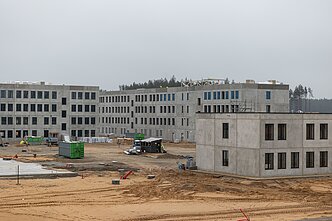
This means that by 2032, we want to have the construction of our technology campus fully completed, all the lines installed. That will be a complex of factories making everything from components to final products. We are building the final product and we are the consumer of those chips, because we need them to produce the finished products. This is the highest possible added value and it will be produced in Lithuania.

The chips will not be sold to others?
You can do that, but my vision is to help Lithuania and to help our people create value here, which means finished products. […]
Let me explain: one product consists of 7-10 different chips. In order to reduce the product’s dimensions, mass, weight, for example, for aeroplanes, drones, we need small cells. In this case, we can put 7, 8 or 10 chips on a single chip and have a minimal footprint […].
By being able to minimise our chips here in Lithuania, we will have a competitive advantage and the highest maximum value creation because, again, the final assembly of the product – the chips – will be in Lithuania. Today, we buy chips.
Does the contract that we have with the Industrial Technology Research Institute have any direct connection with the Taiwanese chip-making giant TSMC?
Well, yes, we will also be manufacturing some chips with them, because they have, for example, technologies that require an investment of 100 billion euros in a single factory. We would not even be able to build such a chip in Lithuania, so we use their services. But not necessarily Taiwan’s, maybe other countries.
Each chip is manufactured in different places. There is global specialisation and each chain is complementary. We saw this very well during the pandemic, when the production of a single chip was disrupted and the car industry could no longer produce a car. So we will be part of that supply chain, producing specialised chips that will be used in both the automotive industry and the energy industry. And here we will have our own niche and our own added value for Lithuania.

And what has Teltonika promised or will give to Taiwan in return for the licences and technology transferred to you?
Well, we will continue to work with Taiwan, and we will buy more chips from them, probably billion of euros.
Have you committed to that?
No, we are not committed, it is a commercial relationship if it is useful. I think that nobody in the world is able to compete with TSMC in terms of their costs, so I would not think that we will abandon their services.
So you will buy some things and you will give them some of your production?
No, the finished product is our product and we can sell it wherever we want. I would say that we are getting a goose from Taiwan that is laying golden eggs.
But you have to give something in return for that goose.
Yes, but we do not need to put it in a pot, cook it and say that there was very little meat. We are really getting the technology and we’ll do with it what we can. To the extent that we are able to produce added value from it in Lithuania, that will be our achievement.

Newsletter
Every Friday morning.