













In an interview with LRT.lt, Angus Lapsley, NATO Assistant Secretary General for Defence Policy and Planning, talks about Baltic defences and lessons from the war in Ukraine.
This year, the NATO summit is taking place in Vilnius. Lithuania wants all the countries to commit 2 percent of GDP on defence spending. What plans do you have for this summit?
I think it’s going to be a really important summit. Last summer, we met in Madrid and took a very important strategic decision to refocus the NATO alliance on collective defence. There are other things which remain important, like fighting terrorism, but it’s very clear that the top priority is collective defence.
I think for Vilnius, we need to demonstrate that we are delivering on that commitment. It’s not new, we started this process of change in 2014 when Russia first invaded Ukraine. But Madrid demanded that we accelerated and intensified that process. And that's what we are going to deliver on in Vilnius.
The big element will be a strengthened collective defence mechanism. We are reengineering how we plan, how we command, what capabilities we ask of allies, how we organise our force. All of that set of issues will be brought together. We need to deliver on the changes to our posture that we agreed on in Madrid. For example, moving from having four battle groups to having eight battle groups and having those battle groups ready to be scaled up into brigades very quickly.

I think that by the time we get to Vilnius, we’ll see that we’ve demonstrated we can do that. So, we need to get all of those things right, we need to carry on modernising our defence, we need to keep thinking and delivering on integrating new technologies into our defence, thinking about the impact of China and the growing importance of the Indo Pacific on Euro Atlantic security, we need to think about resilience, and take some important steps forward there.
And then we need to send a clear message on defence spending. We’ve had the commitment to move towards 2 percent since 2014. Leaders in Vilnius will agree on a new pledge. It’ll be for them to decide exactly what that says. But it’s very clear that many allies now think that 2 percent is the minimum that you need to spend to make NATO secure. Quite a few allies are going to go well beyond 2 percent. And your own countries are a good example of that.
Vilnius will essentially be about delivering that intensification and acceleration of change in the alliance that began in 2014 but really accelerated in 2022.
The Baltic states are also saying that the emphasis should be on strengthening the eastern flank of the alliance, also approving the Baltic defence plans. Are you planning for this? And what could we expect those plans to look like?
We do need stronger defence in the Baltics, which we all recognise is one of the regions in NATO, which is most vulnerable to possible Russian attack. And NATO is developing a family of military plans, war plans, if you like, for exactly how we will do that. That family of plans will be ready by the Vilnius summit. Hopefully, we will get them agreed so we can then begin implementing them and making sure that they are ready to be used if they’re ever needed.
I think the demand from the Baltic countries to understand exactly how we will defend this region is a completely legitimate demand. I think we have got quite a long way by Vilnius towards being able to answer that.

What I would say is that it isn’t just about the number of forces here that’s important – and we’ve scaled that up. It is about the full range of capabilities that NATO could bring to bear to defend this region.
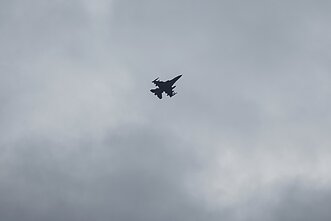
For example, some of the airpower that would be brought to bear to defend the Baltic countries might come from aircraft carriers that are sitting in the Norwegian Sea. It’s not all about what's here. It's about the full range of capabilities that you can bring to bear. And that is what the alliance is focused on, I would say now with a sort of laser-like intensity.
What the Baltic states want are the long-range defence systems stationed here, as well as upgrading NATO’s air policing mission to air defence mission. Is this on the table?
This is a military-led process. So, this starts with what SACEUR, Supreme Allied Commander in Europe, General [Christopher] Cavoli, advises us he needs to achieve the mission of stopping an invasion of any part of the NATO territory. And I think he will ask for a mix of things. He will ask for the ability to have long-range fires, he’ll push I think for stronger, integrated air and missile defence, in particular, along the eastern flank.

But the exact mix of what he asks for, and how he wants to organise it, for example, where he wants to put long-range missiles, that’s something we need to let him do the work on. I think we need to be a little bit careful about jumping ahead to a conclusion that you need to put this here. Let’s wait to see what the professional tells us he thinks will work best.
At last year’s summit in Madrid, Germany, and Lithuania agreed to assign a brigade to Lithuania. But now, there is a lot of discussion about where the brigades should be deployed. Do you think the deployment of a full brigade in Lithuania would significantly increase our security?
What was agreed at Madrid was that we will move from four to eight battle groups and that each of those battle groups could be scaled up quickly to a brigade size. In order to do that effectively, you need to practice it, you need to demonstrate you can do it. And I think we will see that between now and Vilnius.
Then, there is a more complex military question about how much do you need to have here permanently? And how much does it make sense to have back in Germany? That is essentially a military conversation about what is the most effective way of achieving the effect you want to achieve? Again, I think we need to let the military work that out themselves.
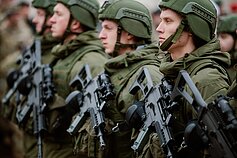
What I think is very clear, is that there is a commitment, backed by Germany in Lithuania, the UK in Estonia, and Canada in Latvia, that the forces that are here and that can be here at very short notice, are more robust and more capable than we were planning for in the past.
But not so long ago, we heard some statements, for example, from the Estonian prime minister that under the current NATO plans, the Baltic states would be wiped out if Russia would invade them. Do you think the current NATO plans are sufficient to defend the Baltic states?
We are very confident that NATO’s ability to deter any kind of attack on NATO territory is solid. And we have seen in this war with Ukraine, that actually Russia has been very careful not to touch NATO territory.
Does that mean that we’re complacent? Do we just think we should just leave things as they are? No. We think that we need to improve our planning, our posture, our command structures, we need to invest in the right capabilities, not least because the nature of the threat is not static, it changes.
Sometimes the nature of the threat might be the Russian ground forces. Other times it might be Russian missiles, or aircraft, or submarines, and you need to be able to respond to whatever the threat is. So, I think we are confident that we can deter and defend the Euro Atlantic area, but we’re also very realistic that we need to keep improving and we need to keep strengthening if we’re to keep pace with the threat we face.
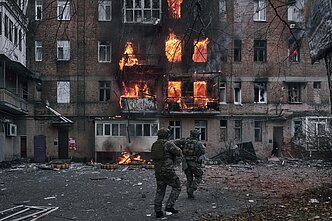
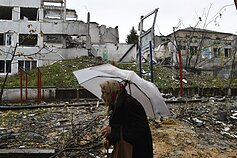
How has the war in Ukraine changed NATO’s planning in terms of defence? Have you re-evaluated the threats that, for example, Russia poses?
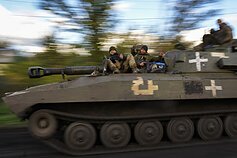
The war is ongoing. And we are learning things all the time. There are a lot of things that we knew in the Cold War which have come back. For example, the importance of air and missile defence, how difficult manoeuvre can sometimes be in a very contested environment. The importance of deep fires, the importance of protected mobility – there’s a whole range of lessons we’re learning.

I think you can probably layer on top of that, something which is even more intense than in the Cold War, which is the importance of electronic warfare, the importance of being able to process information very quickly so that you can react quickly. For example, your targeting cycle – can you understand something about the battlefield and very quickly then bring effects to bear in response to that information? This is something which I think the Ukrainians have been better at than the Russians.
So, those are the kinds of things we’re learning, but it’s a moving target. And one of the things we obviously have to watch is what kind of Russian forces are left at the end of this war? What capabilities will they have? How quickly will they be able to replace those capabilities? And will they replace them in the same way that they had before? Or will they do something different? So, this is a dynamic process.
How do you evaluate Ukraine’s chances to become a NATO member?
NATO foreign ministers met in Bucharest just before Christmas. They very clearly reaffirmed the open-door pledge to Ukraine and indeed to Georgia. The question of when and whether we should move beyond that is not a question that the alliance is in a position to answer right now. I think right now the alliance is focused on what we need to do as allies to help Ukraine win this war. Win this war and a lot of these debates will become a bit clearer.

Newsletter
Every Friday morning.