





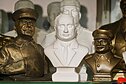






The Vilnius City Municipality’s decision to erect a monument to Antanas Smetona has renewed the public debate on the first Lithuanian president’s legacy in the country’s history.
Monuments to Smetona stand in Ukmergė district and Kaunas, but Lithuania’s first president has not yet been commemorated in the country’s capital.
In mid-December, the Vilnius City Council decided that a monument to Smetona would be erected in front of the Old Theatre of Vilnius on J. Basanavičiaus Street.
The decision was taken following a proposal by the Historical Remembrance Commission of Vilnius City Council based on the results of a public opinion poll.
The representative survey on honouring Lithuania’s first president commissioned by the municipality was organised by Spinter Tyrimai. Around 39 percent of respondents said it was important for them to have a monument to Smetona in Vilnius.
Almost half of the respondents (49 percent) said the most suitable place for such a monument is the square in front of the Old Theatre of Vilnius. On September 18-22, 1917, the Vilnius Conference met at the Old Theatre of Vilnius and elected the Council of Lithuania and its Chairman Antanas Smetona.

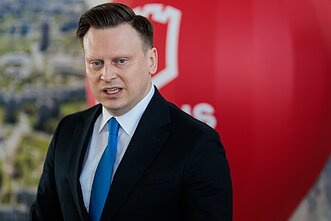
“The place where President Smetona will be commemorated has been chosen after taking into account the opinion of Vilnius residents. This is a very important decision because President Smetona’s activities in Vilnius were of exceptional importance for the restoration of Lithuanian statehood and will remain significant in the future,” said Tomas Gulbinas, Deputy Mayor of Vilnius.
Smetona served as Lithuanian president in 1919-1920 and 1926-1940. He is a signatory of the Act of Independence. Smetona is often commended for his role in the restoration and consolidation of Lithuanian statehood.
However, his role in Lithuanian history is mixed. In 1926, a coup d’état overthrew the democratically elected government and President Kazys Grinius and installed an authoritarian regime led by Smetona. In 1940, as Soviet troops were about to invade Lithuania, he fled to Germany, then to Switzerland, and finally to the US. He was also criticised for not setting up a Lithuanian government in exile at the time.
Denying the legacy
The decision to erect a monument to the first Lithuanian president has received a wave of criticism. Dainius Žalimas, former chairman of the Constitutional Court, believes it is a “betrayal of the partisans”.
“We’re building a monument to a subversive who by his actions denied a provision of democracy of the Act of Independence of February 16, 1918, which he himself signed. Also, this subversive liked the title of the Leader of the Nation (Führer), which was quickly affixed to him by the sycophants who surrounded him in large numbers” Žalimas wrote on Facebook.
“Moreover, by erecting a monument to him, we’re denying the democratic legacy and the memory of those who, unlike this unfortunate ‘Leader of the Nation’, didn’t retreat and resisted the occupation with arms. In other words, we’re betraying the partisans and the idea of freedom, for which they fought,” he added.

According to Žalimas, the debate on the necessity of the monument to Smetona shows people’s attitude towards the rule of law, human rights, and democracy.
“We still don’t dare to admit what the partisans declared on February 16, 1949 – that the constitutions of 1928 and 1938, which served the regime of the ‘Leader of the Nation’, were not constitutions in the true sense of the word. After all, one of the fundamental ideas of constitutionalism is the limitation of the powers of government, not the imposition of arbitrary power on the citizens,” he noted.
Žalimas believes that if the monument to Smetona was erected, it should contain information that it is dedicated “to the self-proclaimed ‘leader’, who usurped the power by means of coup d’état and betrayed the Republic of Lithuania”.
Historical context?
However, the historian Egidijus Aleksandravičius says that not only the coup d’état moment must be remembered when thinking of Smetona’s role in Lithuanian history.
“The sin of the subversive doesn’t go away. But then there are other actions. There is the way in which he implemented his policies as an authoritarian president, and there are no major sins here,” Aleksandravičius told LRT.lt.
“Yes, he clamped down on political parties, persecuted his opponents, but he didn’t interfere with the growth of civil society and was tolerant towards minorities, especially Jews. […] Our entire history is such that there are no unambiguous heroes,” he added.

Virginija Būdienė, head of the Vilnius Institute for Policy Analysis, believes there should be monuments to all Lithuanian presidents in Vilnius.
“There are no commemorative signs for presidents in Vilnius, so we should have a monument not only to Smetona but also to all former presidents,” she said.
Asked about Smetona’s role in the history of Lithuania, Būdienė urged to evaluate the situation in Europe as a whole.
“It is said that Smetona was an autocrat, an authoritarian. But let’s look at what Europe looked like at that time. There were few democratic governments. I think we’re looking at the Smetona period very much from the present day,” she said.
According to her, commemorating Smetona might also help to return the former president’s remains to Lithuania.
“Smetona’s remains are in America. We cannot return them because his descendants don’t agree to this seeing our disagreement over his legacy,” Būdienė said.

Newsletter
Every Friday morning.