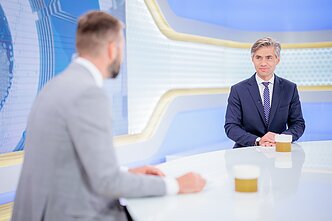















“Not a single person in Vilnius showed the slightest discontent, aggression, or any negative reaction when they heard that I was from Russia,” Russian journalist Tatiana Felgenhauer says in an interview with LRT.lt.
Felgenhauer was a long-time correspondent and programme host of the Russian independent radio station Ekho Moskvy, which was closed in March 2022. The journalist has been living and working in Lithuania for about six months, hosting a programme on Deutsche Welle’s Youtube channel in Russian.
In Lithuania, some politicians and journalists say that independent Russian journalists may not support Putin, but they don’t respect Lithuania either. They also say that they couldn’t have survived in Russia for so long without help from Russian authorities. What can you say to this?
Thankfully, I’ve never heard anything like this. I’d like to see that person saying to my face that I cooperated with Russian authorities for 18 years when I was working for Ekho Moskvy. I’d just laugh and tell that person that he hasn’t heard any of my broadcast.
Often people who talk about what Russian journalists are like have no idea what they’re talking about. They don’t see the difference between Russian propaganda and Russian journalism.
They’ve never heard of Svetlana Reiter or Anastasia Lotareva. They’re not interested and don’t care about it. Thank God they have their own country, interests, concerns, and audience. But if you’re going to say something about Russian journalists, you should first learn the ropes.

I’m not going to comment on Lithuanian politics because I have no expertise and no experience in it. I won’t do so out of respect for my own audience. So, if someone starts talking about how bad Russian journalists are, it would be great if that person first found out more about what they are really like.
I’m happy that no Lithuanian journalist faces what Russian journalists face, that you have no censorship, that you aren’t put in jail for your words, that your editor-in-chief isn’t threatened with dismissal every second, that you don’t have a constant change of ownership, that you don’t face economic pressure.
Unfortunately, this has been taken away from us, and we didn’t find ourselves here by choice. We left because we chose a profession. But in Russia, unfortunately, it’s no longer possible to be a journalist. So, we had to give up everything and leave. [...]
Did Ekho Moskvy’s editorial team have plans to move to some other country after February 24 and broadcast from there?
The editorial office of the Ekho Moskvy radio station is gigantic. From a purely technical point of view, transporting an entire editorial board is not about packing one suitcase and going away for a week. It’s also about the lives of hundreds of people because journalists have families, children, and parents. That’s why Echo Moskvy couldn’t do it even if it wanted to. The station was closed on March 2, and according to the decision of the board of directors, it no longer exists. [...]

They took the radio frequency away from us and then destroyed everything else. We were all sacked, we’re all unemployed. But we all chose to continue working for our audience. And we continue to work because we know that people urgently need information – real, truthful information, not the kind of information that propaganda tries to feed them or the kind of information that aims to silence everyone. People need both information and opinions. That is why we continue to work as best as we can. Some work from Moscow and some from other countries, mostly on YouTube.
In one of your interviews, you said that your audience was growing. How is it now? Do you notice the audience’s weariness of military topics?
Yes, people are tired. The surprising thing is that on the one hand, people are very tired of war, news about war, and discussing war. But on the other hand, as soon as you try to talk about something else, they immediately say: “Wait, there is a war going on. You cannot talk about anything but war.”
You’ve been living in Vilnius for more than half a year now. How do you feel here?
I think it was a great decision to choose Vilnius because it’s very open and welcoming. A lot of Belarusians came here in 2020, and then Ukrainian refugees arrived. Everyone can find a place here.
In Vilnius, you can meet Lithuanians, Italians, Americans, Germans, Belarusians, Ukrainians, or Russians. And everyone is happy here. Everyone finds a place and feels comfortable here.

At first, of course, I was terrified, wondering how I was going to live and find my way around in Vilnius because I don’t speak Lithuanian, but a lot of people here speak English. What surprised me the most was that my attempts to speak English were often interrupted by the question: “Do you speak Russian?” This was very unexpected for me. Such a friendly city. [...]
When you often talk to people, they ask where you’re from. Every time, my heart sinks because I have to tell them that I’m from Russia. And I start thinking in advance what their reaction will be...
And how do people react to the fact that you are from Russia?
Not a single person in Vilnius showed the slightest discontent, aggression, or any negative reaction when they heard that I was from Russia. Not once was there such a thing. And, of course, I’m grateful to Vilnius for this because I was able to relax, breathe more freely here.
And this is, of course, very valuable. In Moscow, the tension was simply unbearable, when you listen for footsteps on the stairs all the time. When you think about whether you’ll be arrested if you go down to the metro. [...] You live in a terrible tension, and you can never get rid of it. And Vilnius, of course, is a city where you’re not afraid of the police. You’re not afraid to walk around the city.
You once covered protests in Bolotnaya Square, Sakharov Avenue. How do you see the future of Russia?
I think about it a lot. I can roughly imagine the future of Ukraine. I know that Ukraine will win this war. I know that the whole world will help Ukraine recover. And I know that Ukraine will be strong, renewed. These are the people who have gone through the most terrible things, and they’ll come out as heroes.

But I don’t see any future for Russia right now. I don’t understand when and how the war will end. I don’t understand when and how the Putin regime will change and what will replace it. I would like to see some ideal scenario, but I don’t know whether it’s possible.
But if suddenly, in some incredible way, a person, who understands that if Russia is to exist and not become a pariah country, replaces Putin, he will probably realise that positive changes are needed. I’d like that person to release political prisoners, abolish repressive laws, and somehow free Russian society from segregation. Is that possible? It’s probably possible. But I don’t know whether it will happen.
There is too much uncertainty about what will happen to Putin. Will his power come to an end because he dies, or will there be a trial? And if there is a trial, who and how will try him? There are so many questions, so it’s very difficult to talk about the future. My colleagues and I used to joke that our planning horizon was a week. And that is quite optimistic.

Newsletter
Every Friday morning.