














The US has assured Lithuania on the continued training of Lithuanian troops, joint exercises, and assistance in modernising the country’s Armed Forces. However, the Americans themselves face challenges of depleting military reserves in the wake of Russia’s war in Ukraine.
During a visit to the US, Commander of the Lithuanian Armed Forces Valdemaras Rupšys met with General Mark A Milley, Chairman of the Joint Chiefs of Staff.
According to Rupšys, he and the US general discussed the acquisition of weapons, the training of Lithuanian troops, joint exercises, and the presence of American troops in Lithuania.
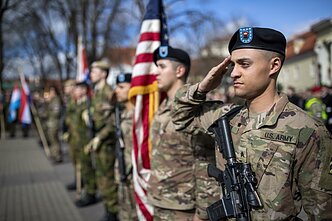
The US has demonstrated that they understand that “their presence in Lithuania is an essential factor in deterrence and defence preparedness”.
“One of the most important aspects is the assurance given by General Mark A Milley that US troops will be permanently deployed in Lithuania,” Rupšys was quoted as saying in a press release on Wednesday.

The US has been sending battalion-size units of more than 500 troops to Lithuania on a rotational basis since 2019.
The US also promised to help Lithuania modernise its Armed Forces before Russia rebuilds its capabilities lost during the war in Ukraine.
“We must use the time when Russia has not recovered its capabilities and has probably lost combat power in this war. But time is certainly limited,” Rupšys told LRT in Washington.
Lithuania has earlier announced plans to buy eight HIMARS missile systems from the US for almost half a billion dollars. According to Rupšys, the Americans are also talking about “anti-tank weapon systems, we are talking about air surveillance systems”.

Limits of American arms manufacturers
However, the American arms industry is currently facing intense demand and struggles to fill orders on time.
The Lithuanian chief of defence and General Milley discussed support for Ukraine.
“The most important thing is ammunition,” according to Rupšys.
However, Mark Cancian, a retired US colonel and senior adviser at the CSIS think tank, told LRT that some American supplies, including ammunition, are running low.
“Although they are not exhausted, this means that the US can only continue to send arms by taking them from its own troops,” says Cancian.
The fastest-depleting stockpile, he says, is of 155 millimetre NATO standard artillery shells. The Americans have already transferred more than 800,000 of them to Ukraine, according to Cancian.
The number of Javelin anti-tank weapons and their missiles alone, which helped repel the Russian offensive last spring, has been transferred by the Americans to Kyiv to the extent that it will take two years to restock.
The solution, according to Cancian, is for the Pentagon to send Tow anti-tank guns to Kyiv: they are more plentiful, albeit heavier and less mobile.
Asked whether the dwindling stocks mean that the Americans will send less military support to Kyiv, Cancian says, not necessarily. However, it may mean, as in the case of anti-tank guns, that the Pentagon will have to hand over slightly less effective weapons, whereas hitherto it has been sending what it has best.
Lithuania will buy American weapons through the US government, most of the permits have been obtained, but production and delivery of orders could take several years, according to Rupšys.

Newsletter
Every Friday morning.