












Several Lithuanians are currently fighting in the Ukrainian Armed Forces. At the beginning of the Russian invasion, there was an entire Lithuanian squad in Ukraine, but heroism fades when people face death, says a soldier who continues to fight.
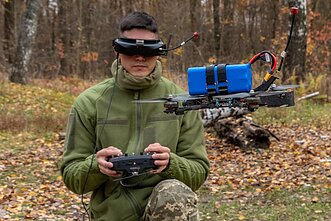
The man came back to Lithuania to collect a drone and other equipment necessary for Ukraine’s resistance.
“I’ve collected the drone, the medical supplies are loaded, so I need to keep going. I feel a responsibility, and I must continue. I could take it to Ukraine, and say, ‘take it, I’m going home’. They wouldn’t be angry with me. But there is a plan, and I stick to it,” he said after the interview with LRT.lt.
You are a professional soldier. However, does the experience of real war differ from expectations?
We are trained for war, but we learn to fight on our own. Hearing about it and experiencing it are two different things. You watch documentaries, and you think about what would happen, how you would react. In a real war, fear and adrenaline kick in I – you don’t experience these things when you watch a documentary or take part in an exercise. They try to bring you as close as possible to the conditions that you could experience, but those sensations are 100 times stronger [in real life].
Why do foreigners, and not only Lithuanians, go to fight in Ukraine?
The desire to help, some grievances against Russia, historical things – a range of reasons. Every soldier’s motivation is different, but the main thing is that everyone wants to help.

Initially, there was an entire Lithuanian squad in Ukraine, but now, there are only a few soldiers. What happened?
When we have a very big heart and a small mind, we don’t realise what death is. The first, second time when people encounter death, they realise how fragile their life is and how much they still want to live. You start to realise that you have friends, family, loved ones, and you don’t want to lose them.
Then, people start thinking, “this is not my war”. It’s not like a game where you have multiple lives. In war, you see your injured or killed friends, you get injured yourself. I’m not talking only about physical injuries. After the war, you might need psychological help. But that is war. It is easy to start and difficult to finish.
Do you make plans for after the war?
I don’t think about the end because it’s very difficult to see it. There will be an end one day, it’s just a question of whether I will see it or not. I would love to see it, but anything could happen.
Is the war changing you?
I’m changing already. The issues of civilian life simply seem worthless to me. I don’t know how I’ll get rid of it. [...] But I don’t think much about it. I will think about it when the war ends.
Now that I am in Lithuania, it is difficult to sleep. When I don’t hear air raid sirens here, I think that something is wrong.

Do you think that people like you who are going to war are different?
For example, at the start of the war, everybody was leaving Ukraine, and we were going to Ukraine. There was a 40-kilometres-long queue to leave Ukraine. You drive and think, “everybody is leaving, and you are going the other way.”
Did you feel like a hero?
No, I felt like a moron. You drive, and you see thousands of people leaving and only a few dozen going the other way.
You’ve been to several liberated cities. What is it like meeting Ukrainian civilians?
I’m just doing my job. Some people welcome us, others say, “we’re tired of both you and them [Russians]”. They want to live a quiet, good life. I understand them, everybody is tired – some get tired sooner, some later.
What you are going through is not easy. Aren’t you afraid that you will feel the consequences of the war for the rest of your life?
My glass is not full yet, but eventually, I will feel it. I don’t know how much I have left.
War changes people. We met a Frenchman who was a sniper in Iraq, Afghanistan. He was wounded but still stayed in Ukraine. He can no longer be a sniper, but he works as an instructor, helps in other ways.

You’ve been injured once before. If the media asks the Defence Ministry whether there are any Lithuanians who are fighting in Ukraine and whether they need medical help, the answer is that there are no Lithuanian soldiers in Ukraine. Should the state help people like you?
We are all there voluntarily, we took the risk. We do it voluntarily, and if we get hit, we heal our wounds ourselves. If the state wants to help, we will accept it, and if it doesn’t want to help, we will do it ourselves.
It’s correct that there are no Lithuanian soldiers in Ukraine. We are Lithuanian citizens, but we get the status of soldiers in Ukraine.
How is the communication with your family and loved ones when you return?
I haven’t had time to talk to my family. They know I’m back, but I told them that I need time to myself. I’m not ready yet. I don’t need to be bothered. They want to talk to me about other things, but I am not ready for that.
You said that other people often see what you do as an adventure. Someone asked you with a smile how many Russians you have killed.
Yes. Everybody is interested in how many you killed, but nobody asks how many lives you could have saved. Killing is not fun. The person you kill also has a family. We forget those things.

Newsletter
Every Friday morning.