













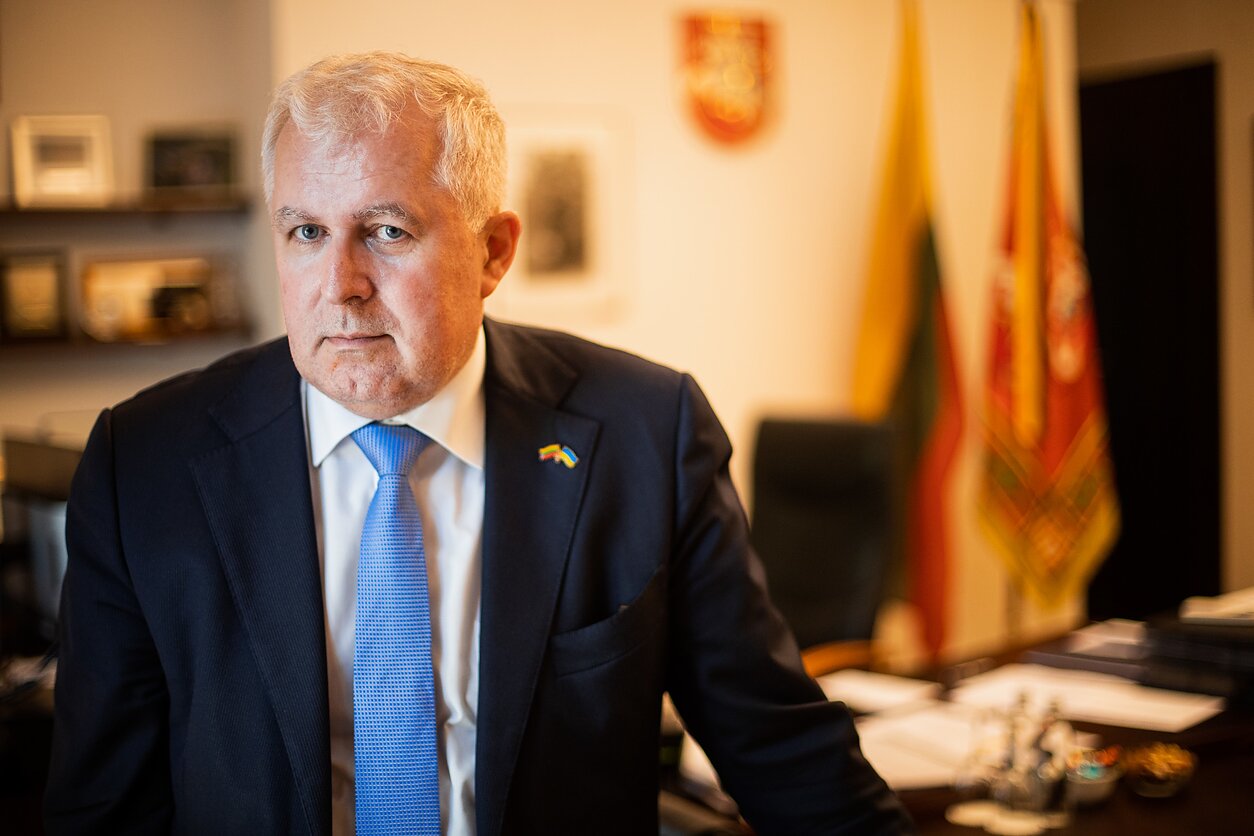
Lithuania should have been prepared to host additional NATO forces three years ago, but the necessary work has not been done. However, the country’s security is being guaranteed by multiple partnerships, while Russia is running out of potential to continue its aggression for much longer, says Lithuanian Defence Minister Arvydas Anušauskas in an interview with LRT.lt.
Before the signing of the parties’ defence agreement, there was talk about compulsory initial military service and raising the defence spending to 3 percent of GDP. But neither of these measures is in the agreement. Is this a huge defeat?
The opposition is also involved in the drafting of such an agreement. We have a unique opportunity to hear their positions [...]. What we have seen in the negotiations is that some of the loud statements are for themselves, but when it comes to signing an agreement, a lot of things change.
Read more: Lithuania’s parties sign new defence agreement, pledging to keep military spending above 2.5%
When it comes to compulsory initial military service, there is a big difference of opinion between the parties. We are in favour of it, but there are nuances. If we want universal conscription, we need the resources to do it. It is not a free thing. It means more professional soldiers to train those conscripts, more infrastructure, more weapons, and more equipment. I am not just talking about training to shoot, but about creating a whole military system and additional units. [...]
When it comes to resources, you can see that the parties are already preparing for the next elections – the municipal elections will be held soon – and they do not want to promise more resources to the national defence in advance despite the geopolitical situation and the war in Ukraine. [...]
In 2013, the parties agreed to allocate 2 percent of GDP to national defence. Achieving this percentage was a good thing, and it looks nice when you talk about it in NATO fora. However, what the money is for and what capabilities are developed with the money, are questions that are not easy to answer.
Once agreements have been concluded on the development of capabilities, they need to be implemented, and this takes time. I have seen in my year and a half in the ministry that in reality, the implementation of contracts has been complicated, whether it is the construction of the infrastructure that was promised for the NATO Forward Battalion or the procurement of some armaments. Either these projects have not been implemented, or they have been implemented but with significant reservations.
This year, we have increased defence spending 1.5 times, so we have closed the host country support gap, meaning that the incoming troops from NATO countries have a place to stay temporarily and to exercise. This should have been done three years ago.
Would our allied troops have enough space to physically settle in Lithuania today?
If we are talking about exercises, then, after the implementation of this year’s plans, ie the construction of temporary camps, yes, they would have.
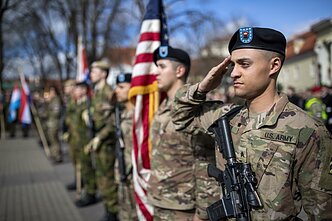
But if the allies put conditions on us that it must be a permanent infrastructure, not a temporary one, then there are questions here. The NATO battalion, which has now reached almost 1,800 troops, was promised infrastructure well in advance. It was promised that by 2020, at least half of the necessary infrastructure would have been built, but that has not happened.
We needed to get that work back on track so that it could reach the project stage this year and we could talk about the actual implementation of the project by 2027. I am talking about the infrastructure for the forces that have been with us since 2017, which is almost 2,000 German and other allied troops. This infrastructure will be built with German and our money.

We have been considering that we need a larger NATO force since March, and finally, at the NATO Summit in Madrid, it was decided to increase the size of the allied force here to the brigade level, with the possibility of prepositioning ammunition and weapons.
Read more: New NATO plans: Shift from retaking Baltics to stopping Russians before they enter
The implementation of these decisions is not so simple. For example, in order to be able to prepare the infrastructure for the Germans troops, we will need to add provisions to six laws that will save us a year or even two years.
Regarding the deployment of the NATO brigade in Lithuania, is there an agenda or action plan with the Germans on this issue?
Let us not forget that a decision on this was taken only a month ago. Germany was waiting for this decision and did not want to make any more commitments. The voice of NATO was important to them, and that is perfectly understandable.
It is clear that we have our work planned, and it will have to be in line with what Germany is doing. They are setting up a forward presence headquarters element here in autumn, and we are giving the barracks in Rukla to the forward battalion. Unfortunately, if the new barracks are not built in time, we have to do it at the expense of our troops, knowing that the barracks for them [NATO forces] will be built in 2024.
What do you mean? Where will our troops go?
We are moving them to other places. Promises must be kept. If you do not fulfil them in time, unfortunately, you have to think about what other solutions there might be. We are giving the allies part of the headquarters in Rukla, and the forward presence headquarters element will be located there.

When exactly could the NATO allied battalion be deployed in Lithuania?
The infrastructure may be ready in Lithuania by mid-2025, but I cannot speak for the Germans.
The Germans have already allocated a specific brigade, which is now training in Germany. Part of it will later train in Lithuania. In a couple of years’ time, the whole brigade will be in Lithuania for exercises. […] In 2025, we should have completed the additional infrastructure to accommodate allied troops. In any case, we want the brigade to be here, but Germany will also make decisions on how and at what level they can provide it.
Have you questioned Germany's willingness to contribute to strengthening NATO’s eastern flank in the wake of the Kaliningrad transit story? Some experts see in this story a possible German influence on the European Commission, which has adjusted its guidelines on the transit of sanctioned goods to Kaliningrad.
I cannot say that these doubts do not exist in society, especially in our society. But let us remember that initially, there were doubts about support for Ukraine. Our society is making demands on NATO as an organisation, on the NATO countries, including Germany, that are much higher than those countries could have imagined.
Reality makes many adjustments. And the countries are going through these changes. We were the third to send military aid to Ukraine (after the US and the UK), and now, 99 percent of NATO countries are supporting Ukraine militarily. This is a huge step.
Few people imagine that Germany’s tank army has shrunk significantly since the Cold War. When it is said that Ukraine needs 500 howitzer tanks, few people probably know that Germany has 80 of them and that they are no longer in production.
Those expectations, without knowing what Germany’s capabilities are, have started to undermine confidence in Germany. But let us not forget that we are members of NATO. Despite Germany’s commitment to the region, it is not the only country with such a commitment. We have not only strategic neighbourhood partnerships, but also transatlantic partnerships, and we are also part of the JEF format, where Britain is the leader, and where the countries of Northern Europe are members. In other words, the capabilities of one country do not determine our defence posture.
For how long do you think Russia has the strength and capacity to continue the war against Ukraine?
Every war needs a lot of resources, and if anyone thinks that Ukraine, the West, is facing a resource problem, then they must understand that Russia is also facing this problem. I am talking about human and other resources. […] Russia seems to have used up every last rusty bolt in its warehouses, so now, it is bringing everything in from Belarus.

I think this is a signal that Russia is facing problems caused by the high-tech weapons that Ukraine has received from the West and has used successfully. […] Belarus is Russia’s backup military warehouse, from which it is pulling everything it can.
Russia is able to drag out the conflict, but it will still run out of potential by March 2023.
Why this date?
Obviously, Russia has the potential for 12 months. Ukraine is receiving weapons, such as HIMARS missile systems, but the enemy is able to adapt to this. I believe that new manoeuvres from Ukraine and retaliation from Russia, which is adapting to this, could take more than six months.
But that does not mean that by March next year, everything will be over because the war may end in a ceasefire or a freeze.
Do you think Russia can take any retaliatory measures in response to Sweden and Finland joining NATO?
Russia does not have such options now. Maybe in 5-10 years, it would develop the capacity to react, but it does not have it now.
Russia sees that, strategically, its position in the Baltic Sea has changed dramatically. Now, it is not us who are the link in the Suwalki Triangle with the NATO country, but Russia with its corner of the Gulf of Finland and the Kaliningrad area. These are the tiny strips that, from a strategic point of view, are very vulnerable.
Russia cannot react to this by any military means. The security situation in the region is certainly improving with the accession of Sweden and Finland to NATO.

Newsletter
Every Friday morning.