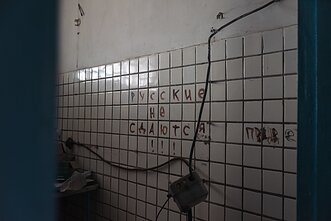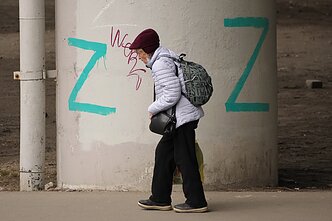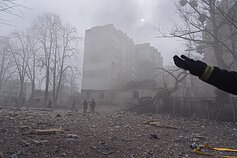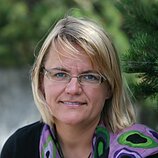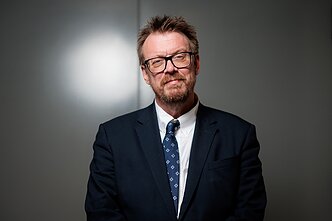














Russia’s attack on Ukraine is increasingly resembling more than a war. Combined with genocidal atrocities and systematic destruction of Ukraine’s culture and statehood, it is now appearing to be a project of colonisation. Russia's colonialism is also one of the reasons why Lithuania sees Ukraine's pain as its own, says Dovilė Budryte, a professor of political science at Georgia Gwinnett College who studies memory and trauma in Eastern Europe and the Baltic States.
What is happening in Ukraine? We can see it isn't ethnic cleansing like in Bosnia or Rwanda, not a killing apparatus like the Holocaust. Can a genocide be more 'subtle'?
The very concept of genocide is complex. Still, we need to remember the 1948 United Nations Convention on the Prevention and Punishment of the Crime of Genocide. That convention, as it were, takes as its starting point the fact that acts of genocide are committed in order to destroy, in whole or in part, a national, ethnical, racial or religious group.
However, especially in colonial or post-colonial genocides, broader definitions are used. That genocidal activity covers a whole range of activities, and here it is worth recalling the writings of Raphael Lemkin himself. He used two terms, which we may no longer use today.
One is barbarism, the physical destruction of groups [...] which never comes without vandalism, that is to say, the destruction of culture and art. Genocide can be defined as a multidirectional activity in which there is not necessarily only the physical destruction of groups, but at the same time there is the destruction of culture and art, and it is a kind of violent, social conflict.

What are we seeing in Ukraine? There is certainly this collectivity, there is targetting of Ukrainians as a group of people, there is targetting of the Ukrainian state. There is certainly no shortage of official statements, propaganda statements, that Ukraine is not recognised as a state, as a nation.
During the Holodomor, a targetted part of the Ukrainian people was also exterminated. What methods are being used now, and is that desire to eradicate a section of society visible? Is a colonial genocide visible?
The case of Ukraine is, of course, not only the Holodomor, but also the terrible experience of the Holocaust, which is also important to mention and to recognise. Whatever that terrible war in Ukraine is, I think there are big differences between the 20th and the 21st century.
Comparatively speaking, there are certain international norms. It is no longer as easy for a state to wage a genocidal war as it was in the 20th century. Although international mechanisms, such as the International Court of Justice, are very weak, countries are more outraged.
"Especially [when] looking at how Lithuania, Latvia, Estonia are reacting to what is happening in Ukraine, we need to look at that reaction, solidarity, identification with Ukraine, through a post-colonial prism. Otherwise, it is very difficult to understand why all those Eastern European countries, with the exception of Hungary, identify so much with Ukraine and it is as if Ukraine's pain becomes our pain."
I fully agree with Timothy Snyder, who wrote that the war in Ukraine is a colonial war. One of the main features of those colonial wars is the denial that nations are real, [saying] that there are little people running around, that it isn't a nation. And the denial that states are real.
The colonisers, including the European powers as they expanded into Africa and Asia, never recognised or respected the indigenous people, their culture, their nation, they certainly didn't think that these were real states.
We are seeing similar things in Russia's war against Ukraine. There is a constant denial that Ukraine is a real nation, that their state must be respected, that this war is like an extension of the Russian Empire. Zbigniew Brzezinski wrote that when Russia loses Ukraine, it will no longer be an empire. That is why Russia is so reluctant to let go of Ukraine, because that will also be the end of the empire, although, of course, there are many other nations that have been enslaved.
That label of colonial war can be used, and the people who oppose that label say that Ukraine is being helped by the United States, by other countries. Still, you have to look at the bottom line - the Ukrainians themselves are fighting and their identity, their state, their nation is being denied.

Is the colonial discourse missing because it is "occupied" by Western countries?
Colonial discourse and post-colonial discourse are linked to the racial aspect, and here it seems that the racial aspect is absent. [Therefore, it is] much more difficult to apply that colonial discourse to Russia. Western countries are still struggling with that colonial heritage themselves.
The other aspect is that, for various reasons, it is very difficult to accept that the Soviet Union was involved in colonial struggles. Even now, Russia is involved in a colonial war, and scholars often do not recognise this. In this case, I think the work of Maria Mälksoo, an Estonian scholar, is very strong, and she has shown that when we look [...] at the Ukrainian-Russian relationship, we can apply that postcolonial perspective.
Especially [when] looking at how Lithuania, Latvia, Estonia are reacting to what is happening in Ukraine, we need to look at that reaction, solidarity, identification with Ukraine, through a postcolonial prism. Otherwise, it is very difficult to understand why all those Eastern European countries, with the exception of Hungary, identify so much with Ukraine and it is as if Ukraine's pain becomes our pain.
Snyder also wrote that Russia is a fascist state. Is it possible to equate colonialism with fascism? If we are talking about Russia's war in Ukraine, should we talk either about fascism or about the Soviet legacy or about the colonialist aspect, or are they somehow intertwined?
There are many opinions, there is no definition of fascism, and there is a debate about whether Russia is a fascist state. Snyder says it is, and Marlene Laruelle, for example, says it is not, and the use of the term fascism is part of the struggle between different propaganda languages.
What is very important about fascism is the suppression of civil society, the suppression of individual freedoms, and sometimes that notion of a totalitarian state is used.
You could say that Russia has a number of elements in how we would define fascism. In terms of whether Russia or any other state is fascist or not, what is very important is that revolutionary nationalism, militarism, which seems to want to change the world, to change the borders, and there is often a desire to spread that ideology by changing the borders, by changing the world.
States like fascist Germany fought those wars. Of course, Russia had been involved in colonial wars for some time. However, the question is whether Russia wants to change the world, or whether it is just looking at its neighbours and trying to 'stabilise' its borders, or whether it actually has some ideas about changing the world and whether this militarism is not just a local phenomenon.
I think Russia has ideas about changing the world order, that emotional hatred of the US, of democratic values, is linked to Russia's desire to change the liberal world. And then when we see that the state wants to change the world model, [...] it is, after all, a colonial project.
There are several characteristics – revolutionary nationalism, autocracy, restriction of individual freedom, militarism. Of those four characteristics, two – revolutionary nationalism and militarism, where there is a desire to engage in colonial wars – are the intertwining of colonialism and fascism.
When fascism becomes an aggressive policy and pushes into other countries, it is because there is an ideology that wants to be exported elsewhere.
Was Russian society prepared in advance for the war in Ukraine?
Certainly, for at least a decade, Russian society was being prepared for that colonial war with Ukraine. Snyder noted that in 2012, [Russian President Vladimir] Putin started talking about Russia as a civilisation state with some alternative norms, and the need to spread that civilisation.
The very next year, he started talking about this supposed unity between Ukraine and Russia, that there are fraternal nations here, but there is no such thing as Ukraine. And, of course, the previous year he had already written that famous essay about the historical, supposed unity between Russia and Ukraine.
Of course, this ideological brainwashing and [...] ideological work to prepare the Russian public for the occupation of Ukraine was started. But Russia has never got rid of that colonial identity. Russia has never said that what we did in Chechnya or in Georgia was a mistake. It [the war in Ukraine] is like a continuation of what happened before.
You can link the preparation of Russian society for colonial wars with the rhetoric against NATO and against the US, always saying how bad NATO is, how they are encroaching on countries that are on our borders, that they are our enemies.
When Ukraine showed that, after 2013–14, it was moving in the direction of wanting to become part of NATO, part of the West, it encouraged, and perhaps made acceptable to a large part of Russian society, the attempt to wage war in Ukraine. We cannot deal with these two discourses separately – the anti-NATO discourse and the one about the civilisation of the state and the unity of Russia and Ukraine.
Can we expect Russia to answer for its actions and be punished? Like Germany after the Second World War.
There are pessimistic predictions from people who study historical justice. They say that our institutions are very weak, like the International Court of Justice. The big problem is that the International Court of Justice is not supported by the US. For example, why are some international institutions stronger? Because they are supported by the big powers.
I do not want to be so pessimistic, we are already seeing the condemnation of Russia by different states. Everything, unfortunately, depends on who wins the war, and the outcome of the war will determine what kind of justice we will see, what forms it will take.
I still believe that everyone has their own agency and nd each person should be responsible for his or her actions. Of course, Russia and Putin have done a lot to bureaucratise that apparatus, so that everyone who goes out to kill Ukrainians feels part of a big machine and does nothing wrong, but is just obeying the law.
Looking at the post-Nuremberg trials, the norm that a person should not obey the law if it involves evil is slowly gaining ground in Western countries. Of course, it is difficult to say what is happening to all the Russian soldiers. There is probably at least one case where [a soldier] says that no, I do not want to do this, I will not obey orders.
We cannot disagree with the preparation of the environment, the brainwashing, but we should still believe that, when the war is over, individual responsibility will still apply.
I think there will still come a time when every Russian who took part in the massacres will have to look back and answer those questions – what they did and why.

This interview, conducted in Lithuanian, was edited and condensed for clarity.

Newsletter
Every Friday morning.