















On Wednesday, the Financial Times reported that Berlin may deploy the 3,500-strong brigade in Germany instead of Lithuania. In Vilnius, there was outrage that Germany had allegedly changed its mind. But what exactly did Berlin said it would do?
Baltic states have been calling on NATO to beef up its presence since the Russian invasion of Ukraine. German Chancellor Olaf Scholz, who came to Lithuania for the first time earlier in June, was expected to make specific promises.
Visiting German troops last week, he spoke of Germany’s commitment to collective defence.
The Lithuanian media was quick to report that the German-led NATO Forward Defence Battalion would be expanded to a brigade. But what did the chancellor actually say?
"As NATO allies, we are committed to each other and in the event of an attack we will defend every inch of NATO territory," he said, adding that "Germany is here, it is working on the ground".
However, the chancellor’s words, spoken in German, about a brigade are quite abstract – Scholz mentions the determination of German politicians and the resources allocated to the military.

"We have set ourselves the objective of increasing our contribution," he said. While speaking about commitments to Lithuania, he said "we are determined to increase our involvement, to expand [it] in the direction of a well-trained combat brigade".
Scholz added that the Baltic countries and Lithuania had promised to work together on this.
These words have been translated in some media as "we will build a strong brigade". However, Scholz did not say it would be deployed in Lithuania, nor did he give exact numbers or possible deployment locations.
The words of Lithuanian President Gitanas Nausėda can also be interpreted in different ways, but he did not talk about German troops in Lithuania either.
"Germany [...] intends to strengthen its military presence in Lithuania and intends to strengthen it up to the level of a brigade [...] already in the next year, year and a half, we can expect to form the necessary combat unit here," Nausėda told reporters.
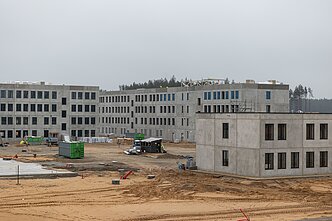
"But we have to do some work on the construction of barracks, on the preparation of deployment sites, on the preparation of the infrastructure," he said, adding that the two countries agreed to increase the number of troops to be deployed in Lithuania.
A joint statement issued by Nausėda and Scholz after the meeting stated that Germany was "ready to lead a well-trained and combat-ready brigade in Lithuania" that would help deter Russian aggression.
The statement says that the unit would be ready to be deployed very soon.
Meanwhile, a separate statement from the Lithuanian president’s office says something slightly different – "Germany is committed to building up a brigade in Lithuania".

Outrage in Vilnius
According to the Financial Times report published on Wednesday, the brigade would be based in Germany and deployed in Lithuania if needed. It would have permanent headquarters in Lithuania of 50–60 staff. The rest of the brigade would only train in Lithuania.
The report concludes that this marks Germany "significantly softening its initial backing for more foreign forces to be stationed in the Baltics".
Read more: Germany may deploy additional NATO troops at home, not in Lithuania – media
On Tuesday, the US ambassador to NATO, Julianne Smith, said Berlin had decided "to take a brigade element headquarters and move it into the country where they already have considerable force presence, and that is the country of Lithuania".
This news caused outrage in Vilnius, with critics saying Germany was not living up to its promises.
Speaking to LRT RADIO later on Wednesday, Lithuanian Defence Minister Arvydas Anušauskas said the country needed to prepare to host the brigade and build the necessary infrastructure.
He said the military and not the political leadership would decide "all the technical aspects", including "how the countries will use the declared forces, how they will move between the countries, whether some of them will be in Germany and some in Lithuania, whether they will be permanently stationed in Lithuania, for example, for training".

On Wednesday, NATO Secretary General Jens Stoltenberg also confirmed to LRT journalists in Brussels that Berlin is not proposing to deploy a 3,500-strong brigade in Lithuania.
"It entails different elements. One element is more forward presence. We have to remember that Germany has practically doubled its presence [in Lithuania], adding almost an additional battalion," Stoltenberg said.
He noted that other countries had already sent more troops to Lithuania.
"Secondly, there will be headquarters elements [in Lithuania], which is extremely critical for operating for command, control and reinforcement. Thirdly, there will be prepositioned equipment. If you have heavy military material already prepositioned, it is quite quick to move the people," Stoltenberg said.
"We will also have pre-assigned forces. You are correct, not all of them will be permanently deployed in Lithuania or in any other countries in eastern part of the alliance. But [...] they will be earmarked, pre-assigned for that specific territory. This means they will train, rotate in and out, know the country, the territory, work on interoperability with home defence forces and have pre-assigned tasks," he added.

Embassy: only technical planning remains
The German Embassy in Vilnius was quick to deny the interpretations of Scholz's words.
"We can fully reassure that nothing has changed since June 7, when President Nausėda and Federal Chancellor Scholz issued their joint communiqué on the establishment of a robust, combat-ready brigade in Lithuania, hoping also for the participation of further NATO allies," the embassy said in a statement to LRT.
It also provided further clarification on what decisions are being taken in Germany and when more will be known about the new brigade.
"No further or final political decisions on the German or Lithuanian side are necessary to begin this process after the NATO summit this month," the embassy said, adding that it will now involve "military-technical planning, investment, and stage-by-stage implementation".

Newsletter
Every Friday morning.