














Despite pledging to deploy more troops to Lithuania, Germany is now planning to host the additional troops on home soil, according to a Wednesday report by the Financial Times.
Germany has pledged to “create” a 3,500-strong brigade, a large increase from the current international NATO battalion of 1,000 troops led by Berlin. This was announced during the visit of German Chancellor Olaf Scholz to Lithuania earlier this month.
“We have envisaged that we will scale up our contribution to the strengthening of NATO’s eastern flank, we will create a strong brigade, have discussed that with each other and will have to work on this,” Scholz said on June 7.
According to the FT publication, the latest proposal from Berlin is that a 3,500-strong brigade would only have a permanent headquarters in Lithuania, staffed by 50 to 60 personnel, but be based in Germany. While the the other troops would still rotate to the country for training, this means Germany has “significantly softened its initial backing for more foreign forces to be stationed in the Baltics to deter any potential Russian aggression”, the FT said.
Germany argues that the proximity of Germany to the Baltics allows for the brigade’s swift deployment, according to the FT.

Speaking to LRT RADIO later on Wednesday, Lithuanian Defence Minister Arvydas Anušauskas said the country needed to prepare to host the brigade and build the necessary infrastructure.
He said the military and not the political leadership will decide “all the technical aspects”, including “how the countries will use the declared forces, how they will move between the countries, whether some of them will be in Germany and some in Lithuania, whether they will be permanently stationed in Lithuania, for example, for training”.
Head of the parliamentary Committee on National Security and Defence, Laurynas Kasčiūnas, also downplayed the significance of the information published by the FT, saying the country needed to spend time preparing to base German troops.

“What has now emerged should be seen as a starting point, which is basically where we start. It's not that this position came after Scholz's visit to Lithuania. This starting position was already there before Scholz's visit,” Kasčiūnas told the Delfi.lt news website.
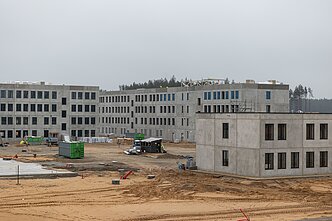
“The first strategy is that our country needs to prepare. We need to build military bases, expand training areas so that we are ready – here, in place – to receive a brigade.”
“The process might take a few years,” he added.
Due to Russia’s invasion of Ukraine, the Baltic states hope to secure additional NATO commitments in the upcoming summit in Madrid later this month.

Pre-assigned forces
NATO Secretary General Jens Stoltenberg confirmed that Berlin wants to station its troops in Germany rather than on Lithuania’s soil, adding that final decisions on forces in the alliance’s eastern flank had yet to be finalised.
“It remains to be decided on the exact details of the new force structure and the implications for specific countries, as for instance Lithuania, but what I can say is that it entails different elements and one element is more forward presence,” Stoltenberg said during a media event on Wednesday.
He noted that Germany had already doubled its presence in Lithuania with “almost an additional battalion” to its existing battlegroup.
“Second, there will be headquarter elements, which is extremely critical for operating commanding and controlling any reinforcement big or small,” Stoltenberg said.
According to the secretary general, while pre-assigned forces may not be deployed permanently in Lithuania, “but the new things is that they will be earmarked, pre-assigned for that specific territory, meaning that they will train, they will rotate in and out, they will know the country, the territory they have worked together on interoperability working with the home defence forces and they have pre-designed tasks”.

Newsletter
Every Friday morning.