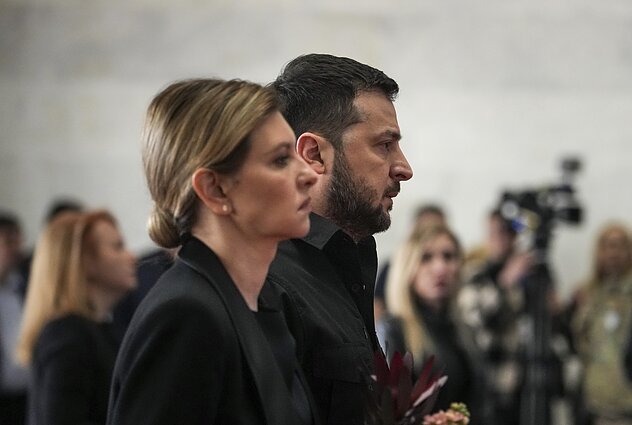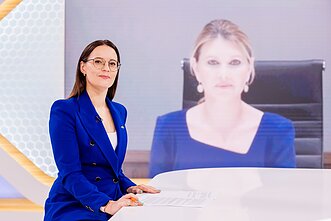















When Russia invaded Ukraine, President Volodymyr Zelensky may have been the first target. His wife, Olena, would have been next. In an exclusive interview with LRT RADIO, she speaks about her decision to stay in the country, the role of women in war, and the traumas the younger generation will face.
More than 100 days have passed since the invasion began. Every day, we see Mr Zelensky standing in front of the cameras, in front of the leaders of other countries. He himself is a leader, not only in his own country, but in the world. But how have the last few months been for you?
Those 100 days were the same as for all Ukrainians. Waiting for news and hoping it will be good. Unfortunately, we heard more and more bad news. Together with my husband we are trying to bring the victory closer so that it comes as soon as possible. Other Ukrainians are doing the same. To wait in those two months was very difficult. But I know that we will reach [victory].
You yourself are actively involved in various support initiatives and have contacts with foreign representatives. You have also recently opened a Ukrainian Centre in Vilnius. Tell us about its significance and how it will help Ukrainians?
First of all, we had to take care of those people who left Ukraine - women, children. They just needed to be helped to settle down and to deal with the problems they face. That is why, together with my colleague and Lithuania’s First Lady Diana Nausėdiene, we opened such a Ukrainian centre in Lithuania.
It is important that Ukrainians need more than just a roof over their heads. We need to think about how to help them find work, how to help their children go to nurseries or schools, how to help them get medical care, how to make their stay in another country safe and comfortable, and, most importantly, how to make them feel dignified.
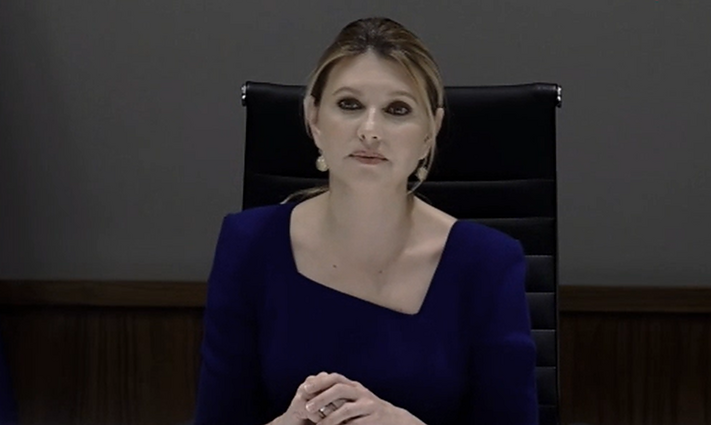
At the beginning of the war, there were offers to leave the country. The fact that neither the president of Ukraine nor your family made such a decision was both surprising and commendable. How was the decision taken in the family when you know that your husband is the first target?
Perhaps choice would not even be the right word. Choice is appropriate when you have a wonderful, peaceful life, and here there was no choice. When there is a war, what choice does a mother have – to defend her child or not to defend her child? She simply does not have that choice.
Or what choice does the soldier, the man or the boy who has to defend his country have? He simply must do it. I think the word 'responsibility' is important here. We have each done responsibly what each of us would do in our place.
In very simple terms about my decision, I made the choice without thinking – I stayed. As for my husband's choice, I think he did not even think about leaving the country. I think he had decided from the very beginning to stay with his country.
You recently gave a presentation at an international conference on women in war. Right now, you are the woman who has a story to tell, who has seen everything with her own eyes, who has held their hands, who has comforted them. What is the experience of Ukrainian women in war, who not only see off their husbands and children, but also participate themselves? Is it possible and how can it be done?
In war, we are all unique – we do not have a common family. It is very difficult for women, but in spite of that, they are very active, they take an active position – a leadership position. There are more than 37,000 women in the Ukrainian army.
For me personally, the most difficult thing was to communicate with women who had lost their children. It is difficult to look them in the eye and find words of comfort when you know that the number of casualties is very high and can only increase as time goes by.

War is indeed very damaging to children and leaves them traumatised. Children see the atrocities of war, they lose their parents, they die, they are injured. How do you think the war in Ukraine will affect the younger generation? How can we help them?
Children are the most vulnerable category. When they see the atrocities of war, when they see their parents killed, when they experience atrocities themselves, they are psychologically traumatised.
We now have dozens of children who have lost their legs or arms as a result of serious injuries. They need prosthetic procedures, treatment and rehabilitation. My aim is to find as many hospitals abroad as possible that can accept children for free treatment and prosthetics. So that they can go with their loved ones, so that they can get back to life.
As far as the psychological trauma is concerned, when children lose their homes, their loved ones, they suffer a deep trauma, which will have consequences for the entire younger generation.
There is now a National Psychological Programme for the country, and it is very widely supported, with the participation of renowned international organisations. We are trying to involve as many people as possible who have specialisations or experience. We have started to develop one programme with the Israeli army, we are trying to retrain military psychologists to be part of this programme.
And the importance of the programme is that it will continue after the war. I am appealing to all those who are involved in psychological support to help us as much as possible.
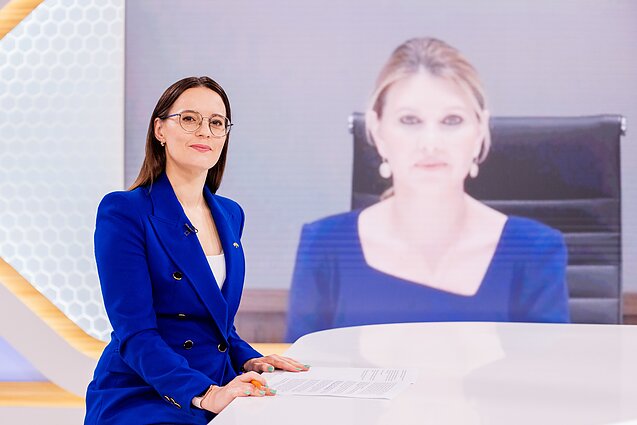
Let us move, I hope, into the near future. What do you imagine the day will look like when the war in Ukraine is over?
This is the ultimate dream of Ukrainians. What could it be? Of course, it will be a very vivid [day], the most vivid in our lives. But we are already thinking about reconstruction.
We must reconstruct not only our buildings, but we must renew ourselves as people. Of course, we have big plans to rebuild our schools, our hospitals. The occupiers have already destroyed over 600 schools and 600 hospitals. This is a very big field of work, but we see a good future in Ukraine. We will make it even better than before.

Newsletter
Every Friday morning.