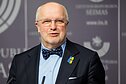











By attacking Ukraine, Vladimir Putin is replicating the conditions that led to the dissolution of the Soviet Union three decades ago, argues Paul Goble, an author and expert on ethnic and religious questions in Eurasia.
In an interview with LRT.lt, Goble speaks about the possible dissolution of the Russian Federation.
A large part of those killed on the Russian side are soldiers from the minority-dominated regions of Russia. We hear explanations that often there are very few opportunities for any kind of career outside of the military in those regions. But do you see any signs of growing discontent there?
There certainly is growing discontent. The number of men coming back in caskets is large, and it can’t easily be hidden. People are angry that they are there, and their nations are suffering disproportionately.
You’re absolutely right. In the poor regions of Russia (that includes both ethnic Russian regions that are far from Moscow, as well as non-Russian regions), military service is a sort of requirement to get to work for the police or some other entry-level position in the government. And so, a disproportionate number of people from those places now serve in the Russian army. It’s probable that something over half of the Russian military consists of either non-Russians or ethnic Russians from the faraway regions.
So yes, they’re angry. There’s a sense that they aren’t getting the compensation that the government has promised. They’re far more aware than people in Moscow about the cost of the war [...]. Some people believe that the war should have never been started. Others think it should be ended as quickly as possible. And some think that other parts of Russia should be paying a bigger price.

Do people in those regions believe the state propaganda about the special military operation and the fight against Nazism? Or are they not connected to this narrative because they are further away from the main centres?
It’s probably true that the greatest suspicion of the anti-Nazi narrative is found in urban centres, where people simply have more things to compare it with. If you live in a Russian village 2,000 kilometres from Moscow, you’re going to have less information.
That doesn’t mean that people aren’t cynical about what they’re told. But it means that they don’t have an alternative narrative to go to. So, while I think there is growing cynicism about what the Kremlin is saying, I don’t think that it has grown into agreeing to an alternative narrative that could become the basis of mass protests yet [...].
You have noted in one of your previous pieces published online that some movements are formed in those ethnic regions, the League of Free Nations. Do you see this as a sign of growing discontent as well?
It’s important to know that the League of Free Nations was created by people who are from non-Russian areas but in emigration. These are the people who’ve already had to flee. Do they reflect a point of view of the republics they come from? Undoubtedly. Is it a mass phenomenon yet? No, I don't think so.

This is the beginning of a process. What you’re seeing is an unwillingness among non-Russians to defer to Moscow’s Russian opposition and a desire to find their own way [...]. The anti-Russian movements in the non-Russian republics want either federation or independence. From Moscow’s point of view, a demand for independence is much more radical than even demanding a change in leadership in the Kremlin.
Russian President Vladimir Putin and his regime have been dismantling the federal structure step by step over the past decades. Where could this lead with the growing discontent over the war in Ukraine?
I think that Putin has been opposed to federalism from the beginning. He’s dismantled the system. Russia is a unitary state, run by a dictator in the Kremlin, which has lines on the map that suggest otherwise.
The mistake that Putin is making is the same mistake that was made at the end of Soviet times. The Soviet Union did not fall apart because Gorbachev liberalised things. The Soviet Union fell apart because after Gorbachev had liberalised things, he got frightened and turned to the right.
Non-Russians in the Russian Federation have experienced greater freedom that has now been taken away from them. That makes it more difficult to imagine the emergence of a genuine Federation and far easier to imagine that in the coming years, we will see various parts of the Russian Federation, including Russian areas, move to acquire independence. I wrote a piece not long ago in which I argued that Putin isn’t restoring the Soviet Union – he’s restoring the conditions that made the demise of the Soviet Union possible.

This process would probably be very bloody and brutal?
This time around, it will be. The amazing thing in many ways is how little violence there was in 1991 [when the Soviet Union collapsed] [...]. This time around, there will be people in the streets, they will have guns, there will be the FSB, the parts of the army. And so, you will have a conflict that will be much more like Yugoslavia than the Soviet Union’s demise in 1991.
That frightens people. One of the grave dangers right now is that many people in the West, who were reluctant to support the demise of the USSR, are even more frightened of the demise of the Russian Federation, forgetting that the Russian Federation is every bit as much an artificial creation as was the Soviet Union. But they’re frightened of the fact that there’s a man in the Kremlin now, who threatens to use nuclear weapons, and there’s a tendency of not wanting to challenge him in any serious way.
But as I said 30 years ago, what the West says and does doesn’t matter as much as people in the West think it does. Some of these things are going to happen because of what the people on the ground want.

Do you see the capacity for these changes inside Russia? Could there be intellectual and political leaders emerging?
I believe that within a few years, we will see parts of the Russian Federation break off, and there will be a reordering of the remainder of the country that will be more decentralised.
One of the things that’s been true of Russian and Soviet history is that every time you have a leader who moves in one direction, he is followed by a leader who moves in the exact opposite direction.
You had Stalin go in one direction, then you had Khrushchev go in the opposite direction. And you had Brezhnev go into something like Stalinism, then you had Gorbachev who was more like Khrushchev. Afterwards, you had Yeltsin moving in a more open direction, followed by Putin, who moved in a more reactionary authoritarian direction. I see no reason to think that this pattern in Russian history isn’t going to be repeated. [...]

In the Russia-occupied regions of Ukraine, the Russians are organising referendums, proclaiming that those regions have the right to choose their own destiny, whether to join Russia or not. Do you think this might backfire?
Absolutely. I think that Putin is playing with fire. [...] By casting this in terms of a Kosovo-like national self-determination right, he has proclaimed a principle that can be used by others against him, and I expect it will be. [...]
Had Putin behaved differently, he could have had a very different relationship with Ukraine. But like many Russian imperialists, he can’t imagine a world in which Russia isn’t dominating other people and doing so by force.
But the Ukrainian people are heroically showing that they’re no longer prepared to bow down to Moscow. And if you’re really cynical, you could say that the quickest way for the Russian Federation to fall into pieces is for Putin to annex Ukraine. Because if he does so, then there will be a country centred on Moscow that will not be two-thirds Russian but only 50 percent Russian. We remember what happened the last time that a country centred on Moscow had a population that was only 50 percent Russian. It fell apart. And the pressure to have it fall apart now is greater than it was in 1990 and 1991.

Newsletter
Every Friday morning.