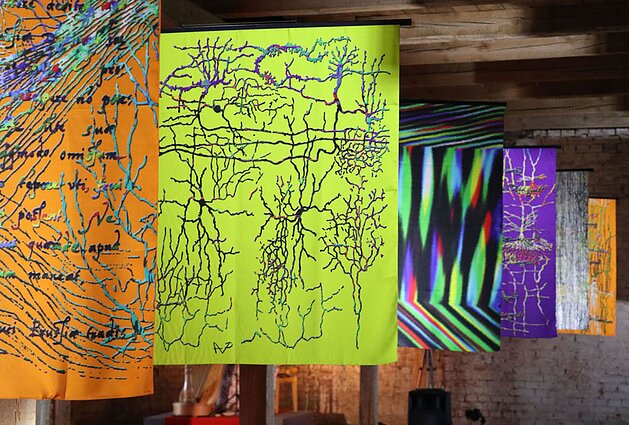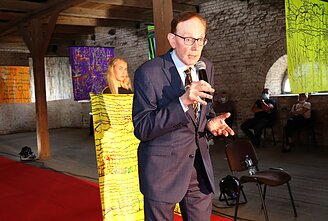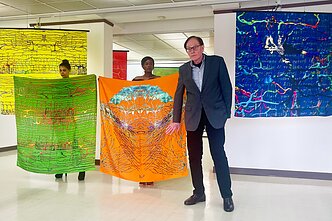















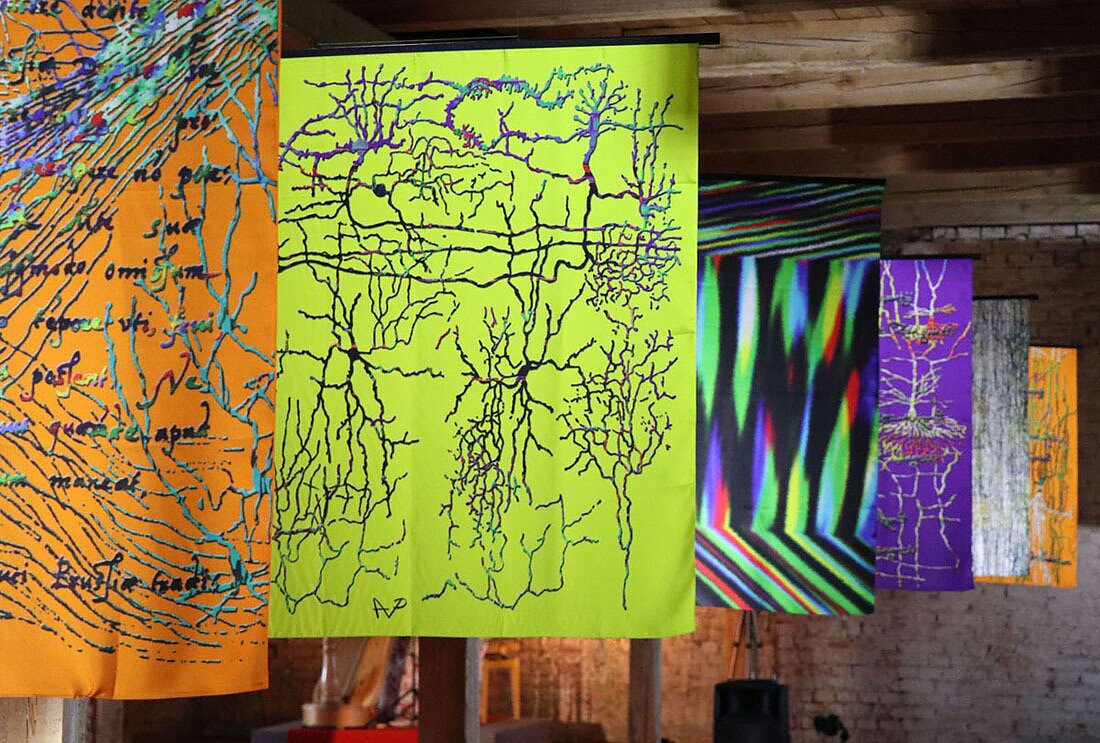
Audrius Plioplys is both a professional artist and neuroscientist. Four decades ago, he turned his art studio into a neuroscience research laboratory, where he is now producing contemporary artwork – silk scarves that capture the layers of human consciousness and thought.
Plioplys was born into a Lithuanian emigrant family in Toronto but is now living in the US. He became interested in art as a child, he said.
“One of my friends was two years older than me. He was a punk, always causing trouble. […] One summer, his parents enrolled him in art school for peace of mind,” Plioplys told LRT.lt.
“I used to see him a lot. He had a white canvas with lines. The next time, the colours appeared. A couple of weeks later, it was a complete work. He took it and made such a beautiful thing out of nothing. I was amazed at how you can create such beauty from scratch,” he added.
Later, Plioplys decided to study medicine. But on top of his studies, he painted surrealist paintings, studied art, and frequented galleries and museums. Despite doubts that he chose the wrong studies, Plioplys’ friends discouraged him from quitting, he said.
But after graduating, the pull toward art became even stronger. Plioplys abandoned medicine altogether and devoted himself to art.
“My paintings evolved into installations that incorporated light and sound systems. Ivan Karp, founder of OK Harris Gallery in Soho, who discovered Andy Warhol, said my artworks were the most original he has ever seen. It was a great achievement for me,” he said.
But in a few years, he became remorseful that he had so much medical knowledge and did nothing with it.
“Then, I realised that I was making a fundamental mistake – I was convinced that I had to choose either art or medicine,” Plioplys said. “And I thought – I’m smart, I graduated from a top medical university, there has to be a way to reconcile the two. I went back to medicine and realised that my art could answer questions about neurobiology.”
Lithuanian roots
In his works, Plioplys combines three dimensions – deep content, inner subconscious dialogue, and visual elements. Lately, he has been displaying his work on silk scarves.
“I am looking for new ways to express art, not just hanging it on the wall or putting it as a statue,” he said. “I wanted to do something with fashion. At first, I thought about dresses, but it was too complicated because people come in different sizes, and the cost of making them would be cosmic.”
Plioplys’ works also deal with various social topics, such as equal rights and immigration. He also pays attention to his roots, which is why Lithuanian motifs often appear in his works.
Plioplys was born in Toronto, Canada, and later moved to the US. He has both countries’ citizenship. However, his parents are Lithuanians, so he still speaks excellent Lithuanian and maintains close ties to his homeland.
He is an active member of the community, which brings together visual artists who grew up in Lithuania’s Sūduva region and have spread around the world. Plioplys first exhibited his NeuroArt scarves in Virbalis, a town in Western Lithuania, in 2021. In the same year, he organised exhibitions and fashion shows in Marijampolė and Vilnius in Lithuania, as well as Chicago in the US.
Plioplys will present his latest work in Marijampolė on June 10 and Virbalis on June 12.

Newsletter
Every Friday morning.