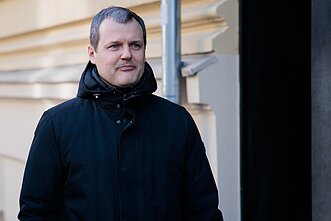











In an exclusive interview with LRT.lt, commander of Estonia’s armed forces, Lieutenant General Martin Herem, talks lessons from the war in Ukraine, the defence plans of the Baltic states, and the “strategic dilemma” now faced by the Kremlin.
How would Finland joing NATO change Estonia’s outlook as well as the defence outlook of the three Baltic states?
That makes up for us much easier to defend our country especially from the sea and in the air. Even more when Sweden follows Finland, all the situational awareness [around the Baltic Sea] will come much easier, [bringing] possibilities to influence the Russian Baltic fleet. Basically, the Baltic Sea almost become the inner waters of NATO.
I hope that Finland and Sweden joining NATO gives a signal to the Russian society that it is not against Russia, it is because of Russia.
On the ground level, what in particular that would change for the Baltic states?
Particularly in the sea. I think that is the first thing. We do cooperate with Finland, also with Sweden, also with Latvia and Lithuania. But the main cooperation, which will develop very quickly, is the sea. Now we can much better make situational awareness, all around Baltic sea we have our sensors. Then also, if there is any threat we can have the kinetic impact capabilities of the sea assets.

There was once a lot of buzz about NATO not having up-to-date Baltic defence plans. Has there been progress?
We have the plan and we develop a next plan, the current plan. The war in Ukraine has made us […] not happy with the situation. [...] We want an even better plan, faster units, more capabilities, more understandable, more practical, more realistic [plans]. And this is what we actually do in NATO.
"You must be ready, from tomorrow, that Russia crosses its border. And then you have to act, and not just in a polite way."
Of course, it is not always as fast as we would like, because, at the same time, we are members among 30 nations. We must also be patient, but things are going better at the current moment and it started to develop [faster] even before the escalation of the Ukraine war.

You were one of the few senior officials to speak publicly that the war in Ukraine is coming. Why did you make the decision to speak about this publicly, to warn that the war is coming?
We all had intelligence already at the end of last year. It was in the media that the Russians are moving troops close to Ukraine and also to Belarus. Everyone saw it. But I think until the end, [Russia's aims] were to threaten, not move toward war. But since in December, the Putin’s government gave their demands to NATO, [...] there was no compromise possible. What they said to NATO – to not protect the Baltic states, and the Baltic states are not allowed to conduct exercises bigger than a brigade [level]. That was already offensive rhetoric and politics toward NATO, which they knew exactly that they will not get what they ask.
"Because I know if they [Russian forces] come to Narva, then I will see Lithuanian [troops]."
Why did they do this? They are always trying to find a reason for the conflict. So, finally, when they started to accuse Ukraine of fascism, [...] then it was very clear. [...] They were moving physical forces but they also started to explain why they are doing it -- to invent the reasons and excuses. That’s why, for me, it was highly possible or highly likely that there will be the escalation of the war.
And, the last time, when I was absolutely sure that it was a matter of hours, it was February 22, the [Russian President Vladimir] Putin’s speech. Then, he basically made a declaration of war.

In your opinion, are we at war?
There is a hybrid war against the West, where Ukraine is mostly in a conventional [war], it is also a hybrid, but conventional operation is happening there, but we are in a hybrid war, in war that we described a few years ago.
Our economy is hit, prices are going up, the resilience [and] psychology of the population is hit, they are scared a little bit, they think much more about the threat that is coming from Russia, we have refugees. We have difficulties when, in hybrid warfare, they make use of relations between states. They put us in the situation that [we say] Germany did not enough, and this country is too slow, it is very good for them.
"Please, you [Russia] block my Suwalki, I block your Finnish Gulf."
It is moving us, West, closer to instability and that is what they enjoy, the muddy waters around them. Then you can spread your culture, for example – the fear, corruption, all the things, which are very characteristic for the Russian statehood, culture, and also the prison culture.

Are there any immediate lessons from the war in Ukraine that the Baltic states should take into account?
If you want to deter, you must be ready. For me, I think we must […] pay more attention to more realistic and practical defence, and that will deter. Not so much to show all kind of elements of our military and political activity and then to hope that Russia is deterred. No, you must be ready, from tomorrow, that Russia crosses its border. And then you have to act, and not just in a polite way.
Are the Baltic states not living up to their deterrence task?
So far, it has worked, but it seems that the Russian government and Putin are taking bigger and faster steps toward the West. […] The objective is instability. Russia cannot occupy the Baltic states, they cannot occupy Eastern Europe, they do not have power for that and I think that they do not want that.
They may do it temporarily, seize some territory, but what they [want to] achieve is the destruction of our culture – way of living – our culture of economy, culture of politics, our values.
They want to export their own values, which is sure that you must listen to what Russia says, they are so big, and if you don’t, they will smash you or hurt you. […] If you are basically a gas station with nuclear power, you earn money through resources and you do not invent anything, then it’s maybe a very wise way to live.

As a commander, how much do you have to take into account the defence issues of Lithuania, such as the so-called Suwalki corridor? In case of any armed escalation, how can the Baltic states assist each other?
Firstly, we are one operational area and we must say that if one of us is hurt, then it has influence on the others.
Suwalki is always seen as [a way] to block us, but they [Russia] may need Suwalki not to block, but to make a connection [with Kaliningrad]. To block, you can just destroy the roads and railways. Then you just monitor when we repair it, you destroy it again. It’s quite easy.
What we will do, and I promise you, in three years, we will do the same with the connection between St Petersburg and Kaliningrad in the [Baltic] Sea. Then they need [the Suwalki] connection, not block, and that’s more difficult. Please, you [Russia] block my Suwalki, I block your Finnish Gulf. But I need the time, just give me two years; we already have sea mines.
The Suwalki gap – gate, line, whatever – that is not only our problem. Next year, we will get the capabilities to cause a strategic dilemma for Russia. We may close the Baltic Sea communication line [between Russia’s exclave of Kaliningrad and St Petersburg], and then the Suwalki gap is not a gap, […] but they need it even more [themselves].
To keep this corridor open, they may need a lot of forces, first against Lithuania and Poland, because you cannot make this connection just on Lithuania’s territory.
It does not matter what happens, we must have the plans, we must understand what Russia could and can do, and then we must be able to react, like we did on a very small scale last summer when Belarus was organising migrants. Then, we also sent our very small [number of] troops to Lithuania, later also to Poland, just to show to Russia and Belarus that if you deal with one, you will get all of us. Because I know if they [Russian forces] come to Narva, then I will see Lithuanian [troops].

Newsletter
Every Friday morning.