












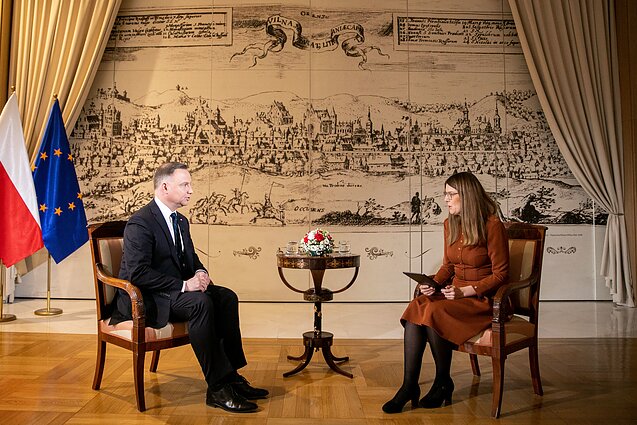
In an interview with LRT, Polish President Andrzej Duda discusses Russian imperialism, Europe’s dependence on Russian energy, and his hopes for a “historic” friendship among Poland, the Baltic countries, and Ukraine.
The world changed on February 24. Before that, we heard about supposed Nazis and Ukraine not being a real country. But why, do you think, Russia launched this war?
The essence of this war is the same as it has always been – to extend influence, to take territory, to increase the Russian empire. Russia cannot tolerate an independent, sovereign, free Ukraine that wants to decide everything for itself. And it has that right, because it is a country recognised by other countries, and the Ukrainians, who participate in elections for the presidency and the parliament, decide for themselves in which direction their country should go. However, as we can see, the Kremlin cannot tolerate this and has decided to attack Ukraine.
What you have quoted is nothing more than Kremlin propaganda, which tries to take away the humanity of Ukraine. It is not true. The most important thing is that the Russians believed that they would occupy Ukraine quickly, that the Ukrainians would surrender. They thought that the Ukrainians did not believe in their own state, but it turned out to be the other way round. They have shown not only to themselves, but to the world, that they are prepared to give their lives, and they have been fighting for more than two months against an army that is much stronger. They are showing their heroism and they deserve honour.
Russia has never recognised the crimes of Stalinism and has never understood that, for some peoples, their so-called liberation was in fact occupation. Could this have been the reason behind the revival of imperialism in Russia?
Russia has always had imperial ambitions. It is safe to say that this has been the case for several centuries. Polish territory was occupied back in the times of the tsars. Several days ago, we celebrated the anniversary of the May 3 Constitution [of 1791], a very important document. A very important governance act was adopted 231 years ago, which was supposed to save the Polish-Lithuanian Commonwealth from being completely destroyed, from being given over to Russian influence. The Constitution, which was adopted, was a source of much joy and hope, but it was not implemented. Why? Because the second partition took place immediately, there were other acts of aggression against Poland, and in the end Poland disappeared from the map.
It was off the map for 123 years, and when it came back, in 1920, Russia invaded Poland. The Communists wanted to take their communism to Paris and beyond, they wanted to spread their communist ideology all over the world. In August 1920, we managed to stop them at the Great Battle of Warsaw.
We can see that these tendencies, these desires to expand their imperial ideology have been there all along. Then came the Second World War, after which, once they [the Russians] were liberated, they did not return home, they remained on our soil. The Red Army units remained, terrorised Poland, imposed a communist system, and we remained under that system until 1989.
We know and we see that, 30 years later, it has all resurfaced again, and Russia is once again trying to subjugate our part of Europe. In 2008, it attacked Georgia, and then President [Lech] Kaczyński said that Russia’s imperial ambitions had been revived again, that today it was Georgia, tomorrow it would be Ukraine, the day after tomorrow it would the Baltic States, and then it would be time for my country, Poland. Unfortunately, these words were prophetic for Ukraine, where the war has been going on since 2014, when Russia first attacked it.
Poland was one of the first countries to extend a helping hand to Ukraine and has provided political, economic, and military aid during these last two months. Since the start of the war, the Poles have already taken in millions of refugees, which has come at a price: constant threats against Poland from top Russian officials. Do the Polish authorities fear that Russia may attack Poland?
We are doing what we believe is right, helping those who did not start the aggression but are suffering as a result. We are helping the Ukrainians and the Ukrainian state. My compatriots are helping people who are fleeing, mostly women, children, and the elderly. There are now more than two million in Poland. People from all over Poland have been going to the border and inviting complete strangers into their homes, to take shelter under their roof. Nobody made them, nobody encouraged them, nobody ordered them – neither politicians nor clergymen – people did it of their own free will, out of the goodness of their hearts. I am very grateful for that, and I have said many times in the last few days that the Poles are a wonderful example.

As for military aid to Ukraine, it is already worth more than 7 billion zlotys. That is approximately 1.7 billion US dollars. In terms of our capabilities, this is a lot of support: we have provided 200 tanks, bulletproof vests, helmets, so that Ukrainian soldiers are better protected. We have given a lot of help because we think it is the right thing to do. We support their courage and their desire to defend their homeland, so we are giving them the means to defend it.
But what about threats against the Baltic states and Poland?
First, we have our own army, we have our own soldiers who will defend their homeland in the event of any attack. We would all go into battle and, as you have seen, it is possible to defeat Russia. Second, US President Joe Biden was in Poland recently and he said very clearly: Any attack against NATO countries – be it the Baltic states, be it Poland, Slovakia, or any country – will be met in accordance with Article 5. The US president stressed the validity of NATO’s Article 5 and that the American army under his command is the strongest one in the world. I will not say too much about it, but I believe his word, I believe that, if necessary, NATO troops will defend our countries.
You said today at the opening of the GIPL pipeline that, for many years, Europe did not want to hear what Gazprom really was. Even today, there is no total unity in the European Union. Hungary is promising to block the oil embargo. How long will the sanctions last and will we go back to business as usual after the war is over, allowing Russia to regain forces for a new war, probably against one of the EU countries?
It is a pity, but there are countries and politicians who think that we can go back to business as usual without giving any thought to how the Russian authorities are acting. It is an authoritarian government and they are now considered war criminals. We need to call things what they are. I hope they will all be prosecuted.
For many years, we’ve been told that Russian companies are just businesses, that giants like Gazprom operate under market conditions. We were saying all along that nothing could be further from the truth. These are not normal companies, they are tools of imperial Russia to increase its influence. Above all, it is the influence of the empire; economic considerations are only second or third in line. There were football teams in Western Europe sponsored by Gazprom, the company sponsored the European Football Championship. How many other fields where Gazprom was promoted?
Russia pursued a policy of domestication, but it wanted to have a monopoly on the European market by building pipelines such as Nordstream 1 or Nordstream 2. A monopoly would have allowed Russia to blackmail countries, they would have lost sovereignty. When the Nordstream 2 project was halted, Russia realised that the plan would not work.
As we were diversifying our gas supply and signing an oil supply deal with Saudi Arabia through our company PKN Orlen, Russia realised that its influence was waning, that countries were concerned about their security, concerned about the security of supply of raw materials. The result of all this is the current war.
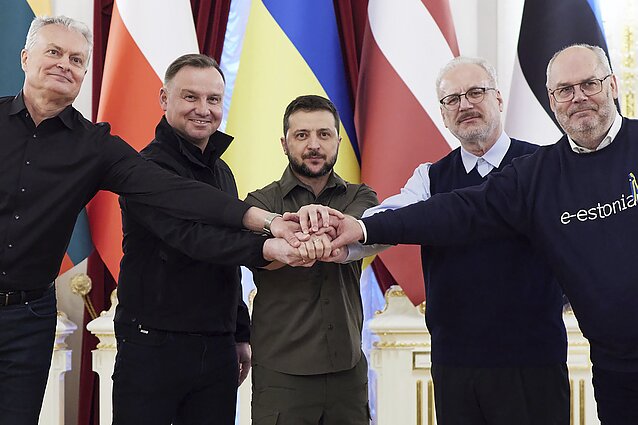
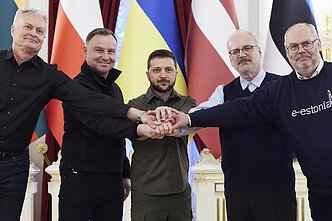
In your recent speech, you mentioned a photograph from Kyiv of yourself, President Zelensky, and the presidents of the Baltic states. You said you hoped the image would become historic. Obviously, our region has a different perception of threats, so if that photograph were to appear in history books, what would it say about cooperation in our region?
All our nations, including Belarus, used to be part of the Grand Duchy of Lithuania. Since King Jagiello took the throne, we were all part of the First Rzeczpospolita. We were our strongest then. Together, we were able to repel any enemy, any aggressor.
Of course, there were many wars, but together all these nations were able to win those wars. That great state survived in spite of the attacks of the Crusaders, in spite of the attacks of the Turks, the Russians, the Tatars. It was able to defend itself, it was very strong.
You have to look from that perspective and say that the presidents who were able to stand together in Kyiv, where bombs were falling, and shake hands with each other are a sign of brotherhood. I hope that it will remain so for decades to come, perhaps centuries.

Newsletter
Every Friday morning.