









Russia's invasion of Ukraine was a blow to ordinary Belarusians. Their country’s territory is being used as a springboard for Russian planes to bomb Ukrainian cities. Despite Lukashenko’s support for Putin, many Belarusians in Belarus and abroad are engaged in war on the Ukrainian side.
On February 24, the first message that woke up Ihar (all names have been changed – AV), a Belarusian residing in Kyiv, was from his Ukrainian friend: “Russia has attacked Ukraine. And so has your country.”
Ihar had lived in Kyiv for a year and a half – in August 2020, he was detained on the street in his native Minsk, from where he had to flee repressions after spending a few days in prison for participating in peaceful protests. Now he had to leave everything for the second time and run into the unknown.
Belarusian SIM cards are no longer working in Ukraine and Belarusian bank accounts have been blocked: the last payment made by many Belarusians was a donation to the Come Back Alive (Povernys zhyvym) Ukrainian fund.
While queuing for evacuation from Ukraine, Ihar faced the first insults because of his passport. Today Ihar is in one of the EU countries, he is helping to receive refugees from Ukraine, engaged in accommodation logistics, translation, consulting. He does not know where he is going to stay, when he will see his parents, and what he will have to do. The most important thing for now, he says, is to stop the war.
There are thousands of such stories among Belarusians from Ukraine alone. And the largest number of Belarusian refugees – many tens of thousands – have remained in Poland and Lithuania since 2020, where people from Ukraine are also fleeing today.
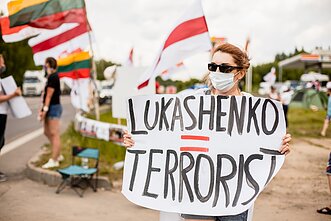
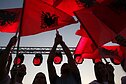
In the EU, Belarusians actively help to support those fleeing the war in Ukraine and develop their own initiatives for that. At anti-war rallies across the EU and North America, white-red-white Belarusian flags are seen next to the yellow-blue ones.
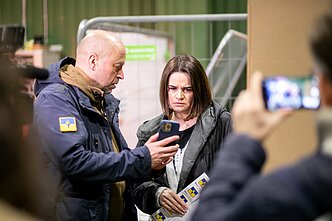
On February 24, Sviatlana Tikhanouskaya, an exiled leader of the Belarusian opposition, announced the launch of the antiwar movement in Belarus. In the movement’s daily reports, one can learn about the efforts and involvement of the Belarusian diaspora in Ukraine and third countries on the Ukrainian side, as well as actions against aggression from within Belarus.
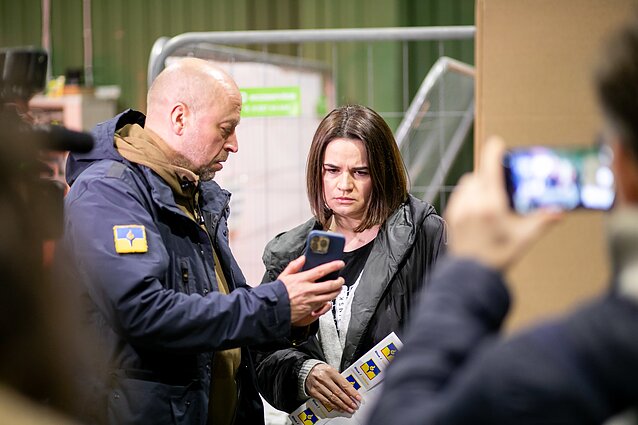
Belarusians have assembled a humanitarian aid minibus for Ukraine in Białystok, Poland, which will travel to Lutsk. Bologna Belarusians have drawn up a map of humanitarian aid collection points for Ukraine throughout Italy. Belarusian medical team Okdoc.me provides free medical advice to Ukrainians. Some 20,000 Belarusians perform a Dvizhbot antiwar task, blocking propaganda accounts on TikTok and Instagram.
In Belarus itself, a vast majority of people (according to the Chatham House poll) does not support the war and even believe that participation in it will have catastrophic consequences for Belarus. According to more recent data, only three percent of the urban population of Belarus support their country's participation in the war on Russia’s side.
Thousands of users on social networks have supported a flash mob with tags in Belarusian saying “Belarusians against” and “No to war”. On February 27, tens of thousands of Belarusians protested in Minsk; 800 people were detained. Although, according to the Viasna Human Rights Center, detainees are being beaten and tortured, protests and detentions have continued for days.
There have been reports about arrests for prayers against the war in church, as well as a teacher arrested for wearing yellow and blue stripes in her hair.
Ana writes to me from Minsk: “I do not want to live because of the war in Ukraine. I’m so incredibly ashamed.” Ana could secretly take some pictures from the protest on February 27, but she is afraid to post them anywhere. In one of the photos, a woman is kneeling in front of the Ukrainian Embassy in Belarus, which has its fence all covered with flowers.

Human rights organisations in Belarus, such as the Belarusian Helsinki Committee, are disseminating their checklist on how not to fight on the side of the Russian Federation. One of the ways to avoid conscription to the Belarusian army is imprisonment. Among the 800 detainees on February 27 is my colleague Denis who had been refusing to leave the country for months, saying “someone has to stay”. Denis is now in jail. A friend tells me: “Maybe he felt mobilisation was almost inevitable and wanted to avoid participating in the war against Ukraine this way?”
Active resistance to war in Belarus often takes partisan forms. Cyber attacks and sabotage by Belarusian railway workers have prevented organised military echelons and ammunition of Russian soldiers from advancing toward Ukraine. Belarusian students have organised DDoS attacks against state university websites so that they do not operate as long as their administration is silent about the war.
Two Belarusian IT companies, Andersen and Gurtam, have announced they are severing ties with Russia and allocating 1.5 million US dollars to their Ukrainian counterparts. The IT giant EPAM, created by Belarusians, has allocated 100 million dollars to support its Ukrainian employees.
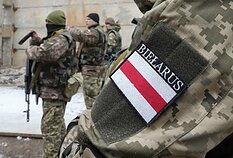
A significant number of Belarusians, who came to live in Ukraine at different times in the past, remain there and directly take part in the war on one side with Ukrainians. The Belarusian company in the Azov Battalion was the first of the foreign troops fighting on the Ukrainian side. Many Belarusians have joined territorial defence units in Ukrainian cities; in some units, such as the Kalinousky Territorial Defence Battalion in Kyiv, they comprise the majority.
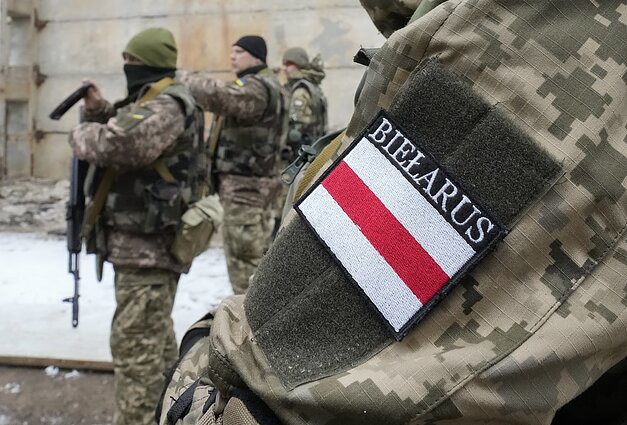
A support centre for volunteers fighting for Ukraine has opened at the Belarusian House in Warsaw. The centre is run by Pavel Kuchta, a brother of Mikita Kryvtsov (Mikita died in protests in Belarus in 2020). Belarusian military medics working in Ukraine form the Medical Solidarity Fund. Belarusian volunteer Ilya “Litvin” died in Ukraine in the first days of the war. Belarusians in Odessa have formed a group of volunteers named after him.
On March 13, another Belarusian who served in an elite unit of the Ukrainian military died near Kyiv. According to Vadzim Prakopyev, more than 200 Belarusians have joined Ukraine’s territorial defence, with another 300 going to Ukraine. In total, more than a thousand Belarusians have registered in person or online to join the Ukrainian side. Since March 12, the Ukrainian media have provided evidence that Belarusian military men categorically refused to take part in the war against Ukraine.
It is impossible to list all forms of Belarusian participation outside Ukraine, and some are risky to publish – even if their initiators are safe abroad, their parents and relatives remain in Belarus, where they can be reached by special services. Such cases have been regular since 2020.
Some believe that Lukashenko has not yet sent his troops to Ukraine because he sees the public sentiment and does not trust his army, not knowing which way they would shoot. In private chats, youngsters of conscription age are discussing how they could use weapons for the benefit of Ukraine once they are sent to the front.
It is hard to accurately estimate the overall impact of Belarusians’ anti-war efforts, but, as of March 13, Belarusian troops are still not officially in Ukraine. At the same time, Belarusians started an anti-war movement abroad and in Belarus, participating in defence and military formations, as well as in civilian assistance initiatives on the Ukrainian side.

‘We could do more’
“But sometimes I just want to give up,” Alena wrote on her Instagram. Alena is now helping to accommodate Ukrainian refugees arriving in the EU, and even in this role she has experienced several episodes of hatred from Ukrainians these days.
Ukraine's Intelligence Agency published a list of people whom it called Belarusian pilots attacking peaceful Ukrainian cities. In comments, dozens of people assure that the pilots are not Belarusians: from more than hundred surnames, none has a typical Belarusian ending: -ovich, -evich, -ionok, -enia, -eka, -euski, -itski. A look at any list of detainees during the protests in Belarus allows us to understand that, statistically, the list published by the Agency cannot be a list of Belarusian pilots. A few hours later, Radio Svaboda (RFE/RL in Belarus) confirmed the information: the list included pilots from Russia's Urals, not Belarusians. Ukrainian media did not publish a retraction.
Feeling grief, fear and shame, Belarusians are waiting for the logical conclusion of Lukashenko’s betrayal – the Belarusian army officially joining the war. Two weeks after its inception, they have no hope that the European Union will differentiate them from a criminal dictator who has been clinging to power through brutal means.
At the same time, Ukrainians blame the Belarusian government for the war (70 percent) rather than the people (24 percent); in the case of Russia, the figures in Ukraine are different: 55 and 38 percent, respectively.
However, when making high level political decisions, both Ukraine and third countries treat the occupied people of Belarus as occupiers: they refuse to issue visas to Belarusians, ban them from entering universities, and block their bank accounts. Lithuania is one of the few countries that provided protection to Belarusians fleeing repressions in 2020; but now relatives of the repressed can no longer obtain family reunification visas. Tens of thousands of Belarusian passport holders are afraid of losing their livelihoods and jobs, and even of being deported to Belarus, which for them would mean imprisonment and inability to do anything against the Kremlin’s aggression.
Andrei Vazyanau is a lecturer at the European Humanities University in Vilnius

Newsletter
Every Friday morning.