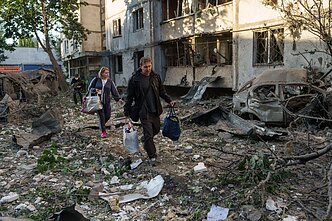







As Russian forces launched a military campaign against Ukraine in the early hours of Thursday, Lithuania is introducing a state of emergency, the president said.
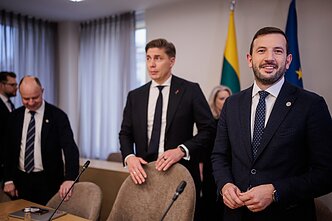
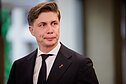
"Today, I will sign a decree on introducing the state of emergency, which will be passed by the parliament in an extraordinary session," President Gitanas Nausėda said on Thursday.
The state of emergency will be in place from 13:00 on Thursday through March 10. The decree allows a more flexible use of the state reserve and steps up state border protection.
Among other things, the authorities will have the right to stop and inspect vehicles, people and luggage in the border area.
The document says the Russian attack on Ukraine creates favourable conditions for hybrid attacks and provocations against Lithuania by Russian and Belarusian authorities, especially in the border area.
According to the decree, the situation poses a threat to Lithuania's national security and public order, which requires "the temporary imposition of emergency measures".
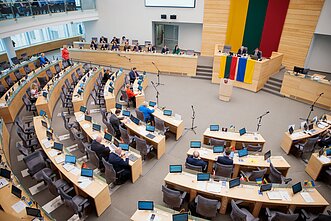
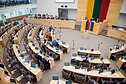
The Lithuanian parliament Seimas voted in favour of Nausėda's decree later on Thursday. The move was unanimously backed by all 118 lawmakers who attended the extraordinary session.
Prime Minister Ingrida Šimonytė said the state of emergency will not involve significant restrictions on Lithuanian citizens. "We need to provide conditions for state institutions to react to situations in the area of infrastructure, to use state reserve fund," Šimonytė told reporters.
President Nausėda said the EU sanctions should cover not just Russia, but also Belarus, where Moscow has deployed some 30,000 troops. "Aggression is being perpetrated from this country [Belarus]," Nausėda said.
Asked whether there was any danger to Lithuania, the president said: "Lithuania is safe, because it has been a NATO member since 2004. I've recently heard reassurances from all NATO state leaders that Article 5 is rock-hard."
Parliament Speaker Viktorija Čmilytė-Nielsen added that "although Lithuania is safe, it does not mean that we do not have to work on strengthening our security". By helping Ukraine, Europe is making the region more secure, she said.

Lithuanian leaders have strongly condemned Russia's invasion of Ukraine.
"Despite what Mr Putin says in his pre-recorded message about some special operation in Donbass, what is actually happening is a full-scale military invasion," Šimonytė told LRT TV, adding that reports are coming in about attacks on Ukrainian cities beyond the separatist-controlled regions in the east of Ukraine.
The Lithuanian prime minister said she spoke with her counterparts in Latvia and Estonia about asking NATO to evaluate the situation in Eastern Europe.

President Gitanas Nausėda called Russia's actions "unprovoked military aggression".
"We are witnessing Russia's criminal actions against Ukraine. We cannot remain indifferent to this unprovoked military aggression, which threatens millions of innocent lives and undermines the foundations of international order," the president said in an address on Thursday morning.
He said he was summoning the State Defence Council in order to "boost our combat readiness".
"I have already started active consultations on further actions with NATO allies and EU partners," the president said. "Our actions will have to include active support for Ukraine as well as heavy sanctions on Russia."
"Although there is no direct threat to stability in Lithuania, we have to assess the situation properly and act responsibly and with solidarity," Nausėda added.
Lithuania's Defence Minister Arvydas Anušauskas told LRT TV that around 10 Ukrainian cities were being targeted by Russian missiles. "Russia's war on Ukraine has begun," he said.
According to him, the West's diplomatic measures to prevent Russia from invading Ukraine "have failed". The Baltic States and Poland will propose to trigger NATO Article 4 on joint consultations of the allies, the defence minister added.

"As a rule, such consultations lead to generating some additional forces in one region or the other, and may lead to the activation of the rapid reaction force," he said.
"The State Defence Council is meeting at 9:00, and I have no doubt that it will be decided to […] ask NATO to invoke Article 4," Laurynas Kasčiūnas, chairman of the parliamentary Committee on National Security and Defence, told LRT TV.
"These consultations will focus on beefing up the defense of NATO’s eastern flank as a whole, and will also consider assistance measures for Ukraine," he added.
"We in Lithuania know it very well that Ukraine is fighting not just for Ukraine, but for us in the region, Europe and everyone in the democratic world. It is our obligation not just to punish Russia for its actions but to help Ukraine with all and every means available," Lithuanian Foreign Minister Gabrielius Landsbergis tweeted.
The Foreign Ministry has confirmed that Landsbergis has called off a visit to Kyiv that was planned for Thursday.
We in Lithuania know it very well that Ukraine is fighting not just for Ukraine, but for us in the region, Europe and everyone in the democratic world. It is our obligation not just to punish Russia for its actions but to help Ukraine with all and every means available. Now.
— Gabrielius Landsbergis (@GLandsbergis) February 24, 2022
Strongest possible sanctions
The Baltic foreign ministers strongly condemned Russia’s attack on Ukraine and called for strict sanctions against the aggressor.
"We, the foreign ministers of Estonia, Latvia, and Lithuania condemn in the strongest possible way the open large-scale Russian aggression against the independent, peaceful, and democratic Ukraine," they said in a statement that was posted by Landsbergis on Facebook.
Russia’s actions are unacceptable and are a flagrant violation of international law and norms, as well as a crime against the Ukrainian people, according to the ministers.

"All of us in the whole international community need to condemn it in the strongest possible way, to impose the strongest possible sanctions on Russia, including disengaging Russia from SWIFT and isolating it politically," the ministers said.
Cutting Russia off from the SWIFT international interbank settlement system would make most financial transactions with the country impossible.
There is also an urgent need to provide Ukraine with weapons, ammunition, and other military assistance, as well as economic and humanitarian aid, according to the statement.
We, the Foreign Ministers of Lithuania, Estonia, and Latvia, condemn Russia‘s open large-scale aggression against an independent, peaceful, and democratic state of #Ukraine 🇺🇦 in the strongest possible terms.
— Lithuania MFA (@LithuaniaMFA) February 24, 2022
Full Joint Statement 🔗 https://t.co/Rel1huH9fS#StandWithUkraine pic.twitter.com/VPVdynlsdW

Newsletter
Every Friday morning.