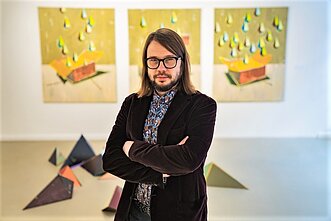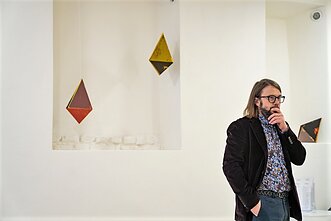








When it comes to their respective art markets, Lithuania is ahead of Latvia, says Andris Vītoliņš, a renowned Latvian artist who recently opened his second exhibition in Vilnius.
According to a press release by the Meno Niša Gallery, Vītoliņš is a Latvian painter, professor, and vice-rector at the Art Academy of Latvia. Since 1996, he has been participating in exhibitions in Latvia as well as Denmark, Sweden, Germany, Austria. In 2004, he won the annual award of the Latvijas Architektūra magazine for Best Debut.
Vītoliņš has long been interested in the industrial theme: machines, vehicles, mechanisms, factories and their parts – pipes, screws, taps, connections.
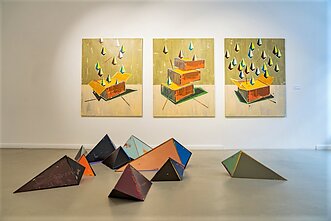
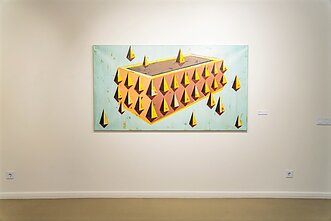
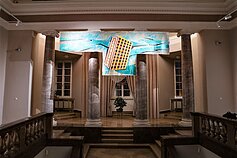
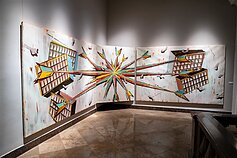
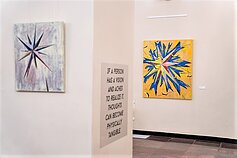
His exhibition We Need a Chance to Be Reborn is open until 26 February in two venues, Vilnius Town Hall and the Meno Niša Gallery.
In an interview, shared by the Meno Niša Gallery, Vītoliņš talks about the history of the exhibition, cooperation with Lithuania, the art market situation in Latvia.
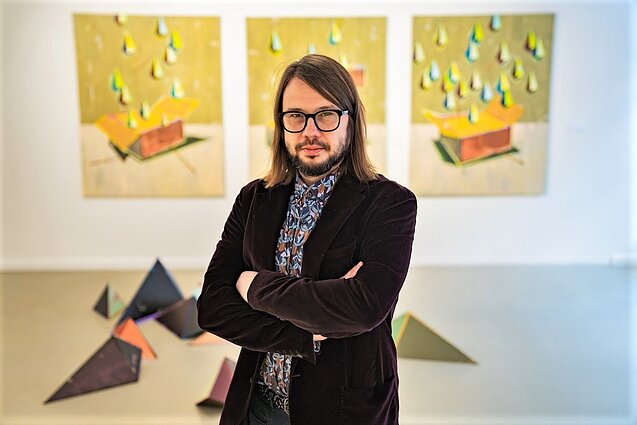
Andris, We Need a Chance to Be Reborn is your second exhibition in the gallery Meno Niša. Tell us more about how you started this collaboration.
The beginning of our collaboration can be considered the year 2009 when my work was exhibited at the first ArtVilnius event by Olga Temnikova, a gallerist from Estonia. Since then, in different formats, I have been a frequent guest in Lithuanian art life. As a result, in 2019, my first solo exhibition in Vilnius took place at the Meno Niša Gallery. Even then, we had the idea that we should continue our collaboration and try to make something bigger.
The exhibition is held in two locations: Meno Niša and Vilnius Town Hall. Why did you decide to do it in 2 locations? What does each location mean to you?
Many of my artworks are physically large in size, which requires epic and grand spaces. So back then, in 2019, we decided to apply for an exhibition in Vilnius Town Hall with the idea of having 2 exhibitions at the same time.
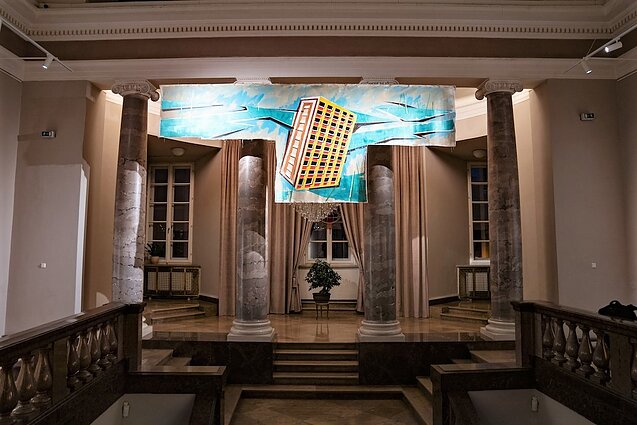
These venues are atmospherically very different: if Meno Niša Gallery is artistic, democratically intimate, then Vilnius Town Hall, by contrast, is majestically noble with a strong architecture of its era. For me, this exhibition is a single project in which the artworks create a synergy between these disparate places.
You are also known to Lithuanian art visitors from the art fair ArtVilnius, where you participated both as an artist and as the chairman of the international jury for selecting the best participants. What do you think about the Lithuanian art scene?
If we compare it with Latvia, it is now clear that Lithuania is well ahead of us. Latvia’s art environment was greatly affected by the privatisation of the 1990s, as a result of which we lost many exhibition spaces and art-supporting infrastructures. At the same time, the attitude of Latvian politicians towards the visual arts industry and economic mechanisms were not supportive. Now, slowly, these processes are recovering. For example, Signet Bank with its collection is supporting my exhibition in Vilnius.
Lithuania is on the right track in this regard, having its numerous galleries, ArtVilnius, the MO Museum, and the Lewben Art Foundation. All that is left is to work and achieve your goals.
Correct me if I’m wrong, but I know that the Art Academy of Latvia’s Experimental Art Space Pilot was also your initiative. Last year, visitors at the fair ArtVilnius’21 selected Pilot as their best gallery.
The idea of an experimental space where art academy students could express themselves had been on my mind for several years. I had a few prerequisites in mind. First, the space should be in the very centre of Riga so that it would be easily accessible to foreign visitors (this is important if we want to think about exporting art), second, the exhibition space should serve as a practical place for young curators and artists to grow, it should serve as a learning tool for the process. And third, the exhibition programme should be collectively negotiated and not serve the subjective wishes of one curator.
At every banquet or meeting where there was some conversation with politicians, I tried to convince them how forward-looking and beneficial it would be for our society. I remember five years ago we met with the vice-mayor of Riga and we presented our ideas. And so, thanks to a confluence of events, such as the EU4ART project and changes in Riga City Council, we managed to open the Experimental Exhibition Space Pilot in 2020.
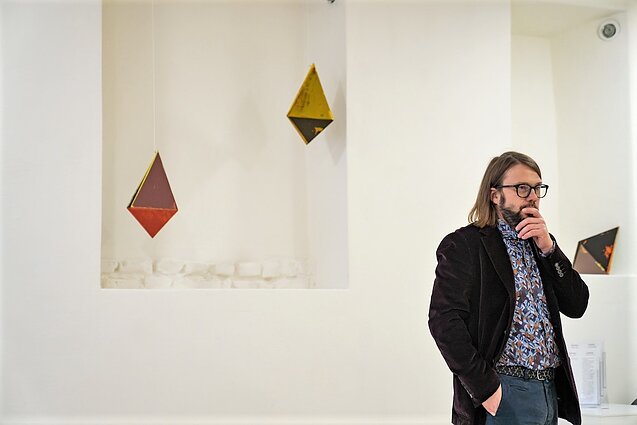
You have a master’s degree in painting from the Art Academy of Latvia and a bachelor’s degree in visual communication. In one interview, you said that was why your view developed differently than one of classic painters. Can you tell us more about your working methods?
Historically, most of the students of the Art Academy came to the painting department after graduating from the Rosenthal School of Art. They entered the Academy with a classical background in technically accurate painting and the use of oil paints. Until the 1990s, each department at the Academy was like a closed association, and students rarely “moved” between departments. I only came to the painting department during my master’s studies and before that, I had already been trained in various fields, including the design department.
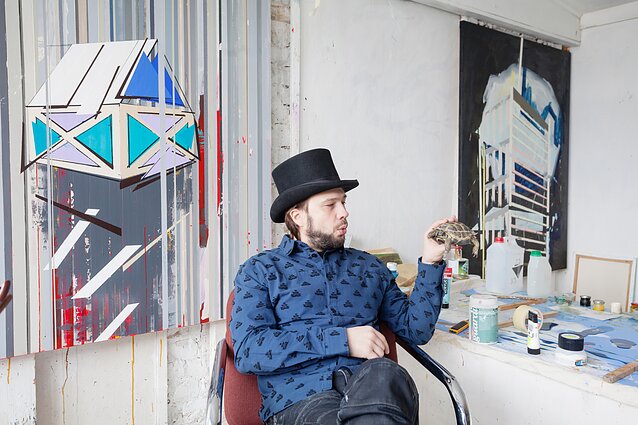
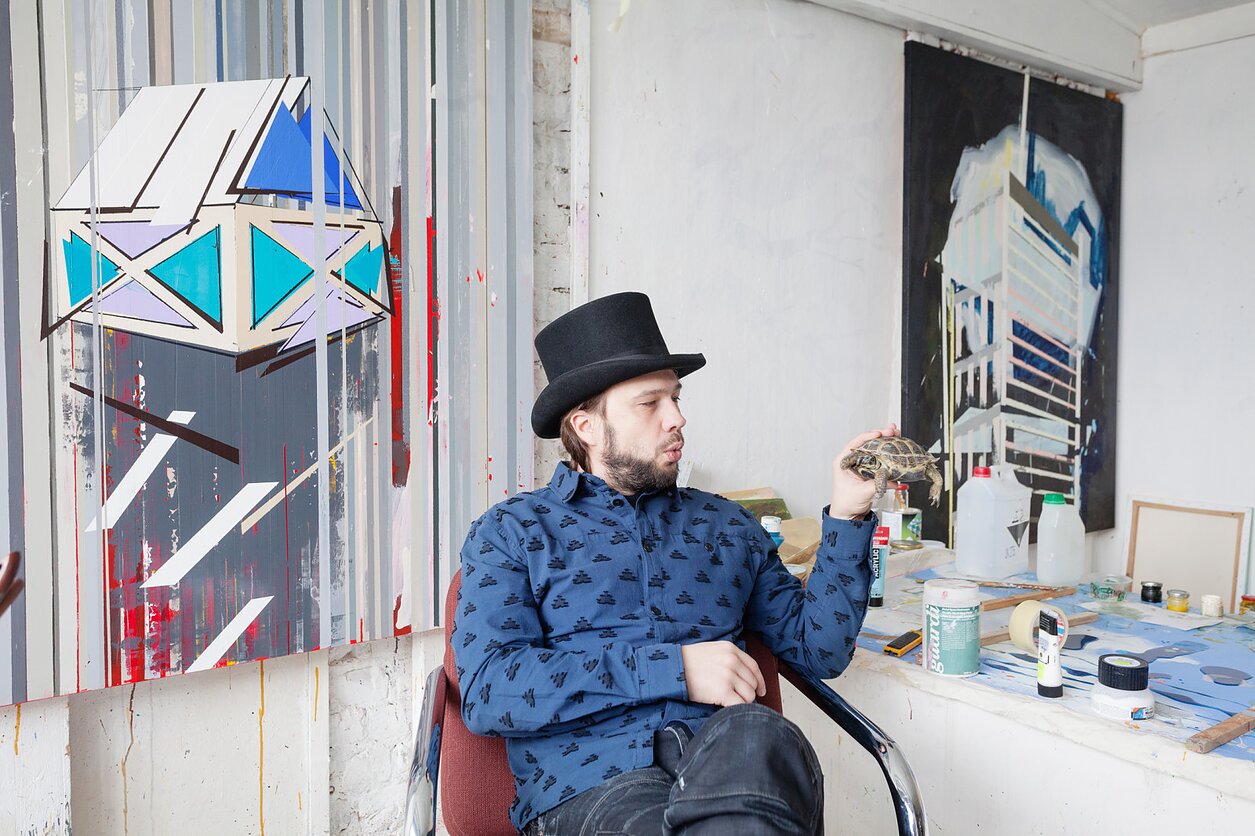
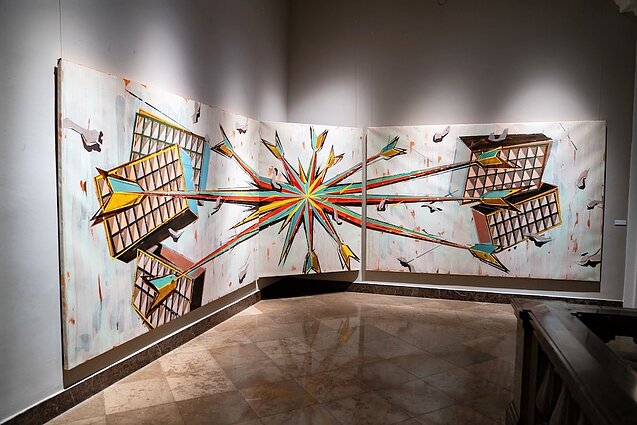
The way of using colors in the process of painting was different in my work because it was not based on the background knowledge of my fellow students. I had learnt a lot on my own, by experimenting and breaking the rules. Also in the works of my solo exhibition, you can see my technique. I started developing this set of painting techniques during my residency at the Cite des Arts in Paris in 2013 and developed more during my stay in Abu Dhabi in 2015 when I developed an interest in painting works without using a brush and pushing the intensity of colour to the limit. The works are made partly using tools and techniques borrowed from construction.
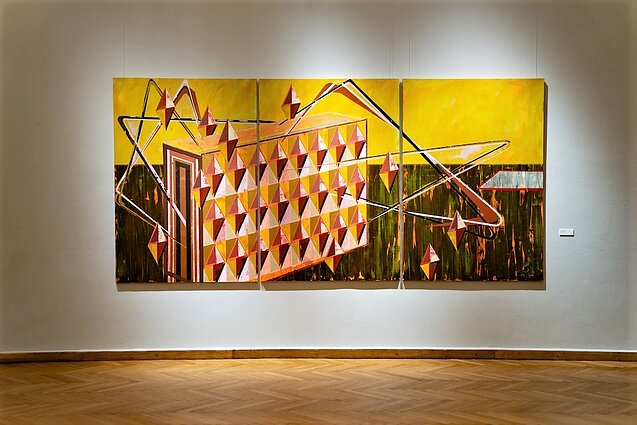
How long did it take you to create these artworks for the exhibition We Need a Chance to Be Reborn?
In total, the exhibition features works created from 2017 to 2022. Most of them are from last year. I even finished one painting on the morning of the opening.
Can you tell us more about the exhibition concept?
At the moment, there is a feeling that the world is stuck in some kind of ideological impasse. Religion has been replaced by hysteria about “pseudo-pandemics”. At the same time, science has become a great playground for manipulation, and social media opinion is taking precedence over logic and common-sense analysis. The “cancel culture”, together with plastic containers, has become a whole economic sector. The world is in upheaval and it is time to be reborn and start thinking. I hope there is hope, we just have to see the stars to aim for!
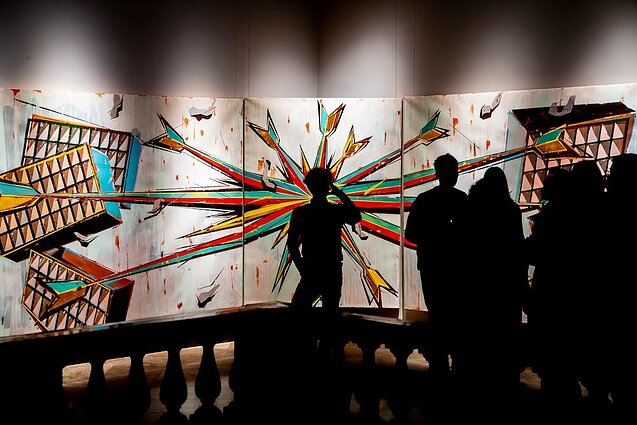
Your works are very rhythmic. You take objects from reality and convert them into your colourful rhythm, or, as you mentioned, you try to capture the vibrant fluency of the world. Where do you get all this inspiration and rhythm from?
The human heart works in rhythm. This has been studied extensively by medical doctors in relation to music. With the help of the rhythm of music, we can speed up or slow down our heartbeat. It is widely used in techno music and rave events.
In nature, rhythm is different from man-made rhythm, such things as trees and grass do not grow in rhythm, and waves in the sea are different… For some of my works, I find inspiration from oriental ornamentalism, in other works, I try to arrange objects in rhythmic combinations, which creates a sense of life and movement. Nothing can stand still, even abstract symbols are alive.
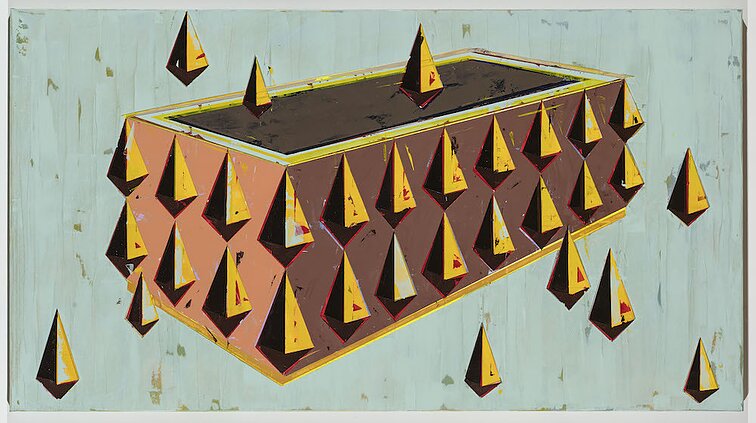
There are no humans in your paintings. Is this intentional? Why do you prefer altered industrial environments?
Perhaps it can be called abstract orientalism. Although the images I create in my artworks form their own legible story. I have deliberately avoided depicting recognisable things, such as people or landscapes. I think that this peculiar limit, where what is seen can be interpreted in different ways, allows the viewer’s mind to stretch wider and to travel into fantasy realms.
You came to the opening of We Need a Chance to Be Reborn with a delegation from Latvia. How important are the relations between the Lithuanian and Latvian art worlds to you?
My exhibition was quite actively communicated on Latvian social networks, and it is both natural and pleasant that art lovers from Riga came to the opening of the exhibition, also visiting MO Museum and other galleries. The main difference between the Baltic art world and the Central European art world is that you can always pick up the phone and call instead of writing an official email. People know each other, therefore many various cooperation projects are going on. Also, there is some kind of competition between art people (in a good way). For instance, the month of galleries has started in Vilnius – it’s such a nice tradition, but in Latvia, we don’t have it yet.
What are your plans?
Perhaps it’s time for me to put my experience into a scientific form, one of my plans is to do a practical PhD. I would like to start painting with oil paints again, which I have recently stopped. It’s a different physical experience and pleasure. There are plans for an exhibition at the Cēsis Concert Hall and Liepājas Museum. There will be a project in Lithuania during the summer, which I will probably take part in. All in all, there is a lot to do.

Newsletter
Every Friday morning.