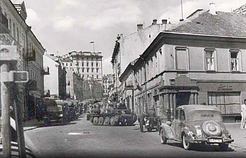







Over 200 Jewish people from Gargždai were murdered on June 24, 1941, two days after the start of the Soviet–Nazi war, marking the first victims of the Holocaust in Lithuania.
It took Germans a week to occupy nearly all of Lithuania, says Artūras Bubnys, director of Lithuania’s state-funded Genocide and Resistance Research Centre (LGGRTC). Following the occupation, Nazi Germany sent operatives to take care of everyone that was seen as a threat to the Third Reich, including Jews, Soviet officers, and members of the communist party.
Nazis began persecuting the Jews almost immediately. On June 22, the commander of one of the special force groups ordered the local security service leader in Tilsit – currently Sovetsk in Russia’s Kaliningrad – to murder Jews and communists.
The first massacre in Lithuania took place in Gargždai, says Bubnys. He believes that the Nazis chose Gargždai because it took longer to occupy the region, and they lost some 100 soldiers during the clash with the Red Army.
“During the very first day of the war, Jewish men living in Gargždai were separated from women and brought to a field near the German border. Gestapo Tilsit, as well as Memel Schutzpolizei from Klaipėda, arrived on June 24,” says Bubnys. “These two groups shot all of the 200 Jewish men and one woman arrested in Gargždai.”

Among those shot were some Jewish people that moved to Gargždai from Klaipėda in 1939, says Bubnys, adding that one of the Jews recognised a German officer during the shooting, and said “aim properly, Gustav”.
“It was the first massacre of Jews in Lithuania, or maybe in the whole Soviet Union,” according to Bubnys.
Before the shooting, Nazis robbed the Jews of their belongings and clothes, ordered them to bury the dead Red Army soldiers. Once the shooting was over, officers from the Gestapo shared glasses of vodka with the policemen and took photos.
Lithuanians did not take part in the first Gargždai shooting, says Bubnys. However, the Gargždai shooting in autumn 1941, when the local Jewish community was completely eradicated, was mainly carried out by the local forces. They shot all Jewish women, children, and the elderly.
Murdered in front of a crowd
After the massacre of Jews from Gargždai, more shootings followed along the border as well as in Kaunas, Lithuania’s second largest city.
On June 25, Stahlecker’s death squad arrived at Kaunas with the aim to involve Lithuanian volunteers in the shootings.
According to the Stahlecker report, some 4,000 Jews were murdered and 60 houses burnt in the Kaunas pogrom. Bubnys believes that these estimates are an exaggeration.
Most of the murders took place in Vilijampolė. Several dozen Jewish men were publicly tortured and executed in a garage of the former Lietūkis company. While Germans were present at the site, it is believed that the killings were perpertrated by local Lithuanians.

“Several dozen Jews were murdered in a cruel way, being hit with sticks and crowbars, in the city centre, in the middle of the day, in front of a crowd,” says Bubnys.
Algirdas Klimaitis’ squad also participated in the Kaunas pogrom. According to the historian, Klimaitis was arrested and tortured during the first Soviet occupation, then was recruited by Stahlecker’s squad. Historians theorise that former prisoners contributed the most to the Kaunas pogrom in Vilijampolė, since they were seeking revenge.
Bubnys points out that shootings near the border were mostly carried out by the Nazi security services, while in Kaunas the Jews were largely murdered by locals.
Rules did not apply to Nazis
Linas Venclauskas, lecturer at Vytautas Magnus University (VDU) in Kaunas, argues that the Holocaust was a systematic process.
In January 20, 1942, Nazi Germany government officials and security service leaders held the Wannsee Conference, during which they discussed the implementation of the Final solution to the Jewish question, a plan for genocide of Jews.
This date marks the beginning of systematic killing of Jews in Western Europe.
“The entire system, those continuous shootings” prior to the conference “constituted the Holocaust,” he says.
Nazis followed a certain hierarchy, with the so-called Aryans being at the top of it, and Jews at the bottom, explains Venclauskas, adding that the Nazis also looked at Western and Eastern Europe differently. To them, the Slavs were barbaric, less intelligent, and dangerous.
The rules did not apply to Nazis when it came to shootings, since they saw the Soviet Union as not only a savage, but also a dangerous country, says Venclauskas.
“The Bolsheviks were the biggest enemy of the Nazis, and Jews, as well as their supporters, were considered Bolsheviks,” explains Venclauskas. “The message was clear, and the death squads that started the killings were deeply affected by it.”
Nazi calculations proved false
Starting January 1942, the Holocaust became a systematic process, with Nazis scheduling trains for deportation of Jews to concentration camps, according to Venclauskas.
Some 80 percent of Jews in Lithuania were already murdered before the Holocaust had even reached its peak in Western Europe in January 1942. This was a relatively peaceful period for Jewish survivors in Lithuania.
“Sometimes we imagine that the Nazis just bulldozed everything, that they had planned everything well, [...] and had everything under control. It was quite the opposite: they were calculating, experimenting,” says the historian. “They didn’t know how many Jews would resist, or how many locals would get involved.”
Nazis hoped that every second Lithuanian citizen would spontaneously start attacking Jews with sticks and stones, but that did not happen, says Venclauskas.
The number of mass shootings in Lithuania also decreased because the Nazis were short on workforce, however, Jews were still being murdered on the local level.
Looking for culprits after Soviet deportations
Deportations to Siberia were an unprecedented event in Lithuanian history. Therefore, many citizens were scared and angry, says Bubnys. The people were seeking revenge and looking for culprits, which the Jews were rumoured to be.
Nazis also propagated the myth that the Jews were communists, which further fueled the hate, according to Bubnys.
“There were many Lithuanians who thought that the Jews and the communists were to blame for all their troubles,” says Bubnys. “This influenced many to join various security services and squads that would later arrest and murder Jews.”

Intense propaganda
The first mass killings of the Jews took place in Tauragė and Kretinga, located near the border with Nazi Germany. Unsure of how they will be met there, Nazis used anti-Soviet propaganda so that they could be seen as saviours, according to Venclauskas.
“The first Soviet occupation led to a false impression of the Jews being supporters of bolshevism, or Bolshevists themselves, so many Lithuanian citizens saw the Nazis as liberators,” says Venclauskas.
Nazi Germany knew that it could strengthen its position as a liberator by taking action against the Jews in Kaunas, which was an important strategic point and a symbol of Lithuania’s independence.
“Deportations inflicted a psychological trauma on the Lithuanian society, while the [Soviet] occupation eradicated all symbols of statehood, took away belongings,” explains the historian. “Deportations, arrests, [...] were a clear message that the totalitarian Soviet regime won’t limit itself with just erasure of statehood and religious restrictions.”
Period of mass murder
From June to December of 1941, Lithuania lost around 80 percent of Jews. It was a period of mass murder, says Bubnys.
The largest shootings took place between August and October in 1941, since Nazis wanted to eradicate the Jews as soon as possible, according to the historian.
However, Nazis soon began running out of workforce, as “German civil officers needed Jewish experts, so they opposed Gestapo’s and Security Service’s aim to murder all Jews”, explains Bubnys. Nazis then began murdering those that could not be hired, such as the elderly and children.

Holocaust and the June uprising
“The June uprising and the beginning of Holocaust are related, but they are not one and the same,” says Bubnys, and points out that the uprising ended much earlier, during the first week of the Soviet–Nazi war.
“The aim of the uprising was to restore independence, while [the aim] of the Holocaust was to completely eradicate the Jews both in Lithuania and across the entire Nazi-occupied Europe,” he adds.
When the uprising ended, some rebels joined German police battalions or squads and contributed to massacres of Jews.
“The Holocaust began after the uprising ended, in specific locations of Lithuania. In some regions, those by the German border, for example, the uprising only took a day, while it took five to six days in northern and eastern Lithuania,” says Bubnys.
“I don’t know any facts that say that the rebels took part in mass shootings of local Jewish residents before the Germans came,” says the historian. “It all happened after the German army occupied Lithuania.”
Revenge and jealousy
The Soviet–Nazi war and the June uprising led to mass panic. Some Jews had already heard about the ghettos in Poland and Nazi Germany and fled Lithuania.
Rebels mostly targeted the retreating Red Army soldiers and Soviet activists. There were some Jews among those killed, but that wasn’t the aim, says Bubnys.
“Those were armed actions with the aim of persecuting political and military opponents, but it wasn’t based on nationality or race.”
Asked about the connection between the June uprising and the Holocaust, Venclauskas points out that both the rebels and the auxiliary volunteers under th Nazis claimed they fought for freedom, independence, and sovereignty.
“The Soviet occupation made a big impact on the division between Lithuanian and Jewish communities. Other factors, such as the claim that the massacres of Jews are the sacrifice we need to make to regain independence, added up to it,” says Venclauskas, adding that the locals falsely believed Jews to be bolsheviks, and murdered them out of jealousy and revenge.
Correction. The article previously incorrectly stated that the killings in the Lietūkis garage massacre were executed by Nazis.

Newsletter
Every Friday morning.