













As most EU ambassadors attended Sunday's World War Two victory celebrations in Moscow, representatives of the Baltic states were absent.
Russia traditionally celebrates the end of World War Two on May 9, one day after Western Europe, with military parades on Moscow's Red Square.
The embassies of the Baltic States and Spain were among the EU representations that were not planning to send anyone to take part in the events, EU Observer reported on Saturday.
According to the publication's sources, the Baltic states were the only ones boycotting the event for political motives.
Lithuanian Ambassador to Russia Eitvydas Bajarūnas placed flowers on the tomb of the Unknown Soldier in Moscow on May 8 instead.
Gegužės 8 d.,tęsiant susiklosčiusią tradiciją, Lietuvos ambasados darbuotojai aplankė Amžinosios ugnies memorialą prie Maskvos Kremliaus sienų.Lietuvos diplomatai tylos minute pagerbė visų II-ojo pasaulinio karo aukų atminimą ir padėjo lietuviška trispalve papuoštą gėlių vainiką. pic.twitter.com/s5CKpHa7uB
— Посольство Литовской Республики в РФ (@LTembassyRU) May 8, 2021
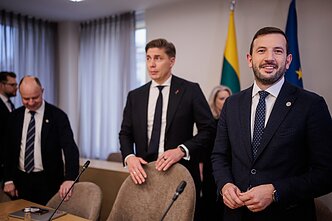
“Participation in militaristic May 9 events in Moscow would be a legitimation of Russia's aggressive policies and acquiescence to the Kremlin's historical revisionism, as well as it would be inconsistent [with Lithuania's position] in view of Russia's recent escalation at Ukraine's border,” Lithuania's Foreign Ministry said in a written comment to LRT.lt.
“For official Moscow, May 9 events is not just a commemoration of victory in World War Two, but also a way to showcase its military might and militaristic poltics,” it added.
The Baltic states maintain that the war did not end for them in 1945, as the three countries remained under the occupation of the Soviet Union for another four decades.
Relations between EU members and Moscow have been tense due to the Russian government's alleged attempt on the life of Alexei Navalny, currently the highest-profile opposition figure.
Moreover, a number of EU countries have recently expelled Russian diplomats in solidarity with the Czech Republic which accused Russian spies of blowing up an arms depot in its territory in 2014.
According to EU Observer, however, the fact the Czech ambassador was present at the victory events indicates Prague wanting to mend ties with Moscow.
“Ambassadors cannot escape from an invitation to attend such an event – it's a matter of courtesy and, actually, their duty to come – unless bilateral relations are so bad that they couldn't care less,” the source told EU Observer.

Newsletter
Every Friday morning.