








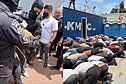



Moscow finds itself in a lose-lose situation, with EU sanctions looming over the sentencing of Alexey Navalny, said Lithuania's Foreign Minister Gabrielius Landsbergis after the Kremlin critic was given a 3.5-year prison term.
“Russia shows it has backed itself into a corner and has hardly any possibilities to back down from its position. They are perfectly aware that if Navalny is released from prison or is not sentenced, corruption issues will be escalated throughout the summer ahead of the Duma election, and if he's detained, there will be other losses,” Landsbergis said in an interview with the radio Žinių Radijas.
Imprisoning Navalny is, in the Kremlin's view, the “lesser of two evils”, Landsbergis believes, although “there's no good solution as wherever you go, you will face failure”.
“So, it probably shows that the regime has weakened, it does not have objectively good solutions that would allow it to get out of the crisis,” Landsbergis said.

A Moscow court on Tuesday handed a 3.5-year prison sentence to Navalny, having found him guilty of violating the previous 3.5-year probation. With the time Navalny has already been under house arrest, he will spend two years and eight months behind bars.
Lithuanian President Gitanas Nausėda has called on EU and global leaders to respond to the ruling.
“Stalinistic approach ‘no person no problem’ is still being applied in Russia. Ruling against @navalny by fake court is not justice but a crime against #HumanRights & democratic values. I call on EU leaders&international community to act.Sanctions on Russian regime back on the table,” Nausėda tweeted on Tuesday.

Speaking with Žinių Radijas, Landsbergis said he had no doubt that EU ministers would back sanctions for Russia.
“Some countries had suggested to wait and see whether a real prison term would really be handed [to Navalny]. Russia was given time to change its mind and free Navalny. In my opinion, it was not a good decision, since Rusia was not showing any signs it intended to release Navalny. I believe that since a real prison term has been issued, sanctions should come into force automatically and without any major resistance from European ministers,” Landsbergis said.
Even if some EU ministers oppose sanctions for Russia, Lithuania could impose its own national measures, the minister said.
“If we see that there is resistance for some reason, although I wouldn’t want to believe in that, I would not rule out that Lithuania could propose national sanctions, visa bans for entering Lithuania's territory,” Landsbergis said.

Newsletter
Every Friday morning.