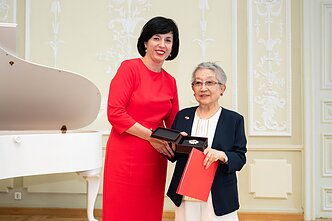



Last Friday, Irena Veisaitė, a Jewish-Lithuanian literary scholar and Holocaust survivor, passed away at the age of 92. She had Covid-19. LRT.lt presents excerpts from interviews with Veisaitė collected in the book by Aurimas Švedas, Life Should Be Transparent.
Born in Kaunas in 1928, Veisaitė was a known intellectual, theatre scholar, and human rights activist.
Veisaitė's mother died in the Kaunas Ghetto during World War Two. She herself was later sheltered by a non-Jewish family.
After the war, Veisaitė earned a doctorate in Leningrad in 1963 with a dissertation on the poetry of Heinrich Heine and was a lecturer at Lithuanian University of Educational Sciences from 1953 to 1997.
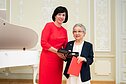
She was awarded the Goethe Medal in 2012 for her contribution to the cultural exchanges between Germany and Lithuania.
Quotes from Aurimas Švedas’ book Irena Veisaitė: Life Should Be Transparent

Let’s start from your maternal grandfather Chiel Štrom and grandmother Chaya Katz-Štromienė.
Normal communication with my grandparents stopped when I was 13 years old. Remembering my grandpa, I can say that I am immediately overwhelmed by the wave of his extraordinary kindness that I have experienced. Grandpa shone from within. I was fascinated that he was not a fanatic.
My grandma strictly followed kosher rules. When grandpa visited our house, he could not eat, because we did not follow kosher. But he often had a snack and asked me not to tell my grandma. I really enjoyed it. We had our secrets.
Grandpa often visited our house. In my childhood, the feeling of warmth was created primarily by my grandparents, and especially by my grandpa. We did not celebrate religious holidays at home, but my parents encouraged me to respect other people’s beliefs and faith.
I vividly remember Easter and Hanukkah holidays, when my cousins and I visited grandparents. These beautiful holidays are probably the only deeper connections I have with Jewish religious traditions. I only knew them thanks to my grandparents, but I never doubted that I was Jewish.
I remember my trip to Berlin together with my father in 1938. We had Lithuanian passports, so we were not treated as Jews. One day, my dad took me to the major boulevard in Berlin, Unter den Linden. There were ordinary and yellow benches. Jews could only sit on the yellow benches.

My dad sat on that bench together with me and said: “I want you to know that in Germany, Jews are excluded. We are also Jews. Of course, we do not have to sit here because we are Lithuanian citizens. But you have to understand how it feels to be excluded.”
My parents were aware of who they were and never tried to deny their identities.
What was the atmosphere like in your home?
We were not a typical Jewish family; we did not follow religious traditions and were open to the world. Both parents took great care of me, but the atmosphere in our family wasn’t very good and I felt that clearly. Besides, my parents spent a lot of time abroad, while I stayed with governesses.
My father tried to teach me not to abuse the fact that I came from a wealthy family. I was never brought to school by car, and when I went to cinema, I could not buy the most expensive tickets.
In 1936, my father built a house on Trakų Street in Kaunas. In the same year, that house received an award as the best residential house in Kaunas. But the Soviets nationalised it.

By the way, I am convinced that the library is a very important part of every home. My parents’ library, which contained a great number of masterpieces of western and Russian literature, played a crucial role in my development. There, I saw works by Molière, Shakespeare, Balzac, Schiller, Byron, Flaubert, Zola, Dostoyevsky, Goethe, Pushkin, Thomas Mann. Maybe that is the reason why after the war, I felt a constant hunger for such books.
Unfortunately, my parents got divorced in 1938. For me, it was the greatest childhood tragedy. After the divorce, my father left Lithuania. He died in the US in 1973. My mother and I moved out of the house [on Trakų Street] and settled in a three-room apartment. When the Soviets came [in 1940], we were forced to move into a communal apartment, which we shared with Jewish refugees from Poland. Then, when the Nazis came [in 1941], we were forced to move to the ghetto.
What is your relationship with Kaunas?
My relationship with my hometown is special. Kaunas is in my blood. I have lived in Vilnius since 1943, but I still consider myself to be from Kaunas.
Describing this feeling is quite simple and tricky at the same time. To this day, I feel Kaunas in my skin. The city’s streets and houses have preserved many beautiful moments – this is where I played, visited my relatives and friends.

But after the war, after the Holocaust, Kaunas became a city of shadows for me. Even now, while walking on the streets of this city, I remember who lived in which house. But these are usually painful memories.
When Lithuania regained independence [in 1990] and the restitution of property began, I went to see my father’s house, which I inherited. I saw my parents’ bedroom, my father’s study, the living room, my room. Although everything had changed, it still reminded me of my lost world.
After this trip to Kaunas, I could not recover for maybe a month. I did not expect that the memories revived by the family house could affect me so strongly.
In the 1930s, the Bank of Lithuania, the Military Museum, the Central Post Office, the Church of Resurrection, and modern residential houses were built in Kaunas. Today, these buildings are recognised as architectural heritage of the interwar period. When I visit Kaunas now, I rejoice at the reviving beauty of my hometown.

The occupation interrupted the development of the city. How do you remember this time? What images and emotions arise when you think about the time when your world began to fall apart?
Even before the Soviet occupation, my family knew that Lithuania was trapped. We had lived with these intuitions for months or even years.
Everyone from my family understood that nothing good would come when the Soviets arrived. But we had to live on. My father was no longer in Lithuania at that time. But I remember my mother sitting at a table with her head in her hands.
I was 12 years old at the time, so I looked at many things through the eyes of a child and was primarily interested in what was happening here and now. At my school, the communist youth and young pioneers’ organisations were founded immediately. I also became a pioneer.
Speaking of the first Soviet occupation, it is necessary to understand the differences in existential situations of ethnic Lithuanians and ethnic Jews. For Lithuanians, the beginning of the [Soviet-German] war and the German occupation seemed like a liberation from the red plague and the horrors of deportations.

For the Jews, Nazism meant death, while the Soviets and even deportations meant at least some chance of survival. We should realise this and stop blaming each other.
During the Soviet occupation, nobody knew who or for what reason they might be deported. It was scary and paralysing. Hitler spoke openly about his goals. It was clear to everyone that his targets included Jews, Gypsies, homosexuals, and the mentally ill. We should consider these facts when we talk about how Jews felt back then. We should not evaluate past epochs based solely on the knowledge, values, and ideas of our time. It took me a long time to come to this understanding.
[...]
Every work of art must have a structure and a narrative rhythm. Only then can art be influential. We can also apply this analogy to life. I especially felt this when I married my very beloved husband Grigory.
Being together helped me realise that every day is special because it provides something new and opens opportunities to build a life. It is very important to feel the rhythm of time and not to delay events or processes (which often happens in films and performances).
This might sound a bit didactic, but life should be transparent. It does not need to be contaminated with alcohol or compromises. The experiences that I have told you about made me realise that living is also a form of art, that life also needs meaning, theme, and rhythm.

Newsletter
Every Friday morning.