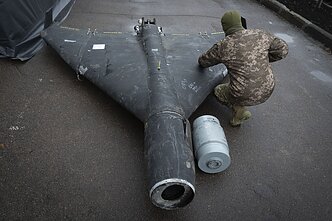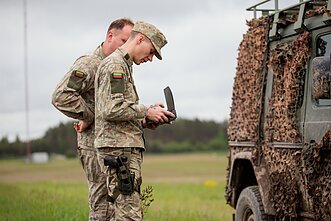














Last Wednesday, Lithuania experienced two hours unlike any in its history. A suspected drone entered the country’s airspace, prompting authorities to declare an air alert for the first time in recent history and instruct people to seek shelter.
Political leaders and heads of responsible institutions said the incident served as a lesson on how to inform the public, ensure shelters and safe locations are not locked, and guarantee preparedness in schools, hospitals and other institutions.
The government was also left with lessons to learn. Each time a drone entered the airspace, officials appeared to adapt to the situation on the fly.
It also became clear that Lithuania is not yet prepared – at least for now – not only to neutralise drones, but even to track them across every part of its airspace.
After drones began appearing in Latvia, it was only a matter of time before they reached Lithuania.
The first one this month crashed in the northeastern Utena district exactly a week earlier. It took nearly a week before Defence Minister Robertas Kaunas confirmed the drone was Ukrainian. In that case, the radars had not detected it at all.
The incident alarmed Lithuania and highlighted weaknesses in the system, something also stressed by President Gitanas Nausėda.
“The president emphasised that the early warning system does not appear to be functioning properly,” said his chief adviser Deividas Matulionis.
A bigger test came on Wednesday, when another drone entered Lithuanian airspace , prompting the authorities to declare an air alert.
Portuguese F-16 fighter jets stationed in Estonia, as well as Lithuanian military helicopters, were deployed in an attempt to intercept the drone. Romanian fighter jets based in Šiauliai did not take off because of poor weather conditions. The pursuit failed, and the drone disappeared from radar.
According to LRT sources, the drone entered Latvia from Russia, flew along the border, crossed into Belarus, returned to Latvia and finally entered Lithuania. The last location where it was detected on radar was near Merkinė.
The subsequent search operation, aimed at determining whether the drone had crashed or left Lithuanian airspace, once again showed that any object flying below radar level can move through the country largely undetected. The search was unsuccessful and was later called off.
“There’s no object, so there’s nothing to talk about,” said Lithuania’s chief of defence, General Raimundas Vaikšnoras.
For now, Lithuania can rely only on NATO’s air policing mission and the air defence systems it already has.
Those include radars unable to detect low-flying objects, expensive air defence batteries not designed for drones, and some smaller-calibre systems. The incidents also exposed weaknesses far beyond military capabilities.
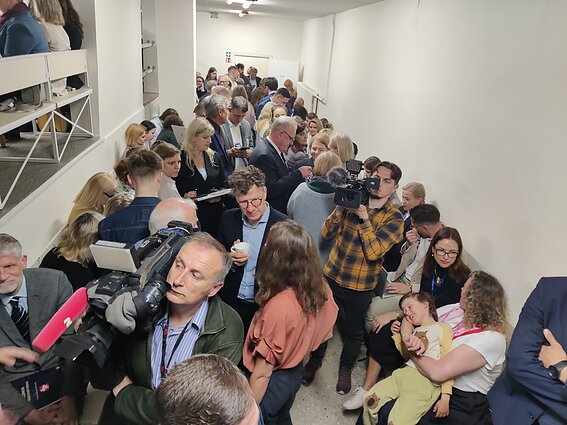
After the air alert was issued, residents reported that many shelters and safe locations were locked.
“A letter has been prepared for municipalities stating that, at least during this period of escalation, shelter owners must ensure 24/7 access – they should not be physically locked,” said Renatas Požėla, director of the Fire and Rescue Department (PAGD).
Prime Minister Inga Ruginienė also criticised the situation in schools and nurseries.
In some places, school leaders or teachers claimed drills were taking place, while elsewhere children were not allowed to seek shelter because tests or assessments were under way.
In some cases, children were simply left in classrooms or taken outside into open areas such as stadiums.
“It was bad, very bad,” the prime minister said.
The third lesson was for the media.
Some people found it ironic that LRT RADIO was playing Frank Sinatra’s My Way, which includes the lyric “and now, the end is near”, while others criticised the public broadcaster for airing a television drama series on its main channel during the alert.
LRT management said lessons had been learned.

“For example, transmitting the radio signal with visuals to all television channels. It was smoothly broadcast on LRT PLIUS, but not to the main channel as quickly as we wanted. That will be improved.
“Also, when radio journalists go to shelters, what should we broadcast live so that it is not just songs that may sound strange, but useful information as well – what a shelter is, where to find one, how to behave in such situations,” said LRT director general Monika Garbačiauskaitė-Budrienė.
The LT72 emergency app also failed under the strain, while warning messages sent to mobile phones arrived only in Lithuanian.
The Interior Ministry said that until the issues are resolved, alerts would be sent by text message.
“There must be an action plan so that this does not happen again. We have solutions and we see areas where improvements can be made. One of them was our rapid reaction through the media. That is not good, but what happened, happened,” Interior Minister Vladislavas Kondratovičius said.
Šarūnas Jasiukevičius, a Lithuanian drone pilot who fought in Ukraine, said the incidents had once again highlighted flaws in civil protection.
“They started putting shelter stickers on virtually any building and gathering people into completely unprotected structures.
“We had many examples in Vilnius when, during an air raid alert, large numbers of civilians were concentrated in entirely unprotected buildings, such as school assembly halls or sports halls,” he said.
The situation should improve within a couple of months after the deployment of new radar systems, Defence Minister Kaunas said.

According to him, data from radars and sensors will be combined in one place, and artificial intelligence will then help determine whether radar signals represent drones, balloons or something else entirely.
The next step, and perhaps the most important, will be the deployment of interceptor drones across Lithuania.
“Those interceptors, once they receive a signal, should launch automatically, fly to the target based on its coordinates, and then a human operator – a soldier – makes the final decision on whether to destroy it or allow the reusable interceptor to return. That is the level of system we need,” the defence minister said.
What remains unclear is when the air defence system – being built from scratch and tailored specifically to Lithuania’s needs – will become fully operational.
For now, one question remains unanswered – what would happen if not one, but 10, or even 50 drones, appeared in Lithuanian airspace at the same time?

Newsletter
Every Friday morning.